• About

Zak From Downunder

~ Zak de Courcy's sometimes incendiary thoughts about politics, life and religion.

Zak From Downunder

Monthly Archives: March 2013

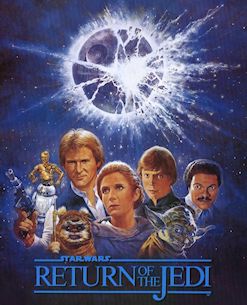
The Sunday Screening Session….. Star Wars: Episode VI – Return Of The Jedi (1983)

31 Sunday Mar 2013

Posted by Zak de Courcy in Film

≈ 1 Comment

Tags

Action, Action & Adventure, Adrenaline Rush, Adventure, Alec Guinness, Billy Dee Williams, Carrie Fisher, Ensemble Film, Epic, Fantasy, Film, film review, Frank Oz, George Lucas, Guy Movie, Harrison Ford, iRate:: 4½ / 5, John Williams, Lawrence Kasdan, Mark Hamill, Master Villain Film, Modern Classic, Other Dimensions, Out In Space, Richard Marquand, Sci-Fi Action, Sci-Fi Adventure, Science Fiction, Science Fiction Epic, Space Adventure, Star Wars, Star Wars Episode VI Return of the Jedi, Sunday Screening Session

Star Wars:
Episode VI Return Of The Jedi (1983)
 (135 min)

iReview: Version: Star Wars: The Complete Saga (Blu-ray);
Video: AVC 1080p; Audio: DTS 5.1.
Genre:: Action | Adventure | Epic | Fantasy | Science Fiction |
Sub-Genre/Type:: Action & Adventure | Ensemble Film |
Master Villain Film | Modern Classic | Sci-Fi Action |
Sci-Fi Adventure | Science Fiction Epic | Space Adventure |
Settings:: Out In Space.
Image
Mood?:: Adrenaline Rush |
Guy Movie | Other Dimensions.
iRate:: 4½ / 5
Director:: Richard Marquand.
Writers:: George Lucas (story); Lawrence Kasdan & George Lucas (screenplay).
Cast:: Mark Hamill, Harrison Ford, Carrie Fisher, Frank Oz, Billy Dee Williams, Alec Guinness, Anthony Daniels, Kenny Baker, Peter Mayhew, David Prowse, James Earl Jones, Sebastian Shaw, Ian McDiarmid, Michael Pennington.
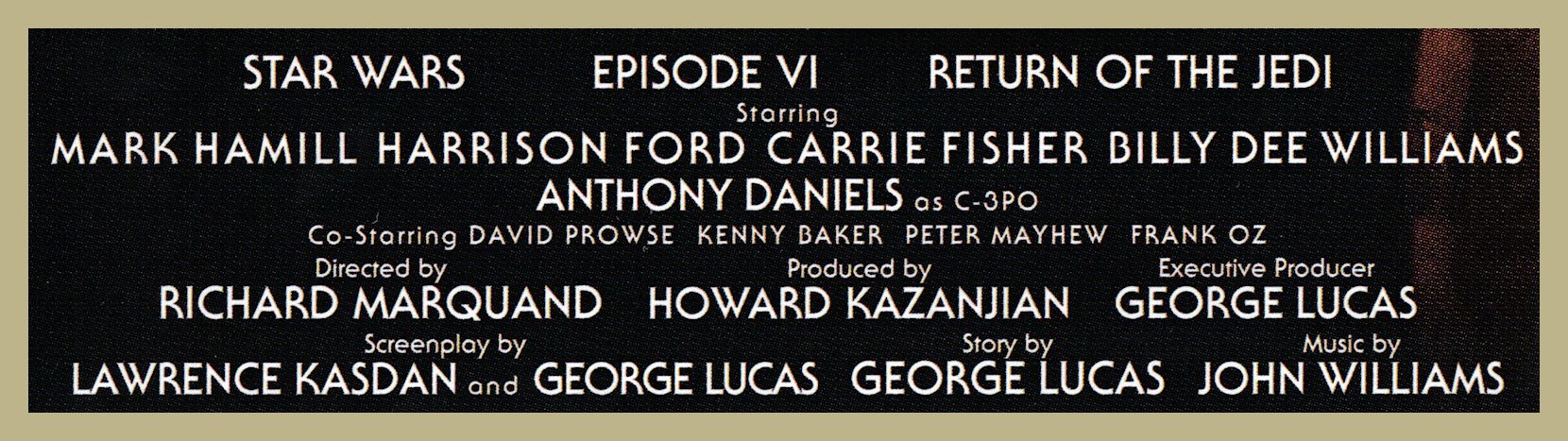
Click for Credits Enlargement
Credits (Click to expand)

Trailer (HD):

iReview:
This week’s selection was a no-brainer, as a happy coincidence of events made the choice very easy. Today is the 30th birthday of all-round-good-bloke and son in law, Morgan, who shares a birthday with the final chapter of one of his favourite film franchises, Star Wars: Episode VI – Return Of The Jedi. It’s hard to believe, I know, that it’s been that long. I had intended to set aside a whole weekend to view the entire Star Wars: The Complete Saga Blu-ray set, with its 6 movie and 3 Extras discs. But that’s going to have to wait. In the meantime, and in honour of Morgan’s birthday, I’m going to enjoy revisiting this much loved film.

What Happens:
In the epic conclusion of the saga, the Empire prepares to crush the Rebellion with a more powerful Death Star.

Han Solo (Harrison Ford) emerges intact from the carbonite casing in which he’d been sealed, after rescue by R2-D2 (Kenny Baker), C-3PO (Anthony Daniels), Chewbacca (Peter Mayhew), Lando Calrissian (Billy Dee Williams), Princess Leia (Carrie Fisher), disguised as a bounty hunter, and Luke Skywalker (Mark Hamill). Then they must escape the clutches of the grotesque Jabba the Hutt.

On the forest moon Endor, the reunited team enlist the help of the Ewoks as the rebellion reaches its decisive stage.

Meanwhile, Luke Skywalker confronts Darth Vader (David Prowse & voiced by James Earl Jones) in a final climactic duel before the evil Emperor Palpatine (Ian McDiarmid). As he enters into this spirited battle with his light saber-wielding enemy, some surprising revelations await the young warrior…
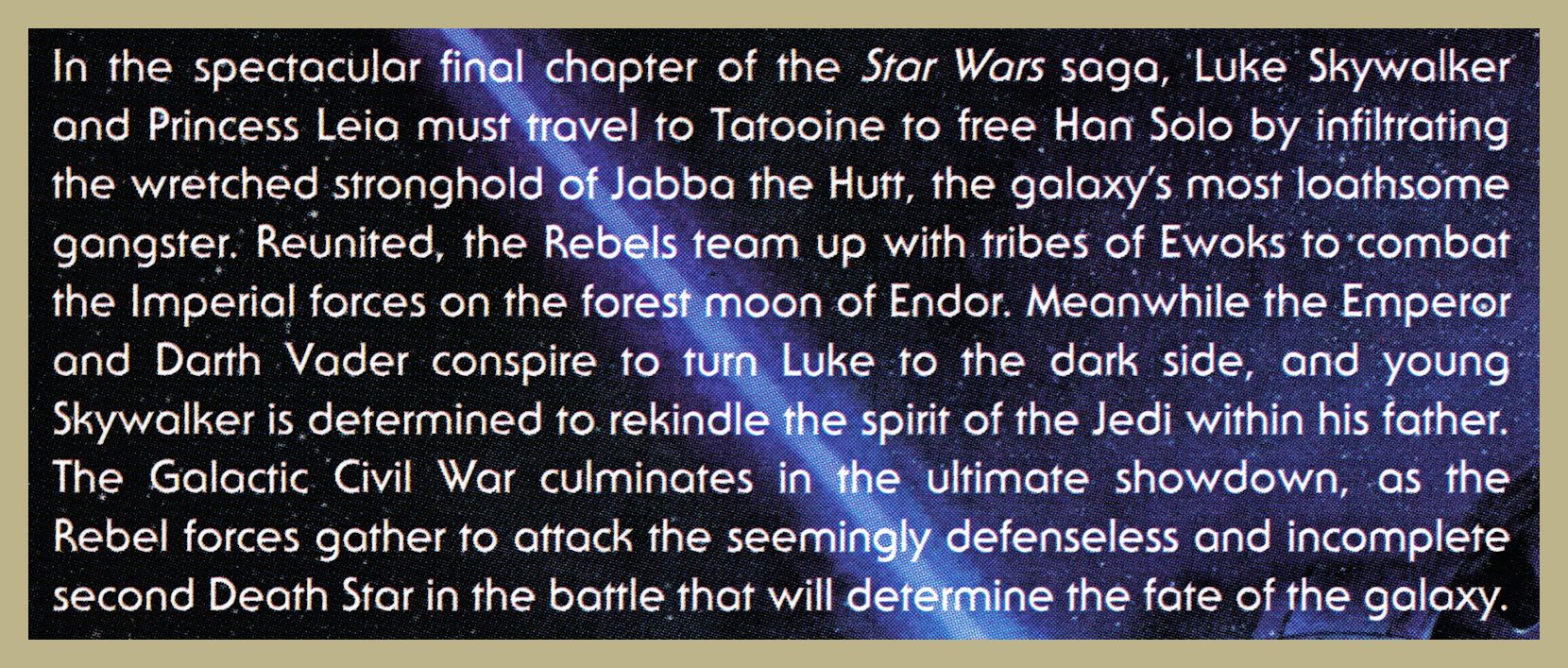
Story
Story (Click to expand)

With the plot safely secured back in my memory, I sat down with a little unease; this was the first time I’d watched Jedi in isolation and also in glorious 1080p HD. How would the movie stand up without its usual crutches, Star Wars and The Empire Strikes Back to lend it support? I wanted it to be great, and you know what, I wasn’t disappointed.

In my memory, Jedi was the least impressive of the original trilogy. That may still be true but I get the feeling that by its release in 1983, we’d become very familiar with the Star Wars universe. I still remember the goose bumps I felt on that day in 1977, when I first saw the mighty Imperial Stardestroyer emerge from above and gradually fill the huge dark screen. The sequence was made perfect by the accompanying deep rumble of the sound track and John Williams’ opening of the Star Wars Symphony. When I first saw it, everything about Star Wars was new for me. I’d seen and been perplexed by 2001: A Space Odyssey (1968) but I’d never seen a space fable like Star Wars. The special effects were not a compromise of Flash Gordon model spacecraft darting drunkenly in front of an obviously painted matte space. They were believable and very real in a way I’d never seen before. I remember that very quickly, Star Wars had been integrated into my life to the extent that the sound-track vinyl album got frequent play even though it was completely out of place next to my Led Zeppelin, Deep Purple and Fleetwood Mac.

With the second installment, The Empire Strikes Back, in the hands of Irvin Kershner, the continuing story transcended the novel appeal of its predecessor and emerged as a cinematic triumph with a great story, great effects, and most importantly, none of Lucas’ dreadful dialogue. I recall seeing Jedi for the first time as a much anticipated closure to the story and with a very high bar set by the first two films, it didn’t disappoint.

The Picture:
In this high definition version of Jedi, the image is brilliantly saturated and crisply defined, with no discernible noise. I don’t remember Endor being quite as lush and beautiful as it appears here. As well, the battle between the Imperial and Rebel fleets fills the screen spectacularly and with a pitch-perfect DTS 5.1 audio track. The final confrontation between Vader and Luke also has all the drama and visual excitement I’d hoped for and remembered.

The Audio:
The Blu-ray DTS 5.1 sound track is stonkingly brilliant and that’s with no ifs, buts or maybes. The mix of sound effects and music score is pristine. The discretion of spacecraft rumble and other mechanical noises together with the subtlety and richness of the sounds of the Endorian natural environment, are a joy to hear. John Williams’ Star Wars theme has been waiting patiently for 30 years for the exposition of this Blu-ray set. And, never has Darth Vader’s respirator assisted voice sounded so menacing and the swoosh and hum of the lightsaber, so threatening.

Verdict:
My only criticism of this edition of Jedi, and it’s very minor; I wish someone had held Lucas back when he decided to tinker with the later releases of the film, including this one. Look out for the CGI soul singer with suitably silly alien backing group singing Jedi Rocks. I found myself mildly irritated that George thought the addition of this turgid song and its inconsequential CGI would somehow elevate the movie. Also, some of the other cosmetic CGI changes that Lucas has brought to the movie seem to stand out even more in HD, especially the not so successful additions of some obviously CGI building structures.

Coming back to the film in isolation, did also highlight how much merchandising Lucas was able to attach to these movies. I’d never been so conscious of how cute, kid friendly and stuffed toy-like the Ewoks were.

Overall though, this has been a wholly satisfying return to one of my favourite movie sagas and one I’m really looking forward to completing. I also have a sneaky feeling that once I’ve seen the rest of this Star Wars: The Complete Saga Blu-ray pack, the old DVD box-set (with the exception of the Special Features disc), might reluctantly have to migrate to Cash Converters.

Anyone looking to augment Morgan’s (if you know him, that is) Blu-ray collection can use these convenient links:
Star Wars: The Complete Saga Blu-ray (at eBay)
Star Wars: The Complete Saga Blu-ray (at JB HiFi)

iRate:: 4½ out of 5.

4Movie Tragics

Extras:
• Feature Commentary by Director George Lucas, actor Carrie Fisher, and crew, Ben Burtt and Dennis Muren (this is a surprisingly interesting and informative track, dominated, as you might expect, by George Lucas, which also appears on previous releases. If you’re new to this then I’d urge you to remember that Lucas is the creator and curator of the Star Wars mythology and so treat his recollections of fact with due caution.)
• Audio commentary from archival interviews with cast and crew.

You want More!
Star Wars: Return Of The Jedi – IMDb (Internet Movie Database)
Star Wars: Return Of The Jedi – Rotten Tomatoes
Star Wars: Return Of The Jedi – allmovie.com
Star Wars: Return Of The Jedi – Wikipedia


Where does “Return of the Jedi” fall on your list of favourite Star Wars flix? A lot of critics were unenthusiastic about this when it was released. Were they wrong? I love it, what about you?

:: Please leave a comment ::


The Sunday Screening Session….. Platoon (1986)

24 Sunday Mar 2013

Posted by Zak de Courcy in Film

≈ 2 Comments

Tags

1867-68, Action, Anti-War Film, Blood and Gore, Charlie Sheen, Cold War Film, Combat Film, Drama, Ensemble Film, Film, film review, Food For Thought, Forest Whitaker, Francesco Quinn, iRate:: 4½ / 5, John C. McGinley, Johnny Depp, Jungle Film, Keith David, Kevin Dillon, Modern Classic, Oliver Stone, Platoon, Richard Edson, Southeast Asia, Sunday Screening Session, Tom Berenger, Tough Guys, Vietnam, Vietnam War Era, War, War Drama, Willem Dafoe

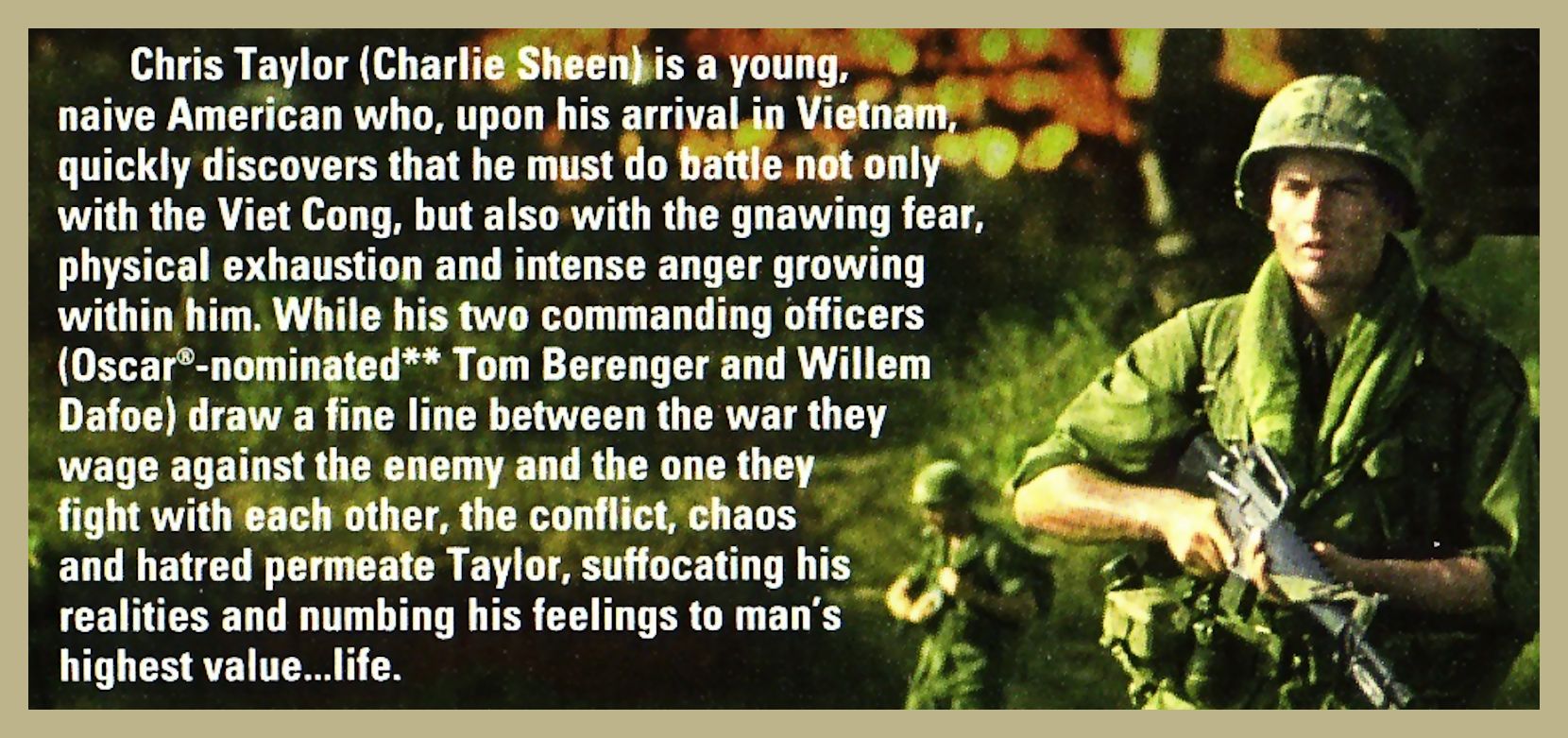
Platoon (1986) (120 min)
iReview: Version: Platoon: 25th Anniversary (Blu-ray);
Video: AVC 1080p; Audio: DTS 5.1.
Genre:: Action | Drama | War |
Sub-Genre/Type:: Anti-War Film | Cold War Film | Combat Film |
Ensemble Film | Jungle Film | Modern Classic | War Drama |
Settings:: 1867-68 | Southeast Asia | Vietnam | Vietnam War Era.
Image

Mood?:: Blood and Gore |
Food For Thought | Tough Guys.
iRate:: 4½ / 5
Director:: Oliver Stone.
Writer:: Oliver Stone (screenplay).

Cast:: Tom Berenger, Willem Dafoe, Charlie Sheen, Forest Whitaker, Francesco Quinn, John C. McGinley, Richard Edson, Kevin Dillon, Reggie Johnson, Keith David, Johnny Depp, David Neidorf.

Click for Credits Enlargement
Credits (Click to expand)

Trailer (HD):

iReview:
I was scratching around my library trying to settle on a film for this week’s screening but found myself spoiled for choice. I asked a few friends for help and suggested they consider titles from science fiction, gangster or graphic novel adaptation. So after extensive consultation within the strict parameters provided, I’m Screening Platoon in this Sunday Session. Umm, yes I know, it’s a war movie. I hadn’t seen this film for more than 10 years and that was the less than stellar, 2000 DVD release, which I viewed on an old 80cm 4:3 TV. So I was looking forward to the opportunity to see the recent 25th Anniversary Blu-ray release, on a 140cm 1080p widescreen.

Throughout the soundtrack, Samuel Barber’s hauntingly beautiful Adagio for Strings, interjects to add a note of melancholy. It’s unfortunate, that after Platoon, overuse has turned such a wonderful feature of this film into a cliche. Nevertheless, I’d still recommend listening to the track while reading this as it sets a darkly appropriate tone.

After a very brief introduction and without fanfare or warning, the audience descends into an impenetrable jungle. The camera at eye level draws us into a patrol alongside the newest member of Bravo Company, Chris Taylor (Charlie Sheen), who is confronted by the claustrophobic thick lush brush, with rough fronds brushing and irritating his fresh face. We experience the gut-wrenching physical exertion of the terrain as he hacks frustrated and incompetently with his machete, dry reaches and is harassed by ants, leaches, and mud. And we sense the contagious and overwhelming fatigue.

“Somebody once wrote: ‘Hell is the impossibility of reason.’ That’s what this place feels like: Hell.” So says the bewildered Taylor as he writes a letter to his grandma.

Most of us could identify with Taylor’s disillusionment. He’s a kid from a good family who dropped out of college because he felt the call to do his patriotic duty and “Live up to what Grandpa did in the first war, and Dad did in the second.”. And, as he put it, “…why should just the poor kids go off to war.” He soon realizes that in ‘Nam the drafted men are largely uneducated, “They’re poor. They’re unwanted… They’re the bottom of the barrel, and they know it.”.

Through Taylor, Oliver Stone stipulates that war has always been fought by the poor and “rich kids always get away with it.”. He’s right of course, You need look no further than the last president and vice-president of the USA, George W. Bush and Dick Cheney. It’s reported that Bush went AWOL (absent without leave) from the National Guard from 1972-’73, while Cheney applied for and received five Vietnam War draft deferments. When asked about his deferments, he reportedly said, “I had other priorities in the ’60s than military service”.

Story
Story (Click to expand)

Platoon is set in a remote area of Vietnam’s east, near the Cambodian border, during 1967-’68. The men of Bravo Company live in barely tolerable conditions, rarely sleep and frequently go out on nerve-jangling ‘ambush’ patrols where they lie in wait for an ethereal enemy, who only seems to emerge from the mist as an apparition. We, like the rest of the patrol, intently watch the dense, steaming wet brush, looking for any movement. Like them, we have no idea if they will appear but sense the danger. Alongside the patrol, we also learn that veteran leaders, Sgt. Elias Grodin (Willem Dafoe) and Sgt. Bob Barnes (Tom Berenger), can spot the seemingly invisible source of much of the danger and uncertainty, the tunnels below them that the VC (Viet Cong) disappear into. Their sense of siege is heightened by the suspicion that the enemy are also the civilians, young and old in local villages. This paranoia and contempt for the Vietnamese results in the most shocking and viscerally disturbing scenes in the film.

In Stone’s vision of the Vietnam War, there are no heroics, just a very real sense that at any time, one of us could be thrown into that hell and how might we react; perhaps just like one of them.

Some of Oliver Stone’s other films, like Salvador, JFK and Natural Born Killers, almost blow the horn before coming down the street, so transparent is their intent; not so Platoon. Here, the plot doesn’t meander and yet, it is brilliantly disorienting, creating a palpable unease. Nor does it telegraph its trajectory and because the whole story is told from the point of view of the camera lens as a member of the squad, there’s no predictability or safe foxhole for us to rest and little indication what we might expect through the next bush.

While the wisps of the enemy provide the danger and uncertainty that keeps us riveted from the first frame, the narrative arc is provided by the tension within the squad. Sgt. Barnes, a scarred battle veteran sees every Vietnamese as the enemy and fosters an attitude among his acolytes that manifests in depraved violence. At the other pole, Sgt. Elias, who acts as mentor to Taylor, blunts his cynicism by shotgunning smoke in the old-fashioned way with his ‘hippy’ friends. He also acts to mitigate the excesses of Barnes. These two characters could easily have been caricatured but in Stone’s writing they are utterly convincing.

The screenplay has been wonderfully crafted and has the polish that often characterises a song-writer’s first album that’s been percolating for years. And knowing that Stone had been working this script for 18 years, seems to confirm that. Watching the result seems like witnessing Stone’s own catharsis, reliving his own experience in Vietnam.

The performances of all the ensemble are authentic and enhanced by the realism constructed in the locations and uniforms that show the effects of constant wear, as well as copious mud and grime that attaches to bodies that are seldom washed.

Before filming began in the Philippines, the cast was sent on a two-week boot-camp. The actors were given military haircuts, required to stay in character, required to dig foxholes, ate only military rations, not allowed to shower, camped in the jungle, had rotations for night watch, and were subjected to forced marches and nighttime “ambushes” with special-effects explosions. Stone explained that he was trying to break them down, “to mess with their heads so we could get that dog-tired, don’t give a damn attitude, the anger, the irritation… the casual approach to death”. In a Bombsite interview, Willem Dafoe said,
“the training was very important to the making of the film… It wasn’t boot camp with lots of push-ups. It was serious, getting no sleep; doing activities at night where you were attacked by real people. Certainly you weren’t going to die, but you did know exhaustion and confusion… the training was important because it gave us a relationship to soldiering… By the time you got through the training and through the film, you had a relationship to the weapon. It wasn’t going to kill people, but you felt comfortable with it.”

This preparation obviously paid off in the delivery of the cast. If anyone were to ask me how an actor is directed, I’d point to one of the worst I can remember as a contrast: George Lucas’ Star Wars: The Phantom Menace. There, fine actors, like Ewan McGregor, appear to be delivering lines with the care of a first Script Read-Through. in a Daily Express interview, McGregor even said,
“Quite honestly, after my initial excitement, the film-making process turned out to be the epitome of tedium,” he said. “There was no spontaneity. Your job, as an actor, was just to get it out. I was frowning a lot. It just became a frowning exercise.”
Now come back to Platoon, and while it’s not the finest bit of actor performance direction, it’s still very good. The acting of this ensemble is delivered with assurity and an easy familiarity. The performances are also understated even though the actions portrayed might be shocking and seem almost implausible at times. This restraint adds to the believability and menace of the scenario with very ordinary people doing inexplicable things.

One of the Vietnam War movies that’s frequently held up in comparison with Platoon, is Apocalypse Now by Francis Ford Coppola which was released seven years earlier. Where Apocalypse Now is epic in its bombast and artifice, Platoon is intimate but a lot more confronting. Where Coppola orchestrated a well crafted Wagnerian opera, Stone has unselfconsciously delivered a frank and unmannered masterpiece.

Francois Truffaut is often quoted as saying, “There is no such thing as an anti-war film”, reasoning that in a good war film, explosions and great cinematography always excite, and there’s always some sense of adventure. Well, I think Platoon goes a long way towards refuting Truffaut; this is a great anti-war film.

iRate:: 4½ out of 5.

4Movie Tragics

Extras:
• Feature Commentary by Director Oliver Stone (This filmmaker enjoys talking and this informative track relates just how personal this film was to him).
• Feature Commentary by Military Advisor Dale Dye (In this interesting track Dye details his training regimen for the cast and how he and the director worked to achieve authenticity. He also relates his own wartime experience).
• Deleted & Extended Scenes (12 scenes) – 12 minutes.
• On the Flashback to Platoon Menu, you’ll find 3 featurettes:
• • Snapshot in Time:1967-1968 (this featurette includes movie clips and interviews with Stone, Dye and others and recalls the Cold War political climate at that time) – 19 minutes.
• • Creating the ‘Nam (this production featurette looks at the design, effects and locations) – 12 minutes.
• • Raw Wounds: The Legacy of ‘Platoon’ (this piece looks at the healing process after the war and how American veterans reacted to the film) – 17 minutes.
• One War, Many Stories (veterans react to a screening of the film and relate how their own experiences compared with that depicted) – 26 minutes.
• Preparing for ‘Nam (war veterans recall their enlistment and basic training) – 7 minutes.
• On the Vignettes Menu there are 3 short elements:
• • Caputo & the 7th Fleet (recollections of the 1975 evacuation of Saigon) – 2mins.
• • Dye Training Method (the technical advisor, Dale Dye discusses his process for turning actors into soldiers) – 3mins.
• • Gordon Gekko (recalls how the name was hatched during a Platoon brainstorming session) – 1min.
• The DVD copy (this is the disappointing dvd version released in 2000 and a questionable addition to this set)

You want More!
Platoon – IMDb (Internet Movie Database)
Platoon – Rotten Tomatoes
Platoon – allmovie.com
Platoon – Wikipedia


In my mind, this film ranks right up with All Quiet on the Western Front (1930) as one of the two or three best anti-war films yet produced. What do you think about the film?

:: Please leave a comment ::

The Leaderless, Leadership Spill:

22 Friday Mar 2013

Posted by Zak de Courcy in Australian Politics

≈ 1 Comment

Tags

ALP, Australian politics, federal government, Julia Gillard, Labor, leadership, Simon Crean, spill, Tony Abbott

Last Monday, the 11th of March, just after Labor’s WA State election disaster, I sent the following letter to all Labor members of the House of Representatives and also enclosed my It’s Time! or It’s Over! post. I’ve reproduced the letter here, to indicate my level of consternation at the current leadership crisis and the inept way in which the Labor Party are dealing with the issue.

Dear Member,

In two weeks, it will effectively be too late to salvage any possibility of winning an election in September or alternatively, saving the great Australian Labor Party from a wipeout.

In two weeks, parliament goes into recess and won’t return until the Budget in May. What the Caucus does now, will have a huge impact on the number of vulnerable members lost in the election in September (or whenever it is held).

I can only imagine the pressure you all must be experiencing at the moment, having survived the last two years with the constant noise from the media, Tony Abbott and a clamoring public, the relentless polls, and an 8 month election campaign to endure.

As a retired member of the ALP and supporter of more than 30 years, it distresses me to envision what lies in wait for the party at the election in September. And while I’ve never welcomed the arrival of a Liberal Coalition government, I’ve rarely been more apprehensive of the possibility.

The normal cycle of politics allows for centre-left and centre-right parties to periodically gain the ascendancy in Australia without the sky falling in.
This is a juncture in history when that’s not the case. With a climate system in crisis, this country can not afford a few years while an Abbott government does its best to unwind the Carbon Price, with a Climate change sceptic at the helm, fiddling while we burn. Nor can we afford the butchering of the NBN and the fiscal shock that will result from an Abbott razor-gang, slashing into the public sector in a show of mettle.

It may be that you have already concluded, from internal polling, that your government will not win the next election with or without the current Prime Minister. You may also have been convinced to stay the present course, no matter what. If, however, you have a glimmer of hope, then would you please take a few minutes to have a quick look at my enclosed blog post on this subject (posted 11-03-2013).

I’m not arrogant enough to think I have any special insight but I’m concerned enough to hope that there might be something, somewhere in what I’ve written, that might strike a chord.

Yours in Solidarity,
Zak Seager
St. James, WA

The Farcical Spill:

Simon Crean-sm Yesterday’s farce of a leadership challenge, did nothing to resolve the issue. The push by Regional Australia Minister, and stalwart Gillard supporter, Simon Crean to bring the issue to a head, would only have succeeded had the Prime Minister resigned. Clearly, his discussion with Julia Gillard, the night before he moved, was the proverbial tap on the shoulder from a loyal and respected colleague that tells a leader, the time is up. Julia is not a leader, it seems, who will go quietly into the night, with her dignity intact. She is a leader who appears ready to defend her castle until every bit of it, the Labor Party included, is destroyed.

By reputation, Mr. Crean is a veteran politician of demonstrable courage, loyalty and principle and a man who would not lightly go to his leader as he did on Wednesday. At the February 2012 leadership bloodbath, Simon Crean was one of Julia Gillard’s most vocal and loyal soldiers.

When he fronted the media on Thursday morning, there was no eagerness for the contest. Instead it was the grave and deeply troubled look on Simon Crean’s face that told of his desire to make the change with as little blood in the water for the encircling Opposition sharks to frenzy over. In making his statement prior to yesterday’s leadership spill, Crean explained that he felt he needed to take the action in the interest of his party and the nation. Without explicitly saying so, he hearkened back to an earlier age when the ALP stood for something, values an electorate could support.

In his statement, Mr. Crean said, “This is an issue that has to be resolved. There’s too much at stake. This is a very regretful decision for me. I think everyone knows the relationship between the Prime Minister and myself goes back some time. This is not personal, this is about the party, its future, and the future of the country. I actually believe we can win the next election. I believe that the agenda that is there but not understood well enough, as reflected in many of the comments that come back. We need to settle this and move forward.”.

He continued, “I’m doing this in the interest of the Labor Party and in turn, the nation. I believe that the great things that I was part of in the Hawke-Keating Government: great decisions; bold decisions; decisions that went through due process; difficult decisions; the decisions built around consensus; the decisions built round bringing people together; the decisions around growing the economy, as we have demonstrated in government, we can do; growing it for a purpose; for fairness; for distribution; for the values that I, like so many others, joined the Labor Party for. We can’t win from the position we’re in, in the polls. I don’t believe our future and our chances in the polls, is just going to be determined by a simple change of leader. People have got to believe, we have conviction, that we believe in what we stand for, there’s a coherence of message and we are determined to pursue it. What we have to do is to take people with us. That means being prepared to argue the case. And I know this, I know the people do not want an Abbott led government. I get so many people in frustration to me saying, ‘we are not going to allow that man to lead this country, are we?’.”

  • See the full text of Simon Crean’s statement here.

That Julia Gillard and Wayne Swan were the only candidates at yesterday’s meeting did not indicate the level of support for their leadership. The returning officer made it clear that there was no vote. What the result did indicate, is that, the Prime Minister knew the numbers were not yet there for a bloody and extremely damaging contest.

After the vote, the Prime Minister said, “I accept [the party’s] continuing support of me as Prime Minister and Labor leader with a deep sense of humility,”. This statememt is a prime example of the disconnect between reality and spin in this current crisis. If Ms Gillard had resigned with a deep sense of humility, that might have been believable.

That almost all the government members tasked with ensuring party unity, chief whip Joel Fitzgibbon, and whips Ed Husic and Janelle Saffin, have now publically withdrawn their support of the Prime Minister and resigned, is an indication that this leadership stoush is far from over.

The only winner so far, on the Government side, is Kevin Rudd, who took a big stride towards his rehabilitation by refusing to challenge. He clearly recognizes that a challenge now would amount to a capitulation at the election, a step he’s not prepared to take. In his statement yesterday, he said that he would honour his pledge not to challenge and that he wouldn’t return to the leadership unless the Prime Minister resigned or he was ‘drafted’ by an overwhelming majority of his colleagues. He enhanced his position, rightly or wrongly, as someone who is prepared to put the interests of the Labor Party and the country before his own. He also astutely contrasted this with Julia Gillard’s apparent willingness to cling to power at any cost.

With barely contained glee beneath feigned gravity, Opposition leader, Tony Abbott, asked “How long must this circus last?”

Well that was the question that Simon Crean bravely tried to answer yesterday before he was sacked. And it’s a question that will hang over the Government until Julia Gillard recognizes that she and Wayne Swan are toxic to Labor’s election prospects. Every day she delays the inevitable, drives the number of vulnerable government members that will be lost at the election, just that much higher.

The Prime Minister has been regularly commended as a tough and astute politician. She needs to add good judgment to the list and see she has no future as Prime Minister and resign for the good of the Labor Party and Australia.


Is this the end of the leadership instability or is there yet another chapter to this saga?

:: Please leave a comment ::


Simon Crean’s Statement:

22 Friday Mar 2013

Posted by Zak de Courcy in Australian Politics

≈ 1 Comment

Tags

ALP, Australian politics, federal government, Julia Gillard, Labor, leadership, Simon Crean, spill, Tony Abbott

Here is the full text of Simon Crean’s statement given before the Labor leadership spill on 21 March 2013.

Simon Crean-sm Something needs to be done to break this deadlock, to resolve the issue once and for all and to enable us to get on with the job we’re actually elected to do and that is to campaign on behalf of Australian people, through labor values. I have talked to the Prime Minister, yesterday and today, and as a result of that conversation, I informed her that I would think about my position and get back to her before I made this announcement; That I am asking her to call a spill of all leadership positions in the Party.

I will not be standing for the leader. I will be putting myself forward in the leadership team for the deputy leader. If the Prime Minister does not agree to it, which I expect she wont, then I urge members of Caucus to petition in the appropriate way, for the calling of such a meeting. This is an issue that has to be resolved. There’s too much at stake.

This is a very regretful decision for me. I think everyone knows the relationship between the Prime Minister and myself goes back some time. This is not personal, this is about the party, its future, and the future of the country. I actually believe we can win the next election. I believe that the agenda that is there but not understood well enough, as reflected in many of the comments that come back. We need to settle this and move forward.

As for the position of the positions being declared open, Kevin Rudd, in my view, has no alternative but to stand for the leadership. He can’t continue to play the game that says he’s reluctant or he has to be drafted. I know that the party will not draft him. I know the party is looking for change and clear air and they don’t see that simply by changing the leader. That’s why I’m putting myself forward as part of the leadership group to demonstrate that we are serious about not just changing leaders, but of actually showing leadership. That’s what we’re elected to do, that’s what I want to be part of. I think in all my life, my public life, I’ve demonstrated that is the driving force. For me, the position itself, again, is not a personal one that I’m taking. I’m doing this in the interest of the Labor Party and in turn, the nation.

I believe that the great things that I was part of in the Hawke-Keating Government: great decisions; bold decisions; decisions that went through due process; difficult decisions; the decisions built around consensus; the decisions built round bringing people together; the decisions around growing the economy, as we have demonstrated in government, we can do; growing it for a purpose; for fairness; for distribution; for the values that I, like so many others, joined the Labor Party for.

We can’t win from the position we’re in, in the polls. I don’t believe our future and our chances in the polls, is just going to be determined by a simple change of leader. People have got to believe, we have conviction, that we believe in what we stand for, there’s a coherence of message and we are determined to pursue it. What we have to do is to take people with us. That means being prepared to argue the case. And I know this, I know the people do not want an Abbott led government. I get so many people in frustration to me saying, ‘we are not going to allow that man to lead this country, are we?’. Now, I agree with that from an obvious point of view, but the truth is there is a mood out there that does not want him but is fed up with us at the moment. We’ve got to change it.

I hope this circuit breaker does it and I look forward to the Caucus taking a mature decision in the interest of their future and this country’s future.


Was Simon Crean’s action: courageous, foolhardy, naive, or fiendishly calculated?

:: Please leave a comment ::


Crap Coverage App:

20 Wednesday Mar 2013

Posted by Zak de Courcy in Gotta Life

≈ 2 Comments

Tags

Android, cellphones, coverage, iPhone, life, mobile phones

Crap cellphone coverage!!! There’s an App for that. For all those Vodafone users who complain noisily about suffering frequently from crap coverage and drop-outs… here’s the app for you.

PhoneApp
ACCAN’s Phone Rights app on Android.

Read Ben Gribb’s, great piece in today’s Age:
• New apps track phone coverage woes (Ben Grubb, Age 20 march 2013)
(Ben Gribb is Deputy technology editor at The Age)


If you want to vent about Vodafone, go for it.

:: Please leave a comment ::


Time to Go, Julia!

20 Wednesday Mar 2013

Posted by Zak de Courcy in Australian Politics

≈ 1 Comment

Tags

ALP, Australian politics, challenge, federal government, Julia Gillard, Kevin Rudd, Labor, Tony Abbott

With the level of backgrounding seemingly exploding in Canberra at the moment, you’d think that the move must be on to replace Julia Gillard. The trouble is, the Prime Minister must also surely know, that a leadership challenge now would be absolutely fatal for Labor’s electoral chances and to force her colleagues into that position would be unforgivable.

The unbridled venom unleashed against Kevin Rudd during the February 2012 leadership contest, was so viscous that it ensured another challenge would be impossible. I don’t think the electorate has forgotten that it seemed Prime Minister Gillard and her key supporters, with the exception of Stephen Smith, had lost the plot and decided that a scorched earth was preferable to Rudd’s return. Their reckless action also provided Opposition leader, Tony Abbott with a plethora of footage and quotes to help destroy Labor at the next election.

Incalculable damage has already been inflicted on the Government’s chances of surviving this current crisis. If Prime Minister Gillard continues with her visibly desperate attempts to cling to power, there’ll only be a carcass of a government remaining and Labor’s chances of saving a rump of the party let alone winning the election, will be dead.

If there is to be any hope for her party members, she should do the honourable thing, resign now and quietly present a new leader, someone who has a glimmer of a chance to lead. And, by glimmer, I don’t mean Simon Crean! There’s chat about that he might be tapped for the job. But while he seems decent enough, he was dumped as party leader 10 years ago for a reason.

There must be someone in the government who can believably string words together, look us sincerely in the eye and tell the electorate why an Abbott government would be such a devastating outcome for Australia.

Also check out:
• Trouble brewing, but don’t blame it on the usual bloke by Peter Hartcher.
(Age, 19 March 2013)


Will/should Julia see the tide and resign or will she continue to tune out the clamour with her “tin ear”?

:: Please leave a comment ::


The Sunday Screening Session….. How the West Was Won (1962)

17 Sunday Mar 2013

Posted by Zak de Courcy in Film

≈ 2 Comments

Tags

1839-1889, Adventure, American Civil War Era, Classic, Debbie Reynolds, Drama, Epic, Epic Western, Film, film review, Frontier Region, George Marshall, George Peppard, Gregory Peck, Henry Fonda, Henry Hathaway, History, History Fiction, How the West Was Won, iRate:: 4 / 5, James Stewart, John Ford, John Wayne, Karl Malden, Romance, Rural Setting, Slice Of History, Spencer Tracy, Sunday Screening Session, Tough Guys, USA, Western, Wild West Era

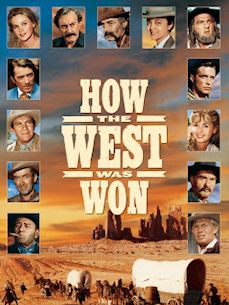
How the West Was Won (1962) (159 min)
iReview: Version: How the West Was Won: 2 Disc Edition (Blu-ray);
Video: VC-1 1080p; Audio: Dolby Digital (AC3) 5.1.
Genre:: Adventure | Drama | Epic | History | Romance | Western |
Sub-Genre/Type:: Classic | Epic Western | History Fiction |
Settings:: 1839-1889 | American Civil War Era | Frontier Region |
Rural Setting | USA | Wild West Era.
Image

Mood?:: Slice Of History | Tough Guys.
iRate:: 4 / 5
Directors:: John Ford
(segment “The Civil War”);
Henry Hathaway
(segments “The Rivers”, “The Plains”
and “The Outlaws”);
George Marshall
(segment “The Railroad”).
Writer:: James R. Webb (screenplay).
Cast:: Henry Fonda, Karl Malden, Gregory Peck, James Stewart, Debbie Reynolds, John Wayne (General William T. Sherman), Eli Wallach, Lee J. Cobb, Richard Widmark, George Peppard, Spencer Tracy (narrator), Harry Morgan (General Ulysses S. Grant), Carroll Baker, Carolyn Jones, Robert Preston, Walter Brennan, Andy Devine, Raymond Massey (President Abraham Lincoln), Agnes Moorehead, Thelma Ritter, Russ Tamblyn.

Click for Credits Enlargement
Credits (Click to expand)

Trailer:

(Note: The vertical bands that appear in this theatrical release trailer, have been digitally removed in the Blu-ray release of the film)

iReview:
In this week’s Sunday Screening, I’ve gone back 51 years to 1962 to seek out films in my library worthy of another look. 1962 was awash with more than 2,000 films released but after a quick scan, I was humbled by my few representatives from that year. But, my small sample does include some notable films: Dr. No, the first Bond film; To Kill a Mockingbird, with Gregory Peck’s outstanding portrayal as Atticus Finch, the lawyer who defends a black man against an undeserved rape charge; Lawrence of Arabia, the story of T.E. Lawrence’s desert war (my favourite film); Lolita, a story of forbidden infatuation by my favourite director, Stanley Kubrick; The Longest Day, the story of D-Day (6th June 1944); The Manchurian Candidate, with a brilliant Frank Sinatra as a brainwashed former captive of North Korea; Mutiny on the Bounty, starring Marlon Brando in an overwrought remake of the 1935 classic; and How the West Was Won. It’s the Blu-ray version of the last of these that I’ve selected for this week’s screening. I’ll be having another look at the rest of this eclectic bunch of 1962 films soon.

How the West Was Won is a curiosity in that it was one of only two narrative films produced using the Cinerama three lens camera system; the other being The Wonderful World of the Brothers Grimm (1962). And, given the complexity of filming in this format and the cost of building theatres capable of screening them, it’s not surprising. Cinerama required three projectors for the three screens used in the curved ultra widescreen presentation. Where the three projected images overlapped, there were thin blurred join-lines, but given the impact of the overall experience as projected onto the unique and enormous screen construction, this was a small infraction. As well as the stunning surround visuals, the system was also one of the first to employ 5.1 audio, giving an unparalleled audio-visual experience.

Story
Story (Click to expand)

For this epic western, three legendary directors, Henry Hathaway, John Ford, and George Marshall, were employed to shoot different segments of the stories of three generations of the Prescott family and their travels from east to west across America between 1839 and 1889. The film chronicles the family’s triumphs and tragedies as they encounter river pirates, suffer drownings and make and lose a fortune in California after travelling the plains together in a wagon train.

This all-star ensemble includes Karl Malden as pioneer Zebulon Prescott who sets out west with his wife (Agnes Moorehead) and their children, Lilith (Debbie Reynolds) and Eve (Carroll Baker). They travel down river and along the way, encounter mountain man and fur trader, Linus Rawlings (James Stewart), who marries Eve.

Lilith continues west after joining a wagon train led by Roger Morgan (Robert Preston), and is accompanied by roguish gambler Cleve Van Valen (Gregory Peck), who saves her during an Indian attack.

These first two vivid segments, dubbed ‘The Rivers (1840)’ and ‘The Plains (1850s)’, were directed by Henry Hathaway.

Moving into the 1860s, the Civil War erupts and Linus and Eve’s son, Zeb (George Peppard), enthusiastically follows his father into the Union army. However, after the Battle of Shiloh, he becomes disillusioned and contemplates a different path. This ‘Civil War (1861-1865)’ segment was directed by John Ford

Richard Widmark also stars as railroad boss Mike King, building the transcontinental railroad, who wants to cut a line straight through Indian territory but is resisted by mountain man, Jethro (Henry Fonda). Zeb, who has rejoined the army as a lieutenant in the U.S. cavalry, is tasked to secure a peace treaty with the Arapaho to allow the railroad construction to proceed peacefully. This segment, titled ‘The Railroad (1868)’, was directed by George Marshall and includes his famous buffalo stampede sequence.

In the final segment, The Outlaws (1880s), directed by Henry Hathaway, Lilith who made it as far west as California, has done well for herself in San Francisco but, after a change in circumstances, auctions most of her possessions and relocates to her ranch in Arizona, inviting Zeb to join her. However, Zeb, now a marshal, has a run-in with an old foe, Charlie Gant (Eli Wallach).

Many more characters and stories are woven throughout this epic film which also features appearances from Raymond Massey as President Abraham Lincoln, John Wayne as General William T. Sherman, and Harry Morgan as General Ulysses S. Grant.

In my earlier description of the plot, I’ve tried to limit the spoilers, so I don’t give everything away. I hope I haven’t just made the story completely obtuse in the process.

As a dramatic narrative, How the West Was Won works more like a travelogue, with emblematic scenic locations providing a visual feast, interrupted by action and dramatic set pieces. The characters are not on screen long enough to develop their identities but that is often a drawback of films that seek to cover an epic story over such a daunting time-span. And with so much visual splendour on offer, it’s only a minor criticism.

The technical restrictions of shooting with three fixed 27mm lenses meant that depth of field variations and close-ups, employed on traditional single lens films were not possible. One of the inadvertent benefits of this constriction is a vivid screen image with the incredible clarity of waving blades of prairie grass in the foreground against crisply defined mountain peaks in the distance. The fact that everything in shot is always in focus, also means that the entire image, including background action is invariably in motion, adding to the window-on-the-world quality of this film. As breath-taking as the magnificent vistas are, the shortcomings of the format are evident. The 400kg Cinerama camera was entirely mechanically rooted and most of the action is front-on because shots needed to be framed in such a way as to avoid foreground actors moving quickly across the boundary between one lens-view and another. These limitations, though, forced directors to become creative in the way shots were constructed and so, there are many wonderful and inventive tracking shots as the camera gracefully glided along its tracks.

When How the West Was Won was first released on VHS and DVD, the presentation was marred by the butchery required to crop the frame for display on the old 4:3 TVs. This compromise also negated one of the film’s main viewing attraction, its wonderful cinematography, rendering the movie barely watchable. Thankfully, for the three disc Special Edition DVD and Blu-ray releases, the film has been painstakingly restored with almost all evidence of the vertical three-panel join lines, digitally eliminated. The stunning result is an image that is brilliantly saturated and a joy to watch. The restoration has also left just enough occasional evidence of the vertical panel lines to demonstrate the ingenuity of the directors in utilising aspects of sets, like doorways, poles and building uprights as well as natural features like trees, to obscure the boundary lines.

For me, the work of John Ford, who filmed the short ‘Civil War (1861-1865)’ segment, is the most evocative and beautifully constructed. In its three scenes, there is the battlefield at Shiloh which ebbs into night with wonderfully lit horizon shots that stretch over and brilliantly amplify the ultra widescreen image. The shots beautifully juxtapose a war scene with the liberal ornamentation of Cherry blossoms, giving the night the look of Christmas decoration. The battle’s aftermath also reveals the short but effective scene with two disheveled Generals, Ulysses S. Grant and William Tecumseh Sherman. The quiet rhythm of the scene moves into the next, when Zeb returns home. The pacing and atmosphere of these scenes is exquisite.

Dave Kehr of the New York Times, in his 2008 review, wrote: “The best reason for buying a Blu-ray player right now is Warner Home Video’s high-definition version of “How the West Was Won,” a film made 46 years ago in the highest-definition moving picture medium the world had seen: Cinerama”. He continued, “Not even the finest home theater installation will be able to reproduce the scale and resolution of the Cinerama experience, or anything close to it. But moving from standard-definition DVD to Blu-ray generates a shock analogous to what the audiences of 1962 must have felt when the curtains parted to reveal the panoramic screen.”

Films like How the West Was Won and Ford’s other western masterpiece, The Searchers (1956), have languished in VHS hell for too long, waiting for the advent of Blu-ray and a big wide home screen on which to showcase their brilliance. This result is a riveting revelation and richly recommended.

iRate:: 4 out of 5.

4Movie Tragics

Extras:
• Feature Commentary by: Filmmaker David Strohmaier; Director of Cinerama, Inc. John Sittig; Film Historian Rudy Behlmer; Music Historian Jon Burlingame; and Stuntman Loren James (This informative and interesting track appears on both the Blu-ray and Special Edition 3-disc DVD versions).
• Cinerama Adventure (This fascinating 93 minute documentary tells you everything you didn’t know you needed to know about the revolutionary Cinerama format and appears on both the Blu-ray and Special Edition 3-disc DVD versions).
• The 2-disc Blu-ray version also offers a Smilebox version of the film, which attempts to mimic the curved screen of the original Cinerama process. The effect is hard to describe so you’ll need to get it to see it.

You want More!
How the West Was Won – IMDb (Internet Movie Database)
How the West Was Won – Rotten Tomatoes
How the West Was Won – allmovie.com
How the West Was Won – Wikipedia


I’d love to hear your impressions of this film. Am I wrong to rate it so highly despite its shallow plot and dialogue? I’d also welcome your impressions and anecdotes, if you’ve been one of the lucky few to have seen this at a Cinerama cinema.

:: Please leave a comment ::


Higgs bosun Particle Confirmed:

14 Thursday Mar 2013

Posted by Zak de Courcy in Religion, Science

≈ 3 Comments

Tags

Albert Einstein, CERN, Galileo, god particle, Higgs bosun, Large Hadron Collider, religion, science

Image
(image: Martial Trezzini/KEYSTONE/Associated Press)

On this birthday of the greatest scientist of the 20th Century, Albert Einstein (14 March 1879 – 18 April 1955), it’s amazing to watch as the mechanics behind the Universe are slowly revealed. CERN Physicists working at the $US10 billion Large Hadron Collider in Switzerland, believe they have confirmed the existence of the Higgs boson particle, greatly solidifying our knowledge of the fundamentals of the universe.

Unfortunately, the intellectual chasm between the guys revealing the origins and mysterious underpinnings of our universe, Einstein and his successors, and the rest of us, is still so massive that ‘creator’ and ‘interventionist’ gods can still profitably fill the gap. It was only a little under 400 years ago that the Catholic Church and its inquisitors, locked up Galileo and threatened him with torture, for the heresy of suggesting that the Bible was wrong in that the Earth was not the centre of the Universe. Those fearful and blinkered churchmen must have trembled at the thought of the consequence of his heresy. For, if a book of absolute truths, written as the word of God, could be disproved in only one part, then that would call into question the whole. Now the heresy is a largely accepted theory and a settled consensus of fact for humanity.

Likewise, the widely accepted Theory of Evolution, will one day soon achieve the same settled status and Creationists will be relegated as an embarrassing joke in history.

Science has now largely abrogated the notion of a god as an omnipotent being who can miraculously disrupt the laws of physics and chemistry on our behalf. These magical beings will soon be archived alongside Norse gods of an earlier age when simple but incomprehensible things like storms, rain, lightning, life, the sun and the moon, needed supernatural explanation: Odin (the ruler of the gods), Thor (the god of thunder) and Hel (queen of the underworld). As famed cosmologist, Carl Sagan put it when dismissing the existence of a sentient interventionist god, “it does not make much sense to pray to the law of gravity.” What will become of all those magnets of greed and wealth, the televangelists, when the core message of their wealth ministries, that God showers money on followers, is finally confirmed as the folly it is.

So with the ‘interventionist gods’ on very shaky ground, that leaves just the ‘creator gods’.

The Higgs boson particle is key to current understanding of the Big Bang.
First theorized in 1964 by British physicist Peter Higgs, as part of the Standard Model of Physics, the Higgs boson was until very recently, the only Standard Model particle yet to be discovered. The model explains how the constituent particles of matter interact.

CERN scientist, Professor William Trischuk explains, “The Higgs field is everywhere around us, and all particles are moving in the presence of this field,” All these particles “interact more or less strongly with it, and they are either slowed down or not slowed down so much and that’s what gives them mass. The heavier ones interact strongly with this field and the light ones interact very weakly with this field.”, he said.

Now with the confirmation of the Higgs boson Particle’, one of the last pieces of the puzzle needed to explain the origin of our universe, has been confirmed, and the Big Bang is also a little closer to being settled (if they could just figure out that pesky ‘dark matter’). With this significant step, the ultimate fate of the creator gods is also closer.

In his 2010 book, The Grand Design, the world’s most famous living scientist and Big Bang pioneer, Professor Stephen Hawking argues that, “Because there is a law such as gravity, the universe can and will create itself from nothing,” he writes. “Spontaneous creation is the reason there is something rather than nothing, why the universe exists, why we exist.” Hawking added that, “It is not necessary to invoke God to light the blue touch paper and set the universe going.”

And, if a universe can be created spontaneously, there’s no need for a ‘creator god’ to explain why we’re here.

In time, humans may look back on our time in much the same way as we look back on those arrogant and misguided men of God who imprisoned Galileo in 1633; as a time when people who, frightened for the existential consequence should their god prove not to exist, desperately clung to a vision of life on Earth as a court room for sentient, judgmental gods who held humans in special regard and rewarded the deeds of followers and burned the rest.

I predict that it’ll be less than 50 years before a final consensus is reached when all the interventionist and creator gods and their blood-soaked history, can finally be retired.

Happy birthday Albert.

Check out the New York Times report on the confirmation of the Higgs boson:
• CERN Physicists See Higgs Boson in New Particle (NYT, 14 March 2013)
Also see this Huffington Post Report:
• Higgs Boson Discovery Confirmed After Physicists Review Large Hadron Collider Data At CERN (Huff. Post, 14 March 2013)


Will the deity religions be able to hang on for another 50 years? Will a religion fueled war emanating from the Middle East, devastate the world in the meantime? Will fusion propulsion open up exploration of our solar system? will we solve the mystery of ‘dark matter’ any time soon? What do you reckon?

:: Please leave a comment ::


Who Said This about Climate Change?

13 Wednesday Mar 2013

Posted by Zak de Courcy in Australian Politics

≈ Leave a comment

Tags

Australian politics, carbon price, climate change, economy, elections, Malcolm Turnbull, NBN, Tony Abbott

Who said this about Climate Change and carbon emissions pollution reduction?

“First, let’s get this straight. You cannot cut emissions without a cost. To replace dirty coal fired power stations with cleaner gas fired ones, or renewables like wind, let alone nuclear power or even coal fired power with carbon capture and storage, is all going to cost money.”

“To get farmers to change the way they manage their land, or plant trees and vegetation all costs money. Somebody has to pay. So any suggestion that you can dramatically cut emissions without any cost is, to use a favourite term of Mr. Abbott, `bullshit’. Moreover, he knows it.”

“It is not possible to criticise the new Coalition policy on climate change because it does not exist. Mr. Abbott apparently knows what he is against, but not what he is for.”

“…the fact is that Tony and the people who put him in his job, do not want to do anything about climate change. They do not believe in human caused global warming. As Tony observed on one occasion “climate change is crap” or if you consider his mentor, Senator Minchin, the world is not warming, it’s cooling and the climate change issue is part of a vast left wing conspiracy to deindustrialise the world.”

“Now politics is about conviction and a commitment to carry out those convictions. The Liberal Party is currently led by people whose conviction on climate change is that it is “crap” and you don’t need to do anything about it.”

“Any policy that is announced will simply be a con, an environmental fig-leaf to cover a determination to do nothing. After all, as Nick Minchin observed, in his view the majority of the Party Room do not believe in human caused global warming at all.”

“…we have an Opposition Leader who has in the space of a few months held every possible position on the issue, each one contradicting the position he expressed earlier”.


You probably guessed right… It was the Liberal federal Shadow Minister for Communications, Malcolm Turnbull. (Samantha Maiden, The Australian, 7 December 2009)

“Many Liberals are rightly dismayed that on this vital issue of climate change we are not simply without a policy, without any prospect of having a credible policy but we are now without integrity. We have given our opponents the irrefutable, undeniable evidence that we cannot be trusted,” Turnbull said.

And who was also reported in the Australian, on 7 December 2009, as attacking Tony Abbott’s Direct Action Plan to reduce carbon pollution, in a Shadow Cabinet meeting, warning it would cost tax-payers over $50 billion…. Liberal Shadow Treasurer, Joe Hockey.

The Liberal Party leadership don’t believe that humans have caused the change in climate that has seen records tumble with super-heatwaves, super-storms, and many more floods and bush-fires. They profess the so-called Direct Action plan, that Turnbull and Hockey derided, to replace the Carbon Price. But does anyone believe that Tony ‘climate change is crap’ Abbott would implement any effective carbon pollution reduction plan… Hardly.

The rest of the world, including even China, are slowly changing their economies to reduce carbon pollution, while taking opportunities to retool industry for a new more competitive, energy efficient world. An Australia, under Abbott, would see us continue as the the world’s highest per capita carbon polluter, with an old-world high energy, low efficiency, and less competitive economy.

Check out Chief Political Correspondent, Lenore Taylor’s Sydney Morning Herald piece on the effectiveness of the Carbon Price:
• Carbon tax contributes to emissions drop (SMH, 18 October 2012)


Is there any chance the Australian Liberal Party will ever come to terms with “Climate Change” or are they destined to remain “climate change deniers” until we’re cooked?

:: Please leave a comment ::


Richard Dawkins in The Simpsons

12 Tuesday Mar 2013

Posted by Zak de Courcy in Religion

≈ 1 Comment

Tags

religion, Richard Dawkins, Simpsons

Richard Dawkins in The Simpsons

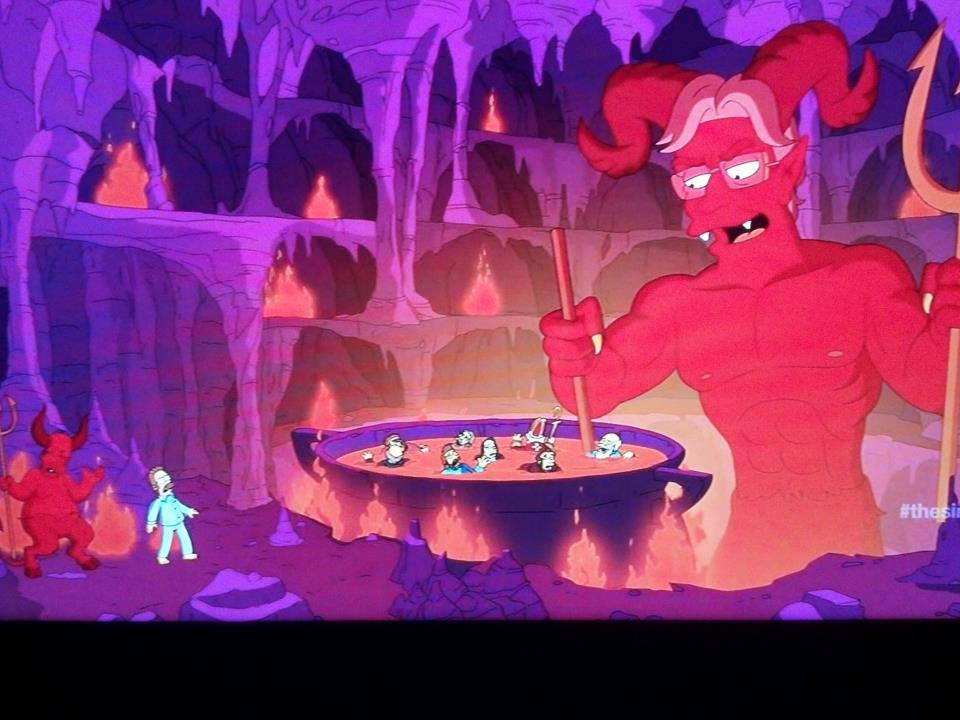
A recent photo of Richard Dawkins stirring up some of his speciality:
Catholic Saint stew. Bon Appetit!!!
Dawkins appeared in a Ned Flanders nightmare in The Simpsons episode: Black-Eyed, Please; which aired on Fox (USA) on Sunday, 10 March.

Thanks to:
• The Richard Dawkins Foundation for Reason and Science (Official)
And The Simpsons.


Is it possible for a fundamentalist to have a sense of humour?

:: Please leave a comment ::


← Older posts

Subscribe

  • Entries (RSS)
  • Comments (RSS)

Archives

  • March 2022
  • May 2019
  • January 2019
  • January 2017
  • June 2016
  • March 2016
  • September 2015
  • January 2015
  • October 2014
  • August 2013
  • June 2013
  • May 2013
  • April 2013
  • March 2013

Categories

  • Australian Politics
    • Aus Pol. Posts Index
  • Film
    • Film Posts Index (All)
    • Reviews Index (Alpha)
  • Gotta Life
    • Gotta Life Posts Index
  • International Politics
    • Int Pol. Posts Index
  • Religion
    • Religion Posts Index
  • Science
    • Science Posts Index
  • Uncategorized
  • WA Politics
    • WA Pol. Posts Index

Meta

  • Create account
  • Log in

Blog at WordPress.com.

Privacy & Cookies: This site uses cookies. By continuing to use this website, you agree to their use.
To find out more, including how to control cookies, see here: Cookie Policy
  • Subscribe Subscribed
    • Zak From Downunder
    • Already have a WordPress.com account? Log in now.
    • Zak From Downunder
    • Subscribe Subscribed
    • Sign up
    • Log in
    • Report this content
    • View site in Reader
    • Manage subscriptions
    • Collapse this bar
 

Loading Comments...