• About

Zak From Downunder

~ Zak de Courcy's sometimes incendiary thoughts about politics, life and religion.

Zak From Downunder

Author Archives: Zak de Courcy

It’s a Cruel World, Margaret Thatcher:

14 Sunday Apr 2013

Posted by Zak de Courcy in International Politics

≈ 1 Comment

Tags

David Cameron, Friedrich Hayek, international politics, Margaret Thatcher, politics, Thatcherism, UK politics, United Kingdom

Margaret Thatcher I know it’s customary to subordinate feelings of ill-will towards the deceased and apply the dictum ‘If you’ve got nothing nice to say, just say nothing’, but having obeyed for several days, I found the flood of memories about Margaret Thatcher too strong.

As a committed groupie of free market neo-liberal guru, Friedrich Hayek, Thatcher came to power in 1979 with the intention of sweeping away impediments to Capitalist power like the Welfare State. She was a firm believer in the Free Market but was never able to describe how a fundamental key to the beneficial operation of such a market could be achieved: perfect knowledge. When cheap horsemeat is substituted for beef, in a Hayekian, Free Market world, free of inspectors and testers (because they’re not needed in Hayek’s view), the consumer would require the supply chain be obvious to all before they could make the informed decision about buying the delicious cheaper product. As well, when strange instruments related to sub-prime mortgages were marketed to national and municipal governments around the world, the buyers completely understood that they were purchasing a toxic asset because they all knew exactly what they were buying. They also knew they were hastening the collapse of the world economy in 2008 and the onset of the current Euro crisis, with their investments. The silly idiots went ahead and did it anyway… NOT!! Hardly anyone, including the people flogging these diabolical products and the rating agencies, had any idea what they really were. So much for the Free Market. Incidentally, the 1986 Big Bang, as it’s called, was the Hayek inspired banking deregulation, championed by Thatcher, that then forced American deregulation and set in train the series of events that culminated with the 2008 crash…
Thanks Maggie!

Learn more:
• Big Bang’s shockwaves left us with today’s big bust
(Guardian/Observer, 9 October 2011)

Thatcher also trashed the legacy of Clement Attlee, the architect of Post-War Britain. Where there had been a settled consensus regarding the shared underpinning of society within the Welfare State, Thatcher proclaimed “there is no such thing as society”. She coldly advanced the notion that we are all alone as she promoted individualism, competition and greed. To those who claim she did what was necessary to reform the country, I’d say there were many paths to reform. She could have chosen something a little more inclusive like a Scandinavian model. Instead, she chose to embark on a sharp elbows era of dog-eat-dog economics, designed to create a brutal, nasty but efficient Britain. The innocent and hapless victims of this compassionless policy were further battered by slashed safety net support and a sharp reduction in the construction of public housing which caused greater hardship and homelessness (ironically, this was a program that had been championed by a previous conservative prime minister, Winston Churchill, in the 1950s). As Glenda Jackson, former Academy Award winning actress and MP for Hampstead and Kilburn, put it, “Every single shop doorway, every single night, became the bedroom, the living room, the bathroom for the homeless.”

See Jackson’s speech here:

At the time Margaret Thatcher came to power, the North Sea Oil bonanza was contributing more than 15% to Britain’s GDP. Instead of investing for the nation’s future with this windfall, as did the other beneficiary of the boom, Norway, she cut the tax rate for the rich. But despite her low-tax mantra, she also almost doubled (to 15%) VAT (Value Added Tax) which, because it’s a sales tax, hurt the poor much more than the wealthy.

Just when polls indicated she was headed for a landslide defeat at the upcoming 1983 elections, the Argentinian’s saved Thatcher by occupying the Falklands, a group of small islands they knew as the Malvinas. The Argentinian’s had claimed since the 19th century that the islands were stolen from them by the British. Thatcher’s government all but put out the welcome mat by indicating an unwillingness to defend the islands by ending their military presence (already reduced to one ice patrol vessel, HMS Endurance). Despite warnings from the Royal Navy and the growing belligerence of the Argentinian Junta, the British were conveniently ‘taken by surprise’ by the occupation. The military operation to retake the islands included the sinking of a retreating Argentine cruiser, the Genral Belgrano, with the loss of 323 lives. The Falklands war resulted in the deaths of 649 Argentine, and 258 British personnel but gave birth to the Iron Lady, wrapped her in the flag and led to a resounding election win.

When confronted by a militant union, the National Union of Mineworkers, did Margaret Thatcher attempt to find a new industrial relations path, like the Germans had done, that avoided the need for unions to use the blunt and destructive strike as a negotiation tool? Did she seek to reform unions to make them more democratic, accountable and effective? No, instead she pledged to defeat “the enemy within”, a phrase that wouldn’t have seemed out of place in Hitler’s Germany, and embarked on a long civil war against the union movement with the assistance of the police, Special Branch and MI5 (the internal spy service).

As it happened, the coal mines were at the sharp end of Thatcher’s plan to reshape Britain, not gradually as previous government’s had done, but with a short and destructive shock. Her pit closure regime resulted in untold hardship as whole towns were laid waste and communities ripped apart. By the time she’d finished applying the wrecking ball to British industry, manufacturing output had collapsed by 30%, she’d added 3 million workers to the unemployment queue and millions of families to her resume of misery.

Also during the 1980s, Thatcher embarked on the radical transformation of public ownership which became synonymous with Thatcherism. Utilities that had previously been deemed essential strategic assets or essential services were sold off. These included British Airways (sold, 1987), British Petroleum (gradually privatized between 1979 and 1987), British Aerospace (1985 to 1987), British Gas (1986), Rover Group (1988), British Steel (1988), British Telecom (1984), Sealink ferries (1984), Rolls-Royce (1987) and the regional water authorities (1989).

In her relations with the rest of the world, Margaret Thatcher had a mixed record. She could claim most of the credit for softening up the stridently anti-communist Republican Party in the USA to the idea that it was OK to deal with the Communist USSR, when she famously declared that, “I like Mr. Gorbachev; we can do business together.”. This was a year before he became Soviet Leader and it certainly gave US president Ronald Reagan the necessary cover to seek a deal with the Soviets. In 1979, she was also instrumental, with the assistance of Australian negotiators, in reaching the Lancaster House Agreement which settled the Zimbabwe independence conflict. Not so laudatory, was her well known and blatant racism (something Australian Foreign Minister, Bob Carr recalled well). She also famously found herself on the wrong side of history in supporting the racist Apartheid regime in South Africa against the international community’s call for sanctions, even welcoming South African prime minister, P. W. Botha, to Britain in 1984. This stand put her sharply at odds with other Commonwealth countries, including Australia and Canada who were at the forefront of the sanctions movement. Thatcher went even further, branding Nelson Mandella a terrorist.

Her support for Chile’s murderous Pinochet regime represents another low point. Thatcher never resiled from her position, even publicly and warmly meeting with Pinochet after he had become an international pariah in the decade before his death. In 1999, the reason for that unwavering support was revealed: Alone among Latin American countries, Chile had provided extensive covert support to the British during their 1983 Falklands war with Chile’s neighbour, Argentina. This action, which almost certainly guaranteed British success, was undertaken at great risk to Pinochet as Chile were greatly outgunned by Argentina and could have suffered grave consequences if this complicity became known.

Learn more:
• Thatcher always honoured Britain’s debt to Pinochet.
(The Telegraph, 13 December 2006)

Unfortunately for Margaret Thatcher, distant memory hasn’t rehabilitated her legacy, as Thatcherism, the ideology that polarised much of the Western World, is still very much alive and cruelly unwell. The divisiveness of her government is also still very raw for many of those old enough to remember. As well, she had the bad fortune to die at a time of rising unemployment and widening economic inequality, declining upward mobility, and entrenched and worsening poverty (fittingly ironic, given she had a big hand in creating those conditions). As well, there is a worthy reminder of her reign in David Cameron who has instituted a deep austerity of his own, with massive welfare cuts, in the middle of a long and painful recession. The offspring of her policies are still being born into a Britain where the process Thatcher began, continues with cuts to disability pensioners and the backdoor privatisation of the cherished NHS (National Health Service).

I think, as well, salt has been ladled into the open wound by Cameron’s insensitive decision to give Thatcher, what amounts to, a State funeral (minus the actual lying in state but with everything else, including the traditional gun carriage). Little wonder then, that the cruelly intentioned, Wizard of Oz song, Ding Dong! The Witch Is Dead, has become the anthem of her death and has rocketed to the top of the charts.

For the geeks:
To get a flavour of the times, here are several films that depict Thatcher’s Britain – a land of poverty, violence and racism – including: Stephen Frears’s My Beautiful Laundrette (1985); Riff-Raff (1991), directed by Ken Loach who slammed Thatcher as “the most divisive and destructive Prime Minister of modern times” and called for her funeral to be privatized and handed to the lowest bidder, consistent with her economic policies; Brassed Off (1996); and Billy Elliot (2000).

As well, In The Cook, the Thief, His Wife & Her Lover (1989), director Peter Greenaway mounts a lavishly grotesque and violent, satirical allegory for the excesses and class divide of the Thatcher years.


In case you hadn’t guessed, I loathed Margaret Thatcher. How do you feel about her?

:: Please leave a comment ::


More on Same-Sex Marriage and the Church:

10 Wednesday Apr 2013

Posted by Zak de Courcy in Australian Politics, International Politics, Religion

≈ 3 Comments

Tags

Anglican Church, Australian politics, catholic church, Episcopal Church, gay rights, Human Rights, international politics, LGBT, marriage, politics, religion, same-sex marriage, United Church of Christ, USA politics

My previous post, The Last Civil Right? Same Sex Marriage:, has generated a bit of heat on Facebook with comments suggesting that in 1967, when the bulk of churches stood against interracial marriage, they were simply reflecting a society with similar attitudes. The argument follows that the churches are doing the same now.

Image In my previous post I did mention that some churches, including the United Church of Christ support marriage equality. The Anglican’s progressive American Episcopalian branch is another wonderful exception. With same-sex marriage now legal in Washington DC, Rt. Rev. Mariann Edgar Budde, the Episcopal bishop of Washington DC, recently announced that The Washington National Cathedral (an Episcopalian church), where the nation gathers to mourn tragedies and presidents, will soon begin performing same-sex marriages. Unfortunately, the main body of that church, the Anglican church in England continues to stand alongside the Roman Catholics, as one of the main churches vocally opposed to marriage equality. Jeffrey John, the Anglican dean of St Albans in the UK, recently accused the church of pursuing a “morally contemptible” policy on same-sex marriage. He writes that, by setting themselves against same-sex marriage, the bishops of the Church have prioritised the union of the Anglican Communion over the rights of gay Christians. “Worst of all, by appeasing their persecutors it betrays the truly heroic gay Christians of Africa who stand up for justice and truth at risk of their lives. For the mission of the Church of England the present policy is a disaster.”
See the whole Guardian Newspaper report here:
• Anglican stance on same-sex marriage ‘morally contemptible’

There’s a reason why the churches have emptied in the most religious country in Europe, Roman Catholic Ireland. I know the Anglican Church is experiencing the same sort of ‘West vs. the Rest’ crisis that’s decimating the Catholic Church in Europe but they both need to decide whether they prioritise expedience over principle.

If the churches were purely political organisations, then it might be reasonable for them to simply reflect or lag behind community consensus or act expediently. But the churches set themselves as moral and social arbiters and as such they should bravely and with principle, lead the community by advocating for tolerance, social inclusion and progressive social policy. Alternatively, they can continue to choose, as they did in 1967, to identify themselves with intolerance, prejudice and exclusion. If the churches continue in that direction, they’ll accelerate their irrelevance to the West and soon exist only in the third world.


I’m almost afraid to ask for comments on this hotly debated issue.

:: Please leave a comment ::


The Last Civil Right? Same Sex Marriage:

08 Monday Apr 2013

Posted by Zak de Courcy in Australian Politics, International Politics, Religion

≈ 4 Comments

Tags

Australian politics, Chief Justice Earl Warren, civil rights, DOMA, gay rights, Guess Who’s Coming to Dinner, Human Rights, international politics, LGBT, Loving v. Virginia, marriage, politics, Proposition 8, religion, same-sex marriage, US Supreme Court, USA, USA politics

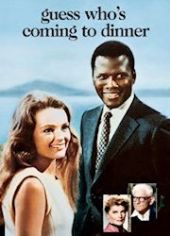
Image For those old enough to remember, Guess Who’s Coming to Dinner (1967), was a challenging and controversial film. At that time (only 46 years ago) interracial marriage was unthinkable and strongly opposed by the church as well as being illegal in 16 states in the USA and opposed by 72% of the American public. Running against the tide in 1967, the US Supreme Court ruled against interracial marriage prohibition in Loving v. Virginia. Chief Justice Earl Warren, who penned the unanimous decision, wrote in words that echo strongly for same-sex marriage:
“Marriage is one of the ‘basic civil rights of man,’ fundamental to our very existence and survival… To deny this fundamental freedom on so unsupportable a basis as the racial classifications embodied in these statutes, classifications so directly subversive of the principle of equality at the heart of the Fourteenth Amendment, is surely to deprive all the State’s citizens of liberty without due process of law. The Fourteenth Amendment requires that the freedom of choice to marry not be restricted by invidious racial discrimination. Under our Constitution, the freedom to marry, or not marry, a person of another race resides with the individual and cannot be infringed by the State.”
Today, such relationships are barely noticed let alone condemned (except by a small minority in the deep south).

Last week, the Supreme Court heard arguments in two landmark cases related to same-sex marriage. The Court is being asked to rule on the constitutionality of California’s Proposition 8, which banned gay marriage, and the federal Defense of Marriage Act (1996), which defined marriage as between a male and female and also required the US federal government to deny benefits to same-sex couples, married in states that allow same-sex unions.

Image It seems that the last great Civil Rights issue is in the balance and once again, just like they did with interracial marriage in 1967, the churches stand on the side of prejudice (with a very few exceptions like the 1 million strong, United Church of Christ).

So while great strides have been made in recent decades to recognize the civil rights of the LGBT communities, there still exists one glaring inequality that defines them and their life partnerships as inferior and somehow frivolous: Marriage inequality.

Marriage today, particularly in the West, has moved away from being an exclusively religious institution and is now celebrated in many ways: in churches; synagogues; court houses; city halls; parks; and sometimes, in less solemn, perhaps even frivolous settings.

Some are religious ceremonies while many are very secular. Generally though, they have one thing in common: they celebrate the love, joy and commitment of two people to each other in the company of friends and family. For most, this is one of life’s highlights but it is one that is wholly denied to gay people and relegates gay relationships to being somehow less worthy and legitimate than those of straight people.

I have no problem with religious people defining for themselves the nature of their creation, their relation to a deity and dogmatically ordained relationships between people within their faith. I similarly have no objection to religious celebrants, declining to marry same-sex partners. I do however, object strongly when those same people seek to impose their definitions on the rest of society. The religious might believe that their deity created marriage to foster procreation but the reality is that marriage was a device developed thousands of years ago, long before Christianity, Islam or Judaism, to ensure property ownership and inheritance. Whatever the view, the decline in formalised religiosity in the West has paralleled an increasing view that marriage is not a necessary precursor to procreation. At the same time, I believe there is a growing identification with the notion of marriage as a desirable way of publicly demonstrating and celebrating the commitment of two people, including mothers and fathers already in a family, to each other. As well, I think many people now see the legal responsibilities inherent in marriage as somehow affirming their willingness to more permanently commit to each other.

Many countries have approved or are in the process of legislating marriage equality, including: Andora, Argentina, Belgium, Canada, Columbia, Denmark, Finland, France, Germany, Iceland, Ireland, Luxembourg, Netherlands, Nepal, New Zealand, Norway, Portugal, Spain, South Africa, Sweden, Taiwan, the United Kingdom, and Uruguay, although I’m ashamed to say, not my own (Australia). In the traditionally conservative United States, same-sex marriage has been legalised in Connecticut, Iowa, Massachusetts, Maine, Maryland, New Hampshire, New York, Vermont, Washington, D.C., the state of Washington and the largest state, California (barring the success of Prop 8, currently before the Supreme Court). Even in the UK which is currently ruled by a right-wing coalition government, the Conservative Party are pushing ahead with marriage equality. British Prime Minister, David Cameron, In a speech to his Conservative Party in 2011 said: “I don’t support gay marriage despite being a Conservative. I support gay marriage because I’m a Conservative.”

  • See the full transcript of Cameron’s speech here.

The conservative fall-back position for those opposed to same-sex marriage, seems to be: that some form of civil union might be possible. While civil unions do legally cement a gay partnership contract in much the same way as a marriage, they do so without the equality of status and celebration conferred by a straight marriage. And worse, such a confirmed legal status further entrenches the inferiority of gay relationships by only recognising their legal but not societal status. Allowing civil unions but not marriage, is akin to legally granting an African American the right to travel at the front of the bus but with a big sign fixed to his seat patronisingly proclaiming “We whites have to let you ride but you’re still BLACK!!!”, thus perpetuating the myth that being white (or in this case, straight) is still somehow superior.

At a time when family and society’s bonds are being increasingly challenged, why would we not take the opportunity to help place family and relationship commitment more firmly at the core of our communities by affirming the role of marriage as a desirable and cherished family institution not just as something religious people do before they procreate.

It’s time to remove one of the last signposts of gay inferiority, reach out the hand of inclusiveness to all people and support the affirmation of family and committed relationships intrinsic to marriage equality for all.


Has this issue reached a tipping point or are the forces of prejudice like the leader of the conservative Liberal Party in Australia, going to be able to hold back what seems like the inevitable tide of history?

:: Please leave a comment ::

The Dean of Movie Critics, Roger Ebert is Dead:

05 Friday Apr 2013

Posted by Zak de Courcy in Film

≈ 3 Comments

Tags

Chicago Sun-Times, Film, film review, Roger Ebert

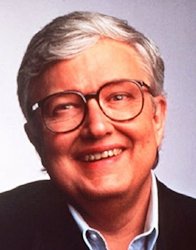
ImageFor movie lovers the world over, today is a very sad day. The most famous of all film critics, Roger Ebert, has died aged 70 after a long battle with cancer.

In 1967 he joined the Chicago Sun-Times as their film critic and had worked continuously since (with a short break in 2006/7 for cancer treatment). Through the years he gained a formidable reputation and was the first critic awarded a Pulitzer Prize for his work.

With partners, first Gene Siskel, then Richard Roeper, Ebert enjoyed success with syndicated television shows, including the long-running At The Movies. In his almost 50 years of criticism, he produced more than 9,000 reviews, a record that’s unlikely to be beaten.

He described his critical style as relativist saying,
“When you ask a friend if Hellboy is any good, you’re not asking if it’s any good compared to Mystic River, you’re asking if it’s any good compared to The Punisher. And my answer would be, on a scale of one to four, if Superman is four, then Hellboy is three and The Punisher is two. In the same way, if American Beauty gets four stars, then The United States of Leland clocks in at about two.”

Although Roger Ebert wasn’t a fan of “top ten” lists, or movie lists in general, he still contributed his top ten to the 2012 British Film Institute’s Sight and Sound Critics’ poll. Listed alphabetically, those films were 2001: A Space Odyssey, Aguirre, the Wrath of God, Apocalypse Now, Citizen Kane, La Dolce Vita, The General, Raging Bull, Tokyo Story, The Tree of Life and Vertigo.

In 1968, when 2001: A Space Odyssey was released, many respected critics realized what a landmark it was, including Ebert, while others like Renata Adler of The New York Times, were short on praise. Adler wrote that the movie was “somewhere between hypnotic and immensely boring”.

In tribute to Roger Ebert, here is his 1968 review of one of my favourite films: 2001: A Space Odyssey.
It was e. e. cummings, the poet, who said he’d rather learn from one bird how to sing than teach 10,000 stars how not to dance. I imagine cummings would not have enjoyed Stanley Kubrick’s “2001: A Space Odyssey,” in which stars dance but birds do not sing. The fascinating thing about this film is that it fails on the human level but succeeds magnificently on a cosmic scale.

Kubrick’s universe, and the space ships he constructed to explore it, are simply out of scale with human concerns. The ships are perfect, impersonal machines which venture from one planet to another, and if men are tucked away somewhere inside them, then they get there too.

But the achievement belongs to the machine. And Kubrick’s actors seem to sense this; they are lifelike but without emotion, like figures in a wax museum. Yet the machines are necessary because man himself is so helpless in the face of the universe.

Kubrick begins his film with a sequence in which one tribe of apes discovers how splendid it is to be able to hit the members of another tribe over the head. Thus do man’s ancestors become tool-using animals.

At the same time, a strange monolith appears on Earth. Until this moment in the film, we have seen only natural shapes: earth and sky and arms and legs. The shock of the monolith’s straight edges and square corners among the weathered rocks is one of the most effective moments in the film. Here, you see, is perfection. The apes circle it warily, reaching out to touch, then jerking away. In a million years, man will reach for the stars with the same tentative motion.

Who put the monolith there? Kubrick never answers, for which I suppose we must be thankful. The action advances to the year 2001, when explorers on the moon find another of the monoliths. This one beams signals toward Jupiter. And man, confident of his machines, brashly follows the trail.

Only at this point does a plot develop. The ship manned by two pilots, Keir Dullea and Gary Lockwood. Three scientists are put on board in suspended animation to conserve supplies. The pilots grow suspicious of the computer, “Hal,” which runs the ship. But they behave so strangely — talking in monotones like characters from “Dragnet” — that we’re hardly interested.

There is hardly any character development in the plot, then, as a result little suspense. What remains fascinating is the fanatic care with which Kubrick has built his machines and achieved his special effects. There is not a single moment, in this long film, when the audience can see through the props. The stars look like stars and outer space is bold and bleak.

Some of Kubrick’s effects have been criticized as tedious. Perhaps they are, but I can understand his motives. If his space vehicles move with agonizing precision, wouldn’t we have laughed if they’d zipped around like props on “Captain Video”? This is how it would really be, you find yourself believing.

In any event, all the machines and computers are forgotten in this astonishing last half-hour of this film, and man somehow comes back into his own. Another monolith is found beyond Jupiter, pointing to the stars. It apparently draws the spaceship into a universe where time and space are twisted.

What Kubrick is saying, in the final sequence, apparently, is that man will eventually outgrow his machines, or be drawn beyond them by some cosmic awareness. He will then become a child again, but a child of an infinitely more advanced, more ancient race, just as apes once became, to their own dismay, the infant stage of man.

And the monoliths? Just road markers, I suppose, each one pointing to a destination so awesome that the traveler cannot imagine it without being transfigured. Or as cummings wrote on another occasion, “listen — there’s a hell of a good universe next door; let’s go.”

Roger, you’ll be greatly missed. – 4/4 and two thumbs up.

Also check out:
• Roger Ebert as a Builder of an Empire by David Carr
(New York Times – April 7, 2013)


Do you have any impressions or recollections of Roger that you’d like to share?

:: Please leave a comment ::


The Sunday Screening Session….. Star Wars: Episode VI – Return Of The Jedi (1983)

31 Sunday Mar 2013

Posted by Zak de Courcy in Film

≈ 1 Comment

Tags

Action, Action & Adventure, Adrenaline Rush, Adventure, Alec Guinness, Billy Dee Williams, Carrie Fisher, Ensemble Film, Epic, Fantasy, Film, film review, Frank Oz, George Lucas, Guy Movie, Harrison Ford, iRate:: 4½ / 5, John Williams, Lawrence Kasdan, Mark Hamill, Master Villain Film, Modern Classic, Other Dimensions, Out In Space, Richard Marquand, Sci-Fi Action, Sci-Fi Adventure, Science Fiction, Science Fiction Epic, Space Adventure, Star Wars, Star Wars Episode VI Return of the Jedi, Sunday Screening Session

Star Wars:
Episode VI Return Of The Jedi (1983)
 (135 min)

iReview: Version: Star Wars: The Complete Saga (Blu-ray);
Video: AVC 1080p; Audio: DTS 5.1.
Genre:: Action | Adventure | Epic | Fantasy | Science Fiction |
Sub-Genre/Type:: Action & Adventure | Ensemble Film |
Master Villain Film | Modern Classic | Sci-Fi Action |
Sci-Fi Adventure | Science Fiction Epic | Space Adventure |
Settings:: Out In Space.
Image
Mood?:: Adrenaline Rush |
Guy Movie | Other Dimensions.
iRate:: 4½ / 5
Director:: Richard Marquand.
Writers:: George Lucas (story); Lawrence Kasdan & George Lucas (screenplay).
Cast:: Mark Hamill, Harrison Ford, Carrie Fisher, Frank Oz, Billy Dee Williams, Alec Guinness, Anthony Daniels, Kenny Baker, Peter Mayhew, David Prowse, James Earl Jones, Sebastian Shaw, Ian McDiarmid, Michael Pennington.

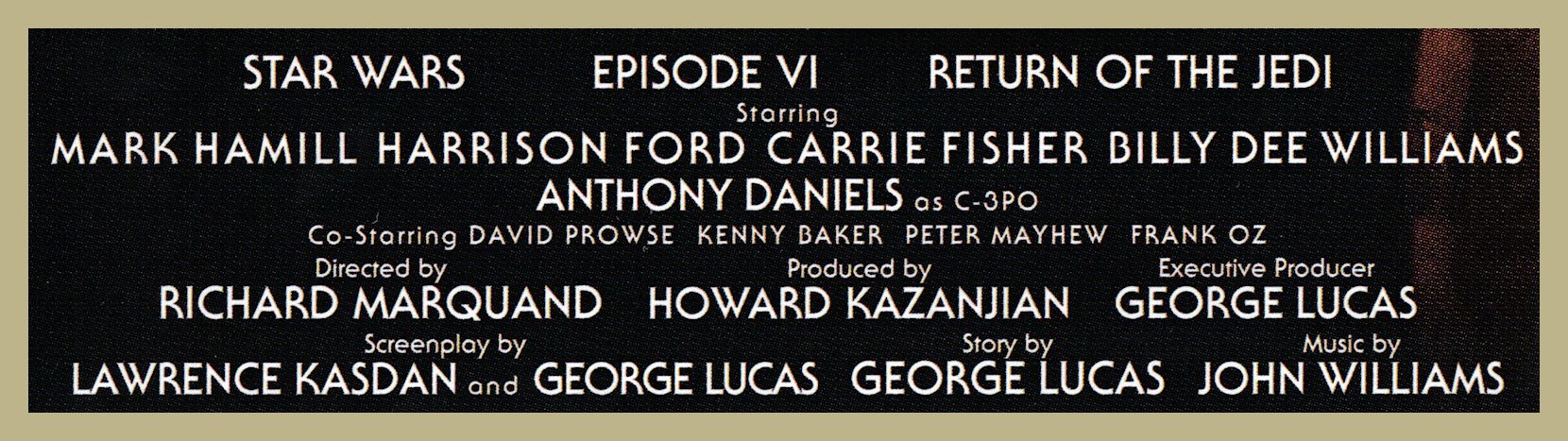
Click for Credits Enlargement
Credits (Click to expand)

Trailer (HD):

iReview:
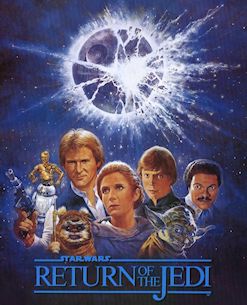
This week’s selection was a no-brainer, as a happy coincidence of events made the choice very easy. Today is the 30th birthday of all-round-good-bloke and son in law, Morgan, who shares a birthday with the final chapter of one of his favourite film franchises, Star Wars: Episode VI – Return Of The Jedi. It’s hard to believe, I know, that it’s been that long. I had intended to set aside a whole weekend to view the entire Star Wars: The Complete Saga Blu-ray set, with its 6 movie and 3 Extras discs. But that’s going to have to wait. In the meantime, and in honour of Morgan’s birthday, I’m going to enjoy revisiting this much loved film.

What Happens:
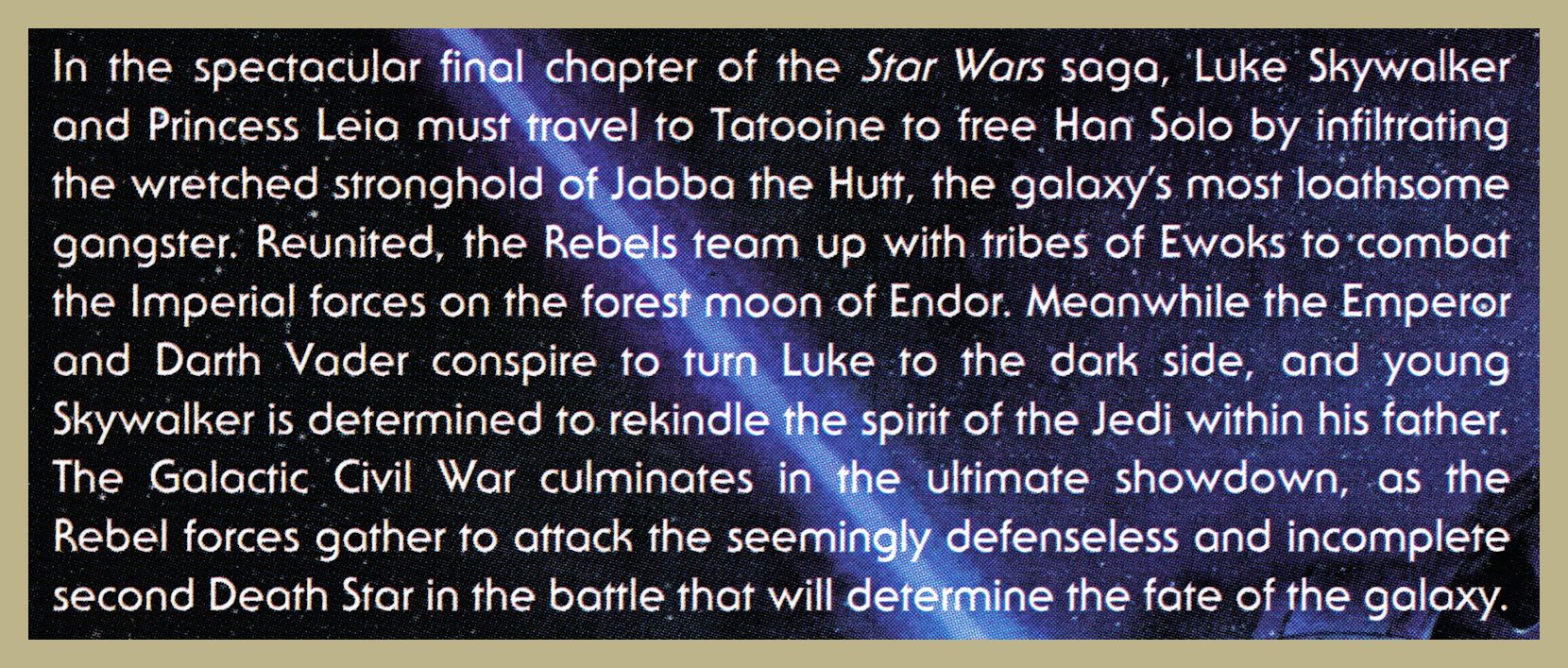
In the epic conclusion of the saga, the Empire prepares to crush the Rebellion with a more powerful Death Star.

Han Solo (Harrison Ford) emerges intact from the carbonite casing in which he’d been sealed, after rescue by R2-D2 (Kenny Baker), C-3PO (Anthony Daniels), Chewbacca (Peter Mayhew), Lando Calrissian (Billy Dee Williams), Princess Leia (Carrie Fisher), disguised as a bounty hunter, and Luke Skywalker (Mark Hamill). Then they must escape the clutches of the grotesque Jabba the Hutt.

On the forest moon Endor, the reunited team enlist the help of the Ewoks as the rebellion reaches its decisive stage.

Meanwhile, Luke Skywalker confronts Darth Vader (David Prowse & voiced by James Earl Jones) in a final climactic duel before the evil Emperor Palpatine (Ian McDiarmid). As he enters into this spirited battle with his light saber-wielding enemy, some surprising revelations await the young warrior…

Story
Story (Click to expand)

With the plot safely secured back in my memory, I sat down with a little unease; this was the first time I’d watched Jedi in isolation and also in glorious 1080p HD. How would the movie stand up without its usual crutches, Star Wars and The Empire Strikes Back to lend it support? I wanted it to be great, and you know what, I wasn’t disappointed.

In my memory, Jedi was the least impressive of the original trilogy. That may still be true but I get the feeling that by its release in 1983, we’d become very familiar with the Star Wars universe. I still remember the goose bumps I felt on that day in 1977, when I first saw the mighty Imperial Stardestroyer emerge from above and gradually fill the huge dark screen. The sequence was made perfect by the accompanying deep rumble of the sound track and John Williams’ opening of the Star Wars Symphony. When I first saw it, everything about Star Wars was new for me. I’d seen and been perplexed by 2001: A Space Odyssey (1968) but I’d never seen a space fable like Star Wars. The special effects were not a compromise of Flash Gordon model spacecraft darting drunkenly in front of an obviously painted matte space. They were believable and very real in a way I’d never seen before. I remember that very quickly, Star Wars had been integrated into my life to the extent that the sound-track vinyl album got frequent play even though it was completely out of place next to my Led Zeppelin, Deep Purple and Fleetwood Mac.

With the second installment, The Empire Strikes Back, in the hands of Irvin Kershner, the continuing story transcended the novel appeal of its predecessor and emerged as a cinematic triumph with a great story, great effects, and most importantly, none of Lucas’ dreadful dialogue. I recall seeing Jedi for the first time as a much anticipated closure to the story and with a very high bar set by the first two films, it didn’t disappoint.

The Picture:
In this high definition version of Jedi, the image is brilliantly saturated and crisply defined, with no discernible noise. I don’t remember Endor being quite as lush and beautiful as it appears here. As well, the battle between the Imperial and Rebel fleets fills the screen spectacularly and with a pitch-perfect DTS 5.1 audio track. The final confrontation between Vader and Luke also has all the drama and visual excitement I’d hoped for and remembered.

The Audio:
The Blu-ray DTS 5.1 sound track is stonkingly brilliant and that’s with no ifs, buts or maybes. The mix of sound effects and music score is pristine. The discretion of spacecraft rumble and other mechanical noises together with the subtlety and richness of the sounds of the Endorian natural environment, are a joy to hear. John Williams’ Star Wars theme has been waiting patiently for 30 years for the exposition of this Blu-ray set. And, never has Darth Vader’s respirator assisted voice sounded so menacing and the swoosh and hum of the lightsaber, so threatening.

Verdict:
My only criticism of this edition of Jedi, and it’s very minor; I wish someone had held Lucas back when he decided to tinker with the later releases of the film, including this one. Look out for the CGI soul singer with suitably silly alien backing group singing Jedi Rocks. I found myself mildly irritated that George thought the addition of this turgid song and its inconsequential CGI would somehow elevate the movie. Also, some of the other cosmetic CGI changes that Lucas has brought to the movie seem to stand out even more in HD, especially the not so successful additions of some obviously CGI building structures.

Coming back to the film in isolation, did also highlight how much merchandising Lucas was able to attach to these movies. I’d never been so conscious of how cute, kid friendly and stuffed toy-like the Ewoks were.

Overall though, this has been a wholly satisfying return to one of my favourite movie sagas and one I’m really looking forward to completing. I also have a sneaky feeling that once I’ve seen the rest of this Star Wars: The Complete Saga Blu-ray pack, the old DVD box-set (with the exception of the Special Features disc), might reluctantly have to migrate to Cash Converters.

Anyone looking to augment Morgan’s (if you know him, that is) Blu-ray collection can use these convenient links:
Star Wars: The Complete Saga Blu-ray (at eBay)
Star Wars: The Complete Saga Blu-ray (at JB HiFi)

iRate:: 4½ out of 5.

4Movie Tragics

Extras:
• Feature Commentary by Director George Lucas, actor Carrie Fisher, and crew, Ben Burtt and Dennis Muren (this is a surprisingly interesting and informative track, dominated, as you might expect, by George Lucas, which also appears on previous releases. If you’re new to this then I’d urge you to remember that Lucas is the creator and curator of the Star Wars mythology and so treat his recollections of fact with due caution.)
• Audio commentary from archival interviews with cast and crew.

You want More!
Star Wars: Return Of The Jedi – IMDb (Internet Movie Database)
Star Wars: Return Of The Jedi – Rotten Tomatoes
Star Wars: Return Of The Jedi – allmovie.com
Star Wars: Return Of The Jedi – Wikipedia


Where does “Return of the Jedi” fall on your list of favourite Star Wars flix? A lot of critics were unenthusiastic about this when it was released. Were they wrong? I love it, what about you?

:: Please leave a comment ::


The Sunday Screening Session….. Platoon (1986)

24 Sunday Mar 2013

Posted by Zak de Courcy in Film

≈ 2 Comments

Tags

1867-68, Action, Anti-War Film, Blood and Gore, Charlie Sheen, Cold War Film, Combat Film, Drama, Ensemble Film, Film, film review, Food For Thought, Forest Whitaker, Francesco Quinn, iRate:: 4½ / 5, John C. McGinley, Johnny Depp, Jungle Film, Keith David, Kevin Dillon, Modern Classic, Oliver Stone, Platoon, Richard Edson, Southeast Asia, Sunday Screening Session, Tom Berenger, Tough Guys, Vietnam, Vietnam War Era, War, War Drama, Willem Dafoe

Platoon (1986) (120 min)
iReview: Version: Platoon: 25th Anniversary (Blu-ray);
Video: AVC 1080p; Audio: DTS 5.1.
Genre:: Action | Drama | War |
Sub-Genre/Type:: Anti-War Film | Cold War Film | Combat Film |
Ensemble Film | Jungle Film | Modern Classic | War Drama |
Settings:: 1867-68 | Southeast Asia | Vietnam | Vietnam War Era.
Image

Mood?:: Blood and Gore |
Food For Thought | Tough Guys.
iRate:: 4½ / 5
Director:: Oliver Stone.
Writer:: Oliver Stone (screenplay).

Cast:: Tom Berenger, Willem Dafoe, Charlie Sheen, Forest Whitaker, Francesco Quinn, John C. McGinley, Richard Edson, Kevin Dillon, Reggie Johnson, Keith David, Johnny Depp, David Neidorf.

Click for Credits Enlargement
Credits (Click to expand)

Trailer (HD):

iReview:
I was scratching around my library trying to settle on a film for this week’s screening but found myself spoiled for choice. I asked a few friends for help and suggested they consider titles from science fiction, gangster or graphic novel adaptation. So after extensive consultation within the strict parameters provided, I’m Screening Platoon in this Sunday Session. Umm, yes I know, it’s a war movie. I hadn’t seen this film for more than 10 years and that was the less than stellar, 2000 DVD release, which I viewed on an old 80cm 4:3 TV. So I was looking forward to the opportunity to see the recent 25th Anniversary Blu-ray release, on a 140cm 1080p widescreen.

Throughout the soundtrack, Samuel Barber’s hauntingly beautiful Adagio for Strings, interjects to add a note of melancholy. It’s unfortunate, that after Platoon, overuse has turned such a wonderful feature of this film into a cliche. Nevertheless, I’d still recommend listening to the track while reading this as it sets a darkly appropriate tone.

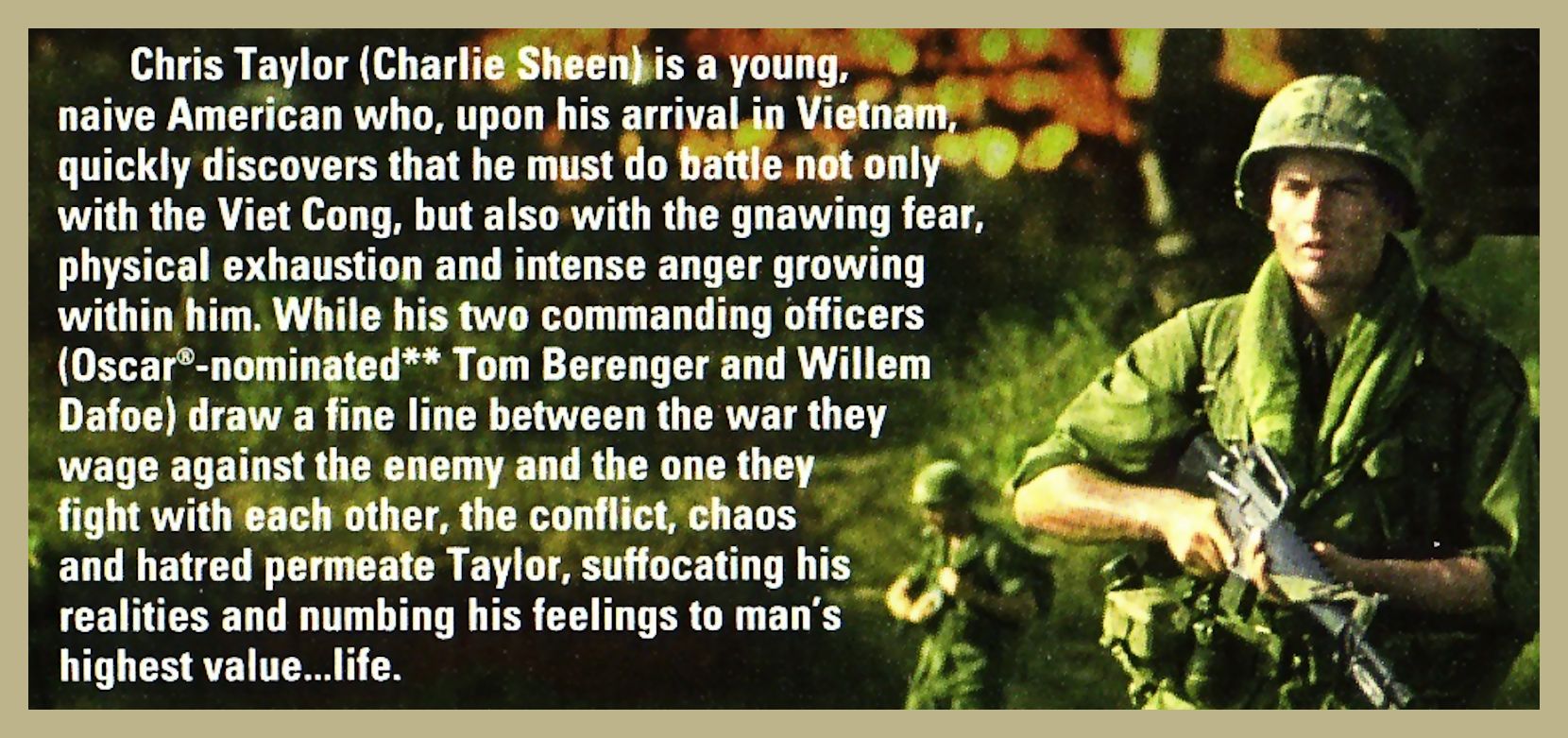
After a very brief introduction and without fanfare or warning, the audience descends into an impenetrable jungle. The camera at eye level draws us into a patrol alongside the newest member of Bravo Company, Chris Taylor (Charlie Sheen), who is confronted by the claustrophobic thick lush brush, with rough fronds brushing and irritating his fresh face. We experience the gut-wrenching physical exertion of the terrain as he hacks frustrated and incompetently with his machete, dry reaches and is harassed by ants, leaches, and mud. And we sense the contagious and overwhelming fatigue.

“Somebody once wrote: ‘Hell is the impossibility of reason.’ That’s what this place feels like: Hell.” So says the bewildered Taylor as he writes a letter to his grandma.

Most of us could identify with Taylor’s disillusionment. He’s a kid from a good family who dropped out of college because he felt the call to do his patriotic duty and “Live up to what Grandpa did in the first war, and Dad did in the second.”. And, as he put it, “…why should just the poor kids go off to war.” He soon realizes that in ‘Nam the drafted men are largely uneducated, “They’re poor. They’re unwanted… They’re the bottom of the barrel, and they know it.”.

Through Taylor, Oliver Stone stipulates that war has always been fought by the poor and “rich kids always get away with it.”. He’s right of course, You need look no further than the last president and vice-president of the USA, George W. Bush and Dick Cheney. It’s reported that Bush went AWOL (absent without leave) from the National Guard from 1972-’73, while Cheney applied for and received five Vietnam War draft deferments. When asked about his deferments, he reportedly said, “I had other priorities in the ’60s than military service”.

Story
Story (Click to expand)

Platoon is set in a remote area of Vietnam’s east, near the Cambodian border, during 1967-’68. The men of Bravo Company live in barely tolerable conditions, rarely sleep and frequently go out on nerve-jangling ‘ambush’ patrols where they lie in wait for an ethereal enemy, who only seems to emerge from the mist as an apparition. We, like the rest of the patrol, intently watch the dense, steaming wet brush, looking for any movement. Like them, we have no idea if they will appear but sense the danger. Alongside the patrol, we also learn that veteran leaders, Sgt. Elias Grodin (Willem Dafoe) and Sgt. Bob Barnes (Tom Berenger), can spot the seemingly invisible source of much of the danger and uncertainty, the tunnels below them that the VC (Viet Cong) disappear into. Their sense of siege is heightened by the suspicion that the enemy are also the civilians, young and old in local villages. This paranoia and contempt for the Vietnamese results in the most shocking and viscerally disturbing scenes in the film.

In Stone’s vision of the Vietnam War, there are no heroics, just a very real sense that at any time, one of us could be thrown into that hell and how might we react; perhaps just like one of them.

Some of Oliver Stone’s other films, like Salvador, JFK and Natural Born Killers, almost blow the horn before coming down the street, so transparent is their intent; not so Platoon. Here, the plot doesn’t meander and yet, it is brilliantly disorienting, creating a palpable unease. Nor does it telegraph its trajectory and because the whole story is told from the point of view of the camera lens as a member of the squad, there’s no predictability or safe foxhole for us to rest and little indication what we might expect through the next bush.

While the wisps of the enemy provide the danger and uncertainty that keeps us riveted from the first frame, the narrative arc is provided by the tension within the squad. Sgt. Barnes, a scarred battle veteran sees every Vietnamese as the enemy and fosters an attitude among his acolytes that manifests in depraved violence. At the other pole, Sgt. Elias, who acts as mentor to Taylor, blunts his cynicism by shotgunning smoke in the old-fashioned way with his ‘hippy’ friends. He also acts to mitigate the excesses of Barnes. These two characters could easily have been caricatured but in Stone’s writing they are utterly convincing.

The screenplay has been wonderfully crafted and has the polish that often characterises a song-writer’s first album that’s been percolating for years. And knowing that Stone had been working this script for 18 years, seems to confirm that. Watching the result seems like witnessing Stone’s own catharsis, reliving his own experience in Vietnam.

The performances of all the ensemble are authentic and enhanced by the realism constructed in the locations and uniforms that show the effects of constant wear, as well as copious mud and grime that attaches to bodies that are seldom washed.

Before filming began in the Philippines, the cast was sent on a two-week boot-camp. The actors were given military haircuts, required to stay in character, required to dig foxholes, ate only military rations, not allowed to shower, camped in the jungle, had rotations for night watch, and were subjected to forced marches and nighttime “ambushes” with special-effects explosions. Stone explained that he was trying to break them down, “to mess with their heads so we could get that dog-tired, don’t give a damn attitude, the anger, the irritation… the casual approach to death”. In a Bombsite interview, Willem Dafoe said,
“the training was very important to the making of the film… It wasn’t boot camp with lots of push-ups. It was serious, getting no sleep; doing activities at night where you were attacked by real people. Certainly you weren’t going to die, but you did know exhaustion and confusion… the training was important because it gave us a relationship to soldiering… By the time you got through the training and through the film, you had a relationship to the weapon. It wasn’t going to kill people, but you felt comfortable with it.”

This preparation obviously paid off in the delivery of the cast. If anyone were to ask me how an actor is directed, I’d point to one of the worst I can remember as a contrast: George Lucas’ Star Wars: The Phantom Menace. There, fine actors, like Ewan McGregor, appear to be delivering lines with the care of a first Script Read-Through. in a Daily Express interview, McGregor even said,
“Quite honestly, after my initial excitement, the film-making process turned out to be the epitome of tedium,” he said. “There was no spontaneity. Your job, as an actor, was just to get it out. I was frowning a lot. It just became a frowning exercise.”
Now come back to Platoon, and while it’s not the finest bit of actor performance direction, it’s still very good. The acting of this ensemble is delivered with assurity and an easy familiarity. The performances are also understated even though the actions portrayed might be shocking and seem almost implausible at times. This restraint adds to the believability and menace of the scenario with very ordinary people doing inexplicable things.

One of the Vietnam War movies that’s frequently held up in comparison with Platoon, is Apocalypse Now by Francis Ford Coppola which was released seven years earlier. Where Apocalypse Now is epic in its bombast and artifice, Platoon is intimate but a lot more confronting. Where Coppola orchestrated a well crafted Wagnerian opera, Stone has unselfconsciously delivered a frank and unmannered masterpiece.

Francois Truffaut is often quoted as saying, “There is no such thing as an anti-war film”, reasoning that in a good war film, explosions and great cinematography always excite, and there’s always some sense of adventure. Well, I think Platoon goes a long way towards refuting Truffaut; this is a great anti-war film.

iRate:: 4½ out of 5.

4Movie Tragics

Extras:
• Feature Commentary by Director Oliver Stone (This filmmaker enjoys talking and this informative track relates just how personal this film was to him).
• Feature Commentary by Military Advisor Dale Dye (In this interesting track Dye details his training regimen for the cast and how he and the director worked to achieve authenticity. He also relates his own wartime experience).
• Deleted & Extended Scenes (12 scenes) – 12 minutes.
• On the Flashback to Platoon Menu, you’ll find 3 featurettes:
• • Snapshot in Time:1967-1968 (this featurette includes movie clips and interviews with Stone, Dye and others and recalls the Cold War political climate at that time) – 19 minutes.
• • Creating the ‘Nam (this production featurette looks at the design, effects and locations) – 12 minutes.
• • Raw Wounds: The Legacy of ‘Platoon’ (this piece looks at the healing process after the war and how American veterans reacted to the film) – 17 minutes.
• One War, Many Stories (veterans react to a screening of the film and relate how their own experiences compared with that depicted) – 26 minutes.
• Preparing for ‘Nam (war veterans recall their enlistment and basic training) – 7 minutes.
• On the Vignettes Menu there are 3 short elements:
• • Caputo & the 7th Fleet (recollections of the 1975 evacuation of Saigon) – 2mins.
• • Dye Training Method (the technical advisor, Dale Dye discusses his process for turning actors into soldiers) – 3mins.
• • Gordon Gekko (recalls how the name was hatched during a Platoon brainstorming session) – 1min.
• The DVD copy (this is the disappointing dvd version released in 2000 and a questionable addition to this set)

You want More!
Platoon – IMDb (Internet Movie Database)
Platoon – Rotten Tomatoes
Platoon – allmovie.com
Platoon – Wikipedia


In my mind, this film ranks right up with All Quiet on the Western Front (1930) as one of the two or three best anti-war films yet produced. What do you think about the film?

:: Please leave a comment ::


The Leaderless, Leadership Spill:

22 Friday Mar 2013

Posted by Zak de Courcy in Australian Politics

≈ 1 Comment

Tags

ALP, Australian politics, federal government, Julia Gillard, Labor, leadership, Simon Crean, spill, Tony Abbott

Last Monday, the 11th of March, just after Labor’s WA State election disaster, I sent the following letter to all Labor members of the House of Representatives and also enclosed my It’s Time! or It’s Over! post. I’ve reproduced the letter here, to indicate my level of consternation at the current leadership crisis and the inept way in which the Labor Party are dealing with the issue.

Dear Member,

In two weeks, it will effectively be too late to salvage any possibility of winning an election in September or alternatively, saving the great Australian Labor Party from a wipeout.

In two weeks, parliament goes into recess and won’t return until the Budget in May. What the Caucus does now, will have a huge impact on the number of vulnerable members lost in the election in September (or whenever it is held).

I can only imagine the pressure you all must be experiencing at the moment, having survived the last two years with the constant noise from the media, Tony Abbott and a clamoring public, the relentless polls, and an 8 month election campaign to endure.

As a retired member of the ALP and supporter of more than 30 years, it distresses me to envision what lies in wait for the party at the election in September. And while I’ve never welcomed the arrival of a Liberal Coalition government, I’ve rarely been more apprehensive of the possibility.

The normal cycle of politics allows for centre-left and centre-right parties to periodically gain the ascendancy in Australia without the sky falling in.
This is a juncture in history when that’s not the case. With a climate system in crisis, this country can not afford a few years while an Abbott government does its best to unwind the Carbon Price, with a Climate change sceptic at the helm, fiddling while we burn. Nor can we afford the butchering of the NBN and the fiscal shock that will result from an Abbott razor-gang, slashing into the public sector in a show of mettle.

It may be that you have already concluded, from internal polling, that your government will not win the next election with or without the current Prime Minister. You may also have been convinced to stay the present course, no matter what. If, however, you have a glimmer of hope, then would you please take a few minutes to have a quick look at my enclosed blog post on this subject (posted 11-03-2013).

I’m not arrogant enough to think I have any special insight but I’m concerned enough to hope that there might be something, somewhere in what I’ve written, that might strike a chord.

Yours in Solidarity,
Zak Seager
St. James, WA

The Farcical Spill:

Simon Crean-sm Yesterday’s farce of a leadership challenge, did nothing to resolve the issue. The push by Regional Australia Minister, and stalwart Gillard supporter, Simon Crean to bring the issue to a head, would only have succeeded had the Prime Minister resigned. Clearly, his discussion with Julia Gillard, the night before he moved, was the proverbial tap on the shoulder from a loyal and respected colleague that tells a leader, the time is up. Julia is not a leader, it seems, who will go quietly into the night, with her dignity intact. She is a leader who appears ready to defend her castle until every bit of it, the Labor Party included, is destroyed.

By reputation, Mr. Crean is a veteran politician of demonstrable courage, loyalty and principle and a man who would not lightly go to his leader as he did on Wednesday. At the February 2012 leadership bloodbath, Simon Crean was one of Julia Gillard’s most vocal and loyal soldiers.

When he fronted the media on Thursday morning, there was no eagerness for the contest. Instead it was the grave and deeply troubled look on Simon Crean’s face that told of his desire to make the change with as little blood in the water for the encircling Opposition sharks to frenzy over. In making his statement prior to yesterday’s leadership spill, Crean explained that he felt he needed to take the action in the interest of his party and the nation. Without explicitly saying so, he hearkened back to an earlier age when the ALP stood for something, values an electorate could support.

In his statement, Mr. Crean said, “This is an issue that has to be resolved. There’s too much at stake. This is a very regretful decision for me. I think everyone knows the relationship between the Prime Minister and myself goes back some time. This is not personal, this is about the party, its future, and the future of the country. I actually believe we can win the next election. I believe that the agenda that is there but not understood well enough, as reflected in many of the comments that come back. We need to settle this and move forward.”.

He continued, “I’m doing this in the interest of the Labor Party and in turn, the nation. I believe that the great things that I was part of in the Hawke-Keating Government: great decisions; bold decisions; decisions that went through due process; difficult decisions; the decisions built around consensus; the decisions built round bringing people together; the decisions around growing the economy, as we have demonstrated in government, we can do; growing it for a purpose; for fairness; for distribution; for the values that I, like so many others, joined the Labor Party for. We can’t win from the position we’re in, in the polls. I don’t believe our future and our chances in the polls, is just going to be determined by a simple change of leader. People have got to believe, we have conviction, that we believe in what we stand for, there’s a coherence of message and we are determined to pursue it. What we have to do is to take people with us. That means being prepared to argue the case. And I know this, I know the people do not want an Abbott led government. I get so many people in frustration to me saying, ‘we are not going to allow that man to lead this country, are we?’.”

  • See the full text of Simon Crean’s statement here.

That Julia Gillard and Wayne Swan were the only candidates at yesterday’s meeting did not indicate the level of support for their leadership. The returning officer made it clear that there was no vote. What the result did indicate, is that, the Prime Minister knew the numbers were not yet there for a bloody and extremely damaging contest.

After the vote, the Prime Minister said, “I accept [the party’s] continuing support of me as Prime Minister and Labor leader with a deep sense of humility,”. This statememt is a prime example of the disconnect between reality and spin in this current crisis. If Ms Gillard had resigned with a deep sense of humility, that might have been believable.

That almost all the government members tasked with ensuring party unity, chief whip Joel Fitzgibbon, and whips Ed Husic and Janelle Saffin, have now publically withdrawn their support of the Prime Minister and resigned, is an indication that this leadership stoush is far from over.

The only winner so far, on the Government side, is Kevin Rudd, who took a big stride towards his rehabilitation by refusing to challenge. He clearly recognizes that a challenge now would amount to a capitulation at the election, a step he’s not prepared to take. In his statement yesterday, he said that he would honour his pledge not to challenge and that he wouldn’t return to the leadership unless the Prime Minister resigned or he was ‘drafted’ by an overwhelming majority of his colleagues. He enhanced his position, rightly or wrongly, as someone who is prepared to put the interests of the Labor Party and the country before his own. He also astutely contrasted this with Julia Gillard’s apparent willingness to cling to power at any cost.

With barely contained glee beneath feigned gravity, Opposition leader, Tony Abbott, asked “How long must this circus last?”

Well that was the question that Simon Crean bravely tried to answer yesterday before he was sacked. And it’s a question that will hang over the Government until Julia Gillard recognizes that she and Wayne Swan are toxic to Labor’s election prospects. Every day she delays the inevitable, drives the number of vulnerable government members that will be lost at the election, just that much higher.

The Prime Minister has been regularly commended as a tough and astute politician. She needs to add good judgment to the list and see she has no future as Prime Minister and resign for the good of the Labor Party and Australia.


Is this the end of the leadership instability or is there yet another chapter to this saga?

:: Please leave a comment ::


Simon Crean’s Statement:

22 Friday Mar 2013

Posted by Zak de Courcy in Australian Politics

≈ 1 Comment

Tags

ALP, Australian politics, federal government, Julia Gillard, Labor, leadership, Simon Crean, spill, Tony Abbott

Here is the full text of Simon Crean’s statement given before the Labor leadership spill on 21 March 2013.

Simon Crean-sm Something needs to be done to break this deadlock, to resolve the issue once and for all and to enable us to get on with the job we’re actually elected to do and that is to campaign on behalf of Australian people, through labor values. I have talked to the Prime Minister, yesterday and today, and as a result of that conversation, I informed her that I would think about my position and get back to her before I made this announcement; That I am asking her to call a spill of all leadership positions in the Party.

I will not be standing for the leader. I will be putting myself forward in the leadership team for the deputy leader. If the Prime Minister does not agree to it, which I expect she wont, then I urge members of Caucus to petition in the appropriate way, for the calling of such a meeting. This is an issue that has to be resolved. There’s too much at stake.

This is a very regretful decision for me. I think everyone knows the relationship between the Prime Minister and myself goes back some time. This is not personal, this is about the party, its future, and the future of the country. I actually believe we can win the next election. I believe that the agenda that is there but not understood well enough, as reflected in many of the comments that come back. We need to settle this and move forward.

As for the position of the positions being declared open, Kevin Rudd, in my view, has no alternative but to stand for the leadership. He can’t continue to play the game that says he’s reluctant or he has to be drafted. I know that the party will not draft him. I know the party is looking for change and clear air and they don’t see that simply by changing the leader. That’s why I’m putting myself forward as part of the leadership group to demonstrate that we are serious about not just changing leaders, but of actually showing leadership. That’s what we’re elected to do, that’s what I want to be part of. I think in all my life, my public life, I’ve demonstrated that is the driving force. For me, the position itself, again, is not a personal one that I’m taking. I’m doing this in the interest of the Labor Party and in turn, the nation.

I believe that the great things that I was part of in the Hawke-Keating Government: great decisions; bold decisions; decisions that went through due process; difficult decisions; the decisions built around consensus; the decisions built round bringing people together; the decisions around growing the economy, as we have demonstrated in government, we can do; growing it for a purpose; for fairness; for distribution; for the values that I, like so many others, joined the Labor Party for.

We can’t win from the position we’re in, in the polls. I don’t believe our future and our chances in the polls, is just going to be determined by a simple change of leader. People have got to believe, we have conviction, that we believe in what we stand for, there’s a coherence of message and we are determined to pursue it. What we have to do is to take people with us. That means being prepared to argue the case. And I know this, I know the people do not want an Abbott led government. I get so many people in frustration to me saying, ‘we are not going to allow that man to lead this country, are we?’. Now, I agree with that from an obvious point of view, but the truth is there is a mood out there that does not want him but is fed up with us at the moment. We’ve got to change it.

I hope this circuit breaker does it and I look forward to the Caucus taking a mature decision in the interest of their future and this country’s future.


Was Simon Crean’s action: courageous, foolhardy, naive, or fiendishly calculated?

:: Please leave a comment ::


Crap Coverage App:

20 Wednesday Mar 2013

Posted by Zak de Courcy in Gotta Life

≈ 2 Comments

Tags

Android, cellphones, coverage, iPhone, life, mobile phones

Crap cellphone coverage!!! There’s an App for that. For all those Vodafone users who complain noisily about suffering frequently from crap coverage and drop-outs… here’s the app for you.

PhoneApp
ACCAN’s Phone Rights app on Android.

Read Ben Gribb’s, great piece in today’s Age:
• New apps track phone coverage woes (Ben Grubb, Age 20 march 2013)
(Ben Gribb is Deputy technology editor at The Age)


If you want to vent about Vodafone, go for it.

:: Please leave a comment ::


Time to Go, Julia!

20 Wednesday Mar 2013

Posted by Zak de Courcy in Australian Politics

≈ 1 Comment

Tags

ALP, Australian politics, challenge, federal government, Julia Gillard, Kevin Rudd, Labor, Tony Abbott

With the level of backgrounding seemingly exploding in Canberra at the moment, you’d think that the move must be on to replace Julia Gillard. The trouble is, the Prime Minister must also surely know, that a leadership challenge now would be absolutely fatal for Labor’s electoral chances and to force her colleagues into that position would be unforgivable.

The unbridled venom unleashed against Kevin Rudd during the February 2012 leadership contest, was so viscous that it ensured another challenge would be impossible. I don’t think the electorate has forgotten that it seemed Prime Minister Gillard and her key supporters, with the exception of Stephen Smith, had lost the plot and decided that a scorched earth was preferable to Rudd’s return. Their reckless action also provided Opposition leader, Tony Abbott with a plethora of footage and quotes to help destroy Labor at the next election.

Incalculable damage has already been inflicted on the Government’s chances of surviving this current crisis. If Prime Minister Gillard continues with her visibly desperate attempts to cling to power, there’ll only be a carcass of a government remaining and Labor’s chances of saving a rump of the party let alone winning the election, will be dead.

If there is to be any hope for her party members, she should do the honourable thing, resign now and quietly present a new leader, someone who has a glimmer of a chance to lead. And, by glimmer, I don’t mean Simon Crean! There’s chat about that he might be tapped for the job. But while he seems decent enough, he was dumped as party leader 10 years ago for a reason.

There must be someone in the government who can believably string words together, look us sincerely in the eye and tell the electorate why an Abbott government would be such a devastating outcome for Australia.

Also check out:
• Trouble brewing, but don’t blame it on the usual bloke by Peter Hartcher.
(Age, 19 March 2013)


Will/should Julia see the tide and resign or will she continue to tune out the clamour with her “tin ear”?

:: Please leave a comment ::


← Older posts
Newer posts →

Subscribe

  • Entries (RSS)
  • Comments (RSS)

Archives

  • March 2022
  • May 2019
  • January 2019
  • January 2017
  • June 2016
  • March 2016
  • September 2015
  • January 2015
  • October 2014
  • August 2013
  • June 2013
  • May 2013
  • April 2013
  • March 2013

Categories

  • Australian Politics
    • Aus Pol. Posts Index
  • Film
    • Film Posts Index (All)
    • Reviews Index (Alpha)
  • Gotta Life
    • Gotta Life Posts Index
  • International Politics
    • Int Pol. Posts Index
  • Religion
    • Religion Posts Index
  • Science
    • Science Posts Index
  • Uncategorized
  • WA Politics
    • WA Pol. Posts Index

Meta

  • Create account
  • Log in

Blog at WordPress.com.

Privacy & Cookies: This site uses cookies. By continuing to use this website, you agree to their use.
To find out more, including how to control cookies, see here: Cookie Policy
  • Subscribe Subscribed
    • Zak From Downunder
    • Already have a WordPress.com account? Log in now.
    • Zak From Downunder
    • Subscribe Subscribed
    • Sign up
    • Log in
    • Report this content
    • View site in Reader
    • Manage subscriptions
    • Collapse this bar
 

Loading Comments...