I know it’s too early to call, and I didn’t want to say anything during the campaign that might jinx it, but I think the ALP ran a shocker of an ad campaign. They didn’t focus on vision or a fair go for all Australians, they concentrated on instability in the Libs which Morrison countered very well by changing the party rules and campaigning as a one man show. Why the hell didn’t Labor play to its strength? They had a very talented team that side by side was streets ahead of their Liberal counterparts. I think the current Labor team is the most impressive since the ‘nations best ever team’ that Hawke had around him. Why didn’t we see those ads, instead of the ineffectual voiceover behind the Morrison/Palmer ads.
I cannot see how the ALP message could have cut through. It was full of mixed and incoherent themes. Labor were very bold in laying out an ambitious agenda which was great and unprecedented. There was a lot of vision for a kinder, fairer, smarter, cleaner, healthier, and more prosperous country that worked for the many not just the few. However, they didn’t educate the electorate enough to counter the Libs baseless scare campaign.
There is no way that anyone could have grasped any story that Labor was trying to tell. Where were the very effective Workchoices style campaign ads from 2007 that humanised the Labor agenda. It just wasn’t there. All we saw were lots of micro campaigns on marginal issues that diluted the message.
Two days after Bob Hawke died, I think he would be asking, where was the gravitas? Where was the straight talk? Where was the coherent message? Rather than help Labor win, I think his death only set the contrast between his campaigns and the pathetic campaign that this Labor campaign organization ran.
I’m bloody angry because this was the most important election in our lifetime and you wouldn’t have bloody known it. The Labor party didn’t hammer that home. This was the election that Labor should never have even come close to losing and if they do, and I think they have, they’ve got some very serious soul searching to do and some serious arsekicking to do.
This was the worst Labor campaign I’ve seen in 25 years.
When I was 17, I was a very undercooked but also very ambitious member of the Australian Liberal Party (I know, I’m shocked too). At that time, 1975, one of the people that inspired me to get involved in politics was an aspiring Liberal senate candidate, Andrew Thomas from Northampton, just north of Geraldton in Western Australia, who entrusted me to organise campaign events for him in places like Carnamah and Mingenew.
We became firm friends and after he was elected in 1975, I started studies at the University of Western Australia and he allowed me to crash nearby at the Crawley apartment, he kept for stopovers on his way home to Geraldton. Quite often he would arrive home on Thursday night, shattered after a long and turbulent week in Canberra. I vividly remember one such Thursday night when, over a couple of stubbies, conversation turned to the Fraser Government’s plans to gradually destroy Medibank (the precursor to Medicare Australia), introduced by the Whitlam Government in 1975. The reason I so well remember the conversation was that as a young Lib, I reflexively joined in the denunciation of Socialist Medicine as we called Medibank. So I was stunned when Andrew said that, although as a Liberal MP, he was required to join the chorus of derision, he was privately full of admiration for Gough Whitlam and his Medibank scheme.
I’m telling this story because this is a pivotal moment in our history. Not only does the fate of Climate change action rest on the outcome of Saturday’s election but so too the fate of our beloved ABC which will be dead within 10 years if the Morrison/Palmer Government is elected.
On top of that, there is a chance to wind back some gross inequities in society that result from past attempts by Liberal governments to shore up their vote by splashing money at their wealthy patrons via measures such as extending franking credit rebates (or gifts) to investors who had not paid any income tax. This is the most contentious of Labor’s economic reform agenda and while the number of people affected by this change is small, the impact on budget savings will be huge, as will Labor’s changes to Negative Gearing.
Liberals are reflexively required to oppose these economic reforms as well as real action on Climate Change. They are also tied to the Murdoch media agenda to destroy the ABC, something he has been pushing for years. Murdoch succeeded in his long campaign to nobble the NBN to protect his Foxtel from streaming services such as Netflix that would benefit from a superfast full fibre NBN. Now he also wants to nobble the ABC because it takes eyeballs away from his paywall protected news outlets and Sky News.
I firmly believe that there are many Liberal MPs who will be privately relieved if a Shorten Labor government is elected. I believe that many of them would be glad to be rid of the albatross of Abbott’s legacy of Climate Change denial; energy policy civil wars; denigration of people on income support; attacks on wage earners via cruel cuts to penalty rates; barely concealed racism; and unsustainable welfare subsidies for the relatively wealthy, like Negative Gearing and Franking Credits.
If I hadn’t heard a Liberal senator say something akin to that to me 40 years ago, I wouldn’t have believed it possible. My friend the Liberal senator, provided me with the proof that politicians quite often say one thing while firmly believing the opposite. Knowing that, I also know there must be decent people who also happen to be Liberal party MPs. I also believe that many of them must be embarrassed that they have been forced into defending an indefensible corner filled with cruelty, corruption and cognitive dissonance.
Help relieve the tortured souls of fair minded Liberal MPs who have a social conscience and are not Peter Dutton, Tony Abbott, Scott Morrison and their like, and…
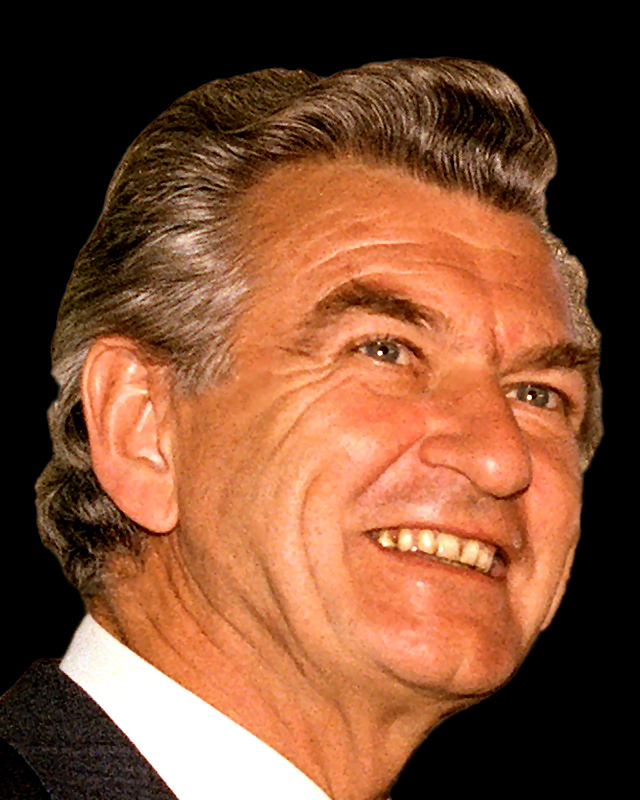
Former Australian Prime Minister Robert James Lee Hawke
Yesterday, Australia lost one of its giants. Throughout our short history we have counted a handful of truly towering figures, people whose existence has sharply shaped the destiny of our nation. And towering above them all was Bob Hawke, our country’s 23rd prime minister. He served in that office from 1983 to 1991, an eight year span that enchanted, at times transfixed, and ultimately transformed this country.
It’s hard in 2019 to convey how omnipresent Bob Hawke was in the life of Australia from the late 1960s right through to the 1990s. No one before or since has had such a profound impact on this country (with the only possible exceptions: Gough Whitlam and war-time prime minister John Curtin). In 1970 he was the most popular and respected person in the country and by 1984 he had also become the most popular prime minister in history with sustained approval at an astonishing 75%. No one has come close since.
In the coming days and weeks, many words will be written and even more will be spoken, lauding this wonderful and great man. I don’t have any great insight into his life and work so I won’t add mine to the many eulogies to come, but I would like to relate my brief impression of him.
In 1975 I met (soon to be prime minister) Malcolm Fraser just before he delivered the first Menzies oration at the University of Western Australia and was impressed by how he turned an innate nervousness backstage into a confident and polished performance on stage. Great (and tall) as he appeared, he was all too human and didn’t fill me with awe the way meeting Bob Hawke did.
In 1981 I met ex-prime minister Gough Whitlam and formed an unlikely friendship with him that lasted several years. While my first meeting with Gough was exhilarating, it still didn’t fill me with awe the way meeting Bob Hawke did.
In 1983 when I met Bob Hawke for the first time, I felt my whole body tingle in a way I hadn’t experienced before or since. I know there were a lot of people around me on that day who also had that strange otherworldly feeling. Bob Hawke had that weird effect on people wherever he appeared.
There were some questionable actions that he took both publicly and privately but when it comes right down to it, who could compare with the way he made us all feel. We could sorely use some of that authenticity and electric raw charisma right now.
There’s a very good case to suggest he was our greatest prime minister. I wouldn’t argue with that.
It will be a very long time before we see his like again.
What a life.
Although Bob was out of office for more than 25 years, he was adored by new generations of young people. Who can forget the chant ‘Hawkie, Hawkie’ at the cricket, when he would skol a beer.
Do you have any recollections or impressions of Bob that you’d like to share?
I’ve seen many crap suggestions for a new post-rule-Britannia Aussie flag design, mostly featuring Kangaroos and/or the Southern Cross. The kangaroo is a beaut looking animal but unlike the Canadian Maple Leaf, which has a simple and beautiful symmetry, the roo is all gangly arms, legs and tail which makes it an awkward fit in a national flag.
So… I’ve had a go at my own crap designs. I think the symbolism is pretty easy to see, including the boomerangs in the above suggestion which symbolise inclusion.
Another simple idea for an Aussie flag
Oh, and before you say it… no there’s no Southern Cross and no Federation Star (that 7 pointy thingy for the 6 states and a 7th for territories and future states) Really!! Do we need to advertise that. Also, I think we all know that in the southern hemisphere, you can see the Southern Cross… Woopdeedoo. And anyone who thinks that blue, green and gold belong together, try wearing it without attracting giggles.
Although the red might be a bit too nuanced for the flag snobs (heraldic tradition and all that), there are plenty of flags out there that also flout heraldic tradition in order to look beautiful.
So, What do you think?
Note: To be honest, I would have preferred the existing red, yellow and black Indigenous Flag that often flies from government flagpoles around the country but unfortunately, that flag is copyright and its designer has specifically rejected its adoption as our national flag.
I’d just like to chuck this out there and see what happens…
I know that there is significant and understandable disquiet with the current Australia Day, January 26, a celebration day that might feel like it’s been around forever but hasn’t and a day that causes anguish for many indigenous Australians. The current Australia Day only became generally accepted throughout Australia in 1935 and only came into real prominence when the public holiday shifted from a long weekend to the actual date in 1994.
Of course indigenous Australians are reminded every year that their country (or rather, the colony of New South Wales) was annexed by Governor Arthur Phillip for Britain on that colonisation date. So for many, it is a day of sad reflection on their history after that date rather than a day to celebrate. Imagine a Tanzanian being asked to celebrate, as their national day, the date that they became a British possession rather than, Uhuru Day (freedom day) – 9 December, the day in 1961 that the country gained its independence.
The overwhelmingly obvious celebration day for Australia is the date we joined to become a united Australian federation on January 1, 1901. However, having a dual celebration of a New Year combined with a national day would dilute both (and even worse, deprive us of a cherished public holiday).
An alternative, May 27, would celebrate the day in 1967 that Australians voted to amend the Constitution to recognize the indigenous population (previously they had been excluded from the population census and were not full citizens) and the right of the Commonwealth to make law relating to indigenous Australians (previously that had been a state prerogative). While there might be a compelling case for selecting this day, I believe a strong argument could also be proffered to instead choose the date 3 June 1992 when Mr. E. Mabo won his momentous High Court ruling that overturned ‘Terra nullius‘ (which had previously assumed Australia to be uninhabited prior to British colonisation). Both these days celebrate an unfinished process of inclusion and reconciliation that may never be completely realised but will certainly not be satisfied until an indigenous treaty and/or full constitutional recognition is achieved.
In the meantime I’d like to suggest January 25 and 26 as ‘Australia Days’, with the public holiday shifted to the 25th. These two days symbolise the critical demarcation between ancient and modern Australia while providing an opportunity to showcase indigenous cultural heritage and celebrate the immigrant nation that is Australia. And, as a trivial aside, the days are a lot warmer than a wintery day in May or June and… hell, how many countries devote a whole two days to celebrate their nationhood?
I’d also like to suggest that May 27 be declared Australian Citizenship Day, the day when Australia voted to confer citizenship rights for all Australians, including the first nations. The current Citizenship Day is 17 September, a day which recognises an obscure event in 1973 when the Nationality and Citizenship Act 1948 was renamed the Australian Citizenship Act 1948.
Queensland Election drubbing update…
The ALP were routed in Queensland’s 2012 election with only a rump of 7 members returned. Tonight’s stunning turnaround will see them take at least 36 seats from Campbell Newman’sLNP government and consign him to history.
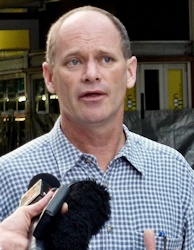
Campbell Newman
During the ABC coverage of the election result…
Question to Jane Prentice, federal Liberal member for Ryan (in Queensland):
“Is Tony Abbott the man to lead the Liberals to the next federal election?”
Her answer: “Well that’s the discussion, isn’t it. We need to look at where we’re going…” She went on to suggest that Prime Minister Tony Abbott’s speech to the National Press Club, next week, will be his last chance.
When a member of Abbott’s team openly talks about a leadership change in such an extraordinarily frank and open way, that generally means that party discipline has completely broken down.
Federal Liberal members will be in a flagellating screaming panic tonight. And tomorrow the phones will be smoking hot as they scramble to put as much distance as they can between themselves and Abbott and Deputy Heartless Joe Hockey.
I’m so looking forward to the bloodbath… Abbott and Hockey will be gone in 3 weeks.
A certain foreign minister recently dined with the svengali of Australian politics, Rupert Murdoch. Why is that significant? Because, Murdoch doesn’t do these things just to be ‘sociable‘. I think he did it because he’s formed a view that unless Tony Abbott goes, the Libs will get hammered at the next election. He’s a man who cherishes his role as our puppeteer in chief and was needed to give Julie Bishop the green light to go for it. No worries, the decks are clear; the memo’s gone out to the editors of the Telegraph, Courier-Mail, Herald Sun and Sunday Times…..
Foreign Minister Bishop
And the bad news is that Julie Bishop will soon be Rupert’s new plaything and Australia’s prime minister (with Malcolm Turnbull as Treasurer). And the news gets even worse because, unlike Julia Gillard who had the Murdoch press baying for her blood for 3 years, Julie Bishop will get a magic carpet ride from the same propaganda song sheet.
It’ll be interesting to look back on this post in a couple of months to see that I was right.
To those who think Minister for Inhuman Services, Scott Morrison will get the top job, I sincerely hope you’re wrong.
I think even the hard right in the Liberal Party (who are currently in control) will see Morrison as too much of a ‘lightning rod’ for PM but as a ‘can-do’ hardnut treasurer, they’ll love it (that’s if the pragmatists who are currently holding their noses and supporting Turnbull, can’t dissuade them). If they do go for Morrison, it’ll be time to start looking out for fluttering squarish flags with a black motif on a red background.
What do you think? Who do you think will replace Abbott?
Oh this is a sad day. There’ll be buckets of political tributes to the great man but for me it was personal so that’s what I’ll remember here.
Gough Whitlam was the giant of Australian life who I admired the most. More than that, for a short period of 4 years (1981-85), he allowed me to be his friend. He must have known I was in awe of him (which, don’t worry his large ego didn’t mind) but he had a knack of making me feel his equal even though he was 40 years older than I and so far ahead of my fledgling 24 year-old knowledge. Even though our conversations were very eclectic, ranging across politics, history, art, music, the cosmos and our lives, he allowed me to feel that I wasn’t out of my depth except when he’d occasionally pepper his sentences with classical Greek and Latin which would remind me just how broad the gulf really was. I remember laughing often and loudly because he was also very witty with a wonderfully wry sense of humour. He also didn’t suffer from false modesty and some of his humour recognized his ‘own greatness’. He was fond of the notion that God wouldn’t welcome him warmly to heaven because he wouldn’t like the competition. It seemed he also liked to stir Catholics a little (he was a protestant) and he recounted with mischievous joy a time he’d asked a clergyman, a bishop I think, if he could rent a cathedral crypt space when he died. He got a quizzical look, to which he added, “I’ll only need it for three days”. It seemed it was one of his favourite self-referential jokes and a good one. Curiously, I was reminded of this by Tony Burke’s recollection of a similar story.
Our meeting was typical of him. He was the ultimate elitist – not because he aspired to be or as a conceit but because he really was elite – but he was also completely down to earth. Why else would he have spent several hours after a Labor Party champagne breakfast fundraiser, sitting on the bank of a lake drinking champagne with a young person like me. I remember when his minder, state Labor deputy leader, Mal Bryce, quietly approached the great man and reminded Gough that he had a plane to catch. I think Gough quietly enjoyed playing with people and the look on Mal’s face was priceless when he replied, “You can get me another flight, can’t you Mal?”. I remember leaving that first meeting completely enthralled; we’d talked about anything and everything and that was the first time I could remember having had such a wide-ranging conversation with anyone.
The next time we met was early the following year when he was the guest of the State Labor Executive at Trades Hall in Perth. After he’d done the necessary circulating, he sought me out and we picked up, it seemed, exactly where we’d left off. We sat at the only table against the far wall and chatted and it seemed we were in a bubble of our own. Why he’d chosen me, of all the exalted people in that hall, to spend his precious time with I didn’t know but the way he had of making me feel like I was the most important person in the room, was a wonderful character trait. Despite his immense intellect and achievement he went to great length to make me feel at ease with him and he left me feeling greatly elevated by the experience. Before he left, he signed a copy of his book, The Truth of the Matter for me and gave me his card with his private number scrawled on the back and said, “Call me”. He said it in such a way that I knew he meant it. Over the next year (until he moved to Paris) I did occasionally call him even though I did feel daunted by the prospect. At the time I was a “young turk” on the rise in the union movement and so I always opened with a request for advice which always went over well but he very quickly moved on to other subjects; he also always kindly remembered to enquire (by name) about my wife, (at the time) Judy and and son, Toby (and later, also my daughter, Alison). That was another of his talents, his amazing memory for minutiae: he not only remembered my wife and children’s names but also their birthdays and the details of their lives. The warmth of his conversation was so disarming and engaging and I always came away feeling invigorated and uplifted. In retrospect, I know that there were many people like me, who were singled out and made to feel like they were a friend. This was part of the genius of Gough Whitlam and one of the many reasons he’ll be so mourned today.
Judy often remarked that my head was full of useless knowledge and that I should go on the quiz show Sale of the Century. I only mention this because I think the only time I felt like that large store of useless trivia was of any real use was when talking with Gough. However, whatever topical fact I was able to conjure into the conversation, he was always able to trump and expand upon it. I never minded this because it always broadened my own knowledge and understanding and because he did it with such unabashed joy, seemingly because it allowed him to expound freely on the subjects of our focus.
I think I was very conscious of the privilege that Gough had bestowed on me so I didn’t discuss my conversations with him with anyone; they were my much cherished secret. When he was appointed to UNESCO, our contact became restricted to the few times he returned to Sydney but he still welcomed my call.
As my life spiraled out of control for a time after my family departed and my brother died (1985-87), we sadly lost touch. I so regret that because who knows how much more wisdom I might have acquired from the crumbs of Gough’s enormous insight.
On this day, I’m very conscious of the loss of the greatest man I’ve ever known or will ever know and someone I am so proud and humbled to have briefly called a friend. Such a sad, sad, sad day. Goodbye Gough.
Gough Whitlam governed through a tumultuous period of Australian history.
Do you have any recollections of Gough that you’d like to share?
iReview:
Last Thursday, 25 April, was Anzac Day, the day Australians and New Zealanders acknowledge the sacrifice of all those who have served in war and peacekeeping. It also commemorates the men and women who have died in that service.
Anzac Day coincides with the landing of ANZAC (Australian and New Zealand Army Corps), French, British and other British Empire troops at Gallipoli in south west Turkey in 1915. The objective was to secure the Dardanelles to provide a sea route to reach the Russian allies and ultimately to take Constantinople (Istanbul) and knock Germany’s ally, Turkey, out of the war.
The eight month campaign that followed cost the lives of 53,000 allied (including almost 12,000 Anzacs) and 56,000 Turks with total casualties reaching almost half a million. Many thousands more, suffered from dysentary, a result of the appalling sanitary conditions encountered by the troops.
Despite the campaign’s ultimate failure, media reports reaching Australia extolled the heroism of the Anzac troops and stirred national pride in the young country which had federated as Australia only 14 years earlier. Albany, the south coast port city in my home state of Western Australia, was the embarkation point for the thousands of troops who left Australia for Gallipoli. Albany also has a special significance for my family as it was my children’s maternal grandmother who, 15 years ago, uncovered the evidence that confirmed Albany as the location for the nation’s first iconic Anzac Day “Dawn Service”.
The way Australians relate to Anzac Day has evolved over the years and has not always been as robustly and reverentially marked as it is today. I remember Anzac Day in the 1970s, as a holiday celebrated largely as a day off from work and school, with a sideshow parade of old soldiers who got together once a year to swap tales of war, gamble a little and imbibe a little too much. The Gallipoli Campaign that sporned the day of remembrance as well as the world wars that were commemorated, were remote, little known and of scant significance to many. At that time, many Australians were also disaffected with all things military as a result of the country’s involvement in the disastrous Vietnam War.
To acknowledge the significance of the day, I thought I’d revisit this best loved of Australia’s War cinema: Gallipoli.
What Happens:
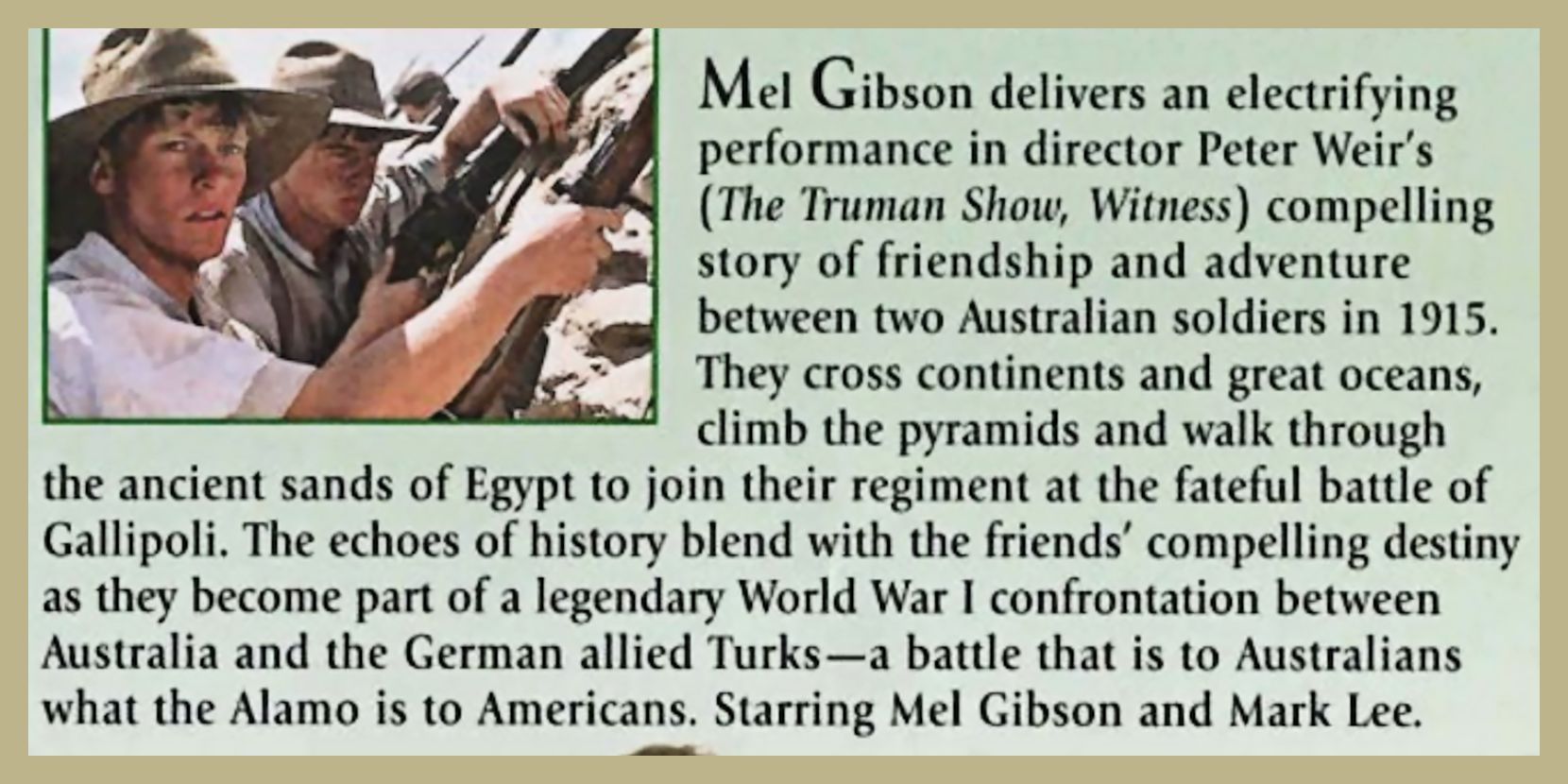
Eighteen year-old Western Australian champion sprinter Archy Hamilton (Mark Lee) could be an Olympic contender, but he disappoints his trainer Jack (Bill Kerr) when he instead enlists in the elite Australian Light Horse cavalry. He’s accompanied by talented sprinter Frank Dunne (Mel Gibson), who also attempts to join but can’t ride a horse and is relegated to the infantry with his other friends.
Training in Cairo, the Anzac cavalrymen are converted to infantry so Archy persuades his Major, Barton (Bill Hunter) to allow Frank to transfer to the regiment.
At Gallipoli in 1915, the Anzacs find that they’re being used as cannon fodder as a ‘diversion’ for British landings elsewhere, and the entire unit realizes that they must obey suicidal orders and charge Turkish machine guns, a lunatic event among a litany of incompetent military planning.
Story (Click to expand)
Since I last saw this movie many years ago, I’d forgotten that it starts out as a boy’s own adventure featuring a very young, very Australian and not so weird Mel Gibson. With the benefit of hindsight, it’s interesting to reflect on this nascent star and his subsequent and controversial career. It’s also interesting to reflect on the very different career trajectories of the two stars. Gibson, we know went on a stellar rise to the A-list in Hollywood while Mark Lee (Archy Hamilton) moved into relative obscurity.
The outback scenes that open the film are spectacularly shot with the heat, dust and desolation radiating off the screen. The stark monochromatic beauty of Australia’s hot, dry interior is a place best admired from the air-conditioned comfort of a 4 wheel drive. That many Australians willingly endured life in these and other hostile environs was the steel that forged the myth of the tough Anzac warrior. Williamson’s script is cloaked in this mythology and he uses it well to set up the main protagonists in this yarn.
Archy is a naive young man and a very talented runner who yearns for the adventure of Gallipoli that he has read and heard about. His sprinting rival, Frank (Mel Gibson) is a cynical descendant of Irish nationalists, and as such, has no desire to fight Britain’s war. At the time, Irish nationalists and unionists were in a bitter struggle over the future independence of Ireland from Britain. The speed with which Frank and Archy are transformed from rivals to such good friends that Frank is prepared to enlist with him, almost stretches my credulity and that’s despite the device of the desert trek bonding ordeal they endure that cements their close mateship. If Weir had taken more time to develop these characters, perhaps this wouldn’t have seemed such a stretch.
Generally, the performances of the cast, particularly, Mel Gibson are strong. Newcomer, Mark Lee also convinced, despite apparently having a particularly nervous time on set.
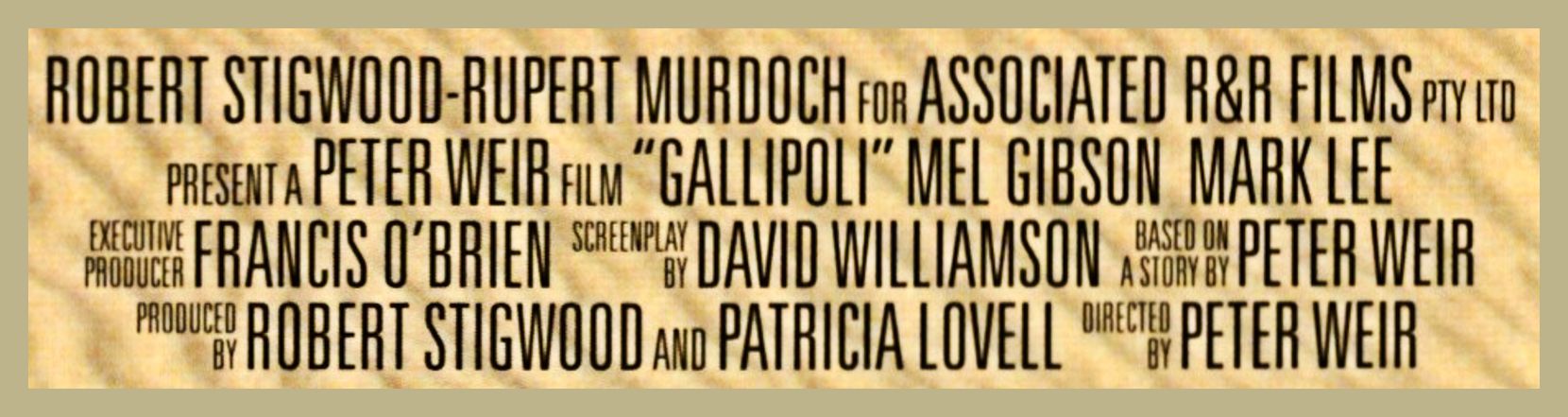
David Williamson’s script also moves the story well and although calculated to draw strong emotion, it doesn’t overindulge in overt tearjerking.
Although half the movie is set in Western Australia, none of it was filmed there. Lake Torrens in South Australia represented the desert in WA and Adelaide Railway Station stood in for Perth. The Marble Hall at the station also provided the set for the Cairo ball, before the troops shipped out to Gallipoli. Various beaches in South Australia, including Gallipoli Beach, were also used to depict the Gallipoli theater. On the other hand, the Cairo pyramid footage was actually shot on location and provides an interesting, and sometimes amusing, leg of the boy’s own adventure. The behaviour of the Aussies in Egypt as they mocked their British counterparts, also provided a neat metaphor for the rebellious teenager relationship, Australia shared with the mother country.
One of the film’s most memorable scenes was the eerily quiet and beautiful night arrival at Gallipoli; the looming terror juxtaposed with the brightly festooned and other worldly hospital ship offshore. And although for a time it looked like the boys were approaching a fun day at the seaside, the blood in the water, as they abandoned their cares and clothes and went swimming, reminded us of the deadly import of their endeavour.
The final scenes in the trenches were laden with the dread of what was coming, interspersed with the evocative strains of Giazotto’s Adagio in G minor. Major Barton’s attempt to shut out the war raging around him, listening to the duet from Bizet’s famed The Pearl Fishers opera, also provided a poignant moment in the buildup to the horrible climax.
On the morning of 7 August 1915, the Australian 8th and 10th Light Horse Regiments were to attack Turkish lines a mere 30 metres from their own. The attack in 4 waves, was to be immediately preceded by an artillery suppression barrage that fatefully ended 7 minutes early as a result of unsynchronised watches. The troops had already been instructed to remove ammunition from their rifles and fix bayonets. So hopeless was their position after the Turks were alerted by the barrage, that many went over the top without even their rifle. I’ll never forget the image of a bayonet being thrust into the wall of the trench to act as a hanger for a doomed soldier’s precious wedding ring. Knowing the terror that those boys must have felt as wave after wave went over the top to a certain death, enraged me today even as it did 32 years ago.
The futile attempts to get the 4 insanely suicidal charges of this Battle of the Nek called off, provided the closing argument in Weir’s prosecution case that: the Gallipoli Campaign was a cruel waste of talented young lives sacrificed by stupid and incompetent leaders. On a larger scale, it also symbolised the generation lost to the insanity that was World War I.
The final freeze-frame which evokes Robert Capa’s famous 1936 Spanish Civil War photograph The Falling Soldier, had me uncomfortably riveted to my seat with tears streaming, the first time round. Seeing it again, all these years later had exactly the same impact.
The Picture:
This is a film crying out for a Blu-ray release. The grainy, artifact laden sky in the early outback scenes, reminded me how disappointing the old DVD format picture can be. Russell Boyd’s wonderful cinematography, particularly in the early scenes, needs to be showcased in high definition.
The Audio:
I would have liked a DTS 5.1 audio track but the Dolby Digital 5.1 track was reasonably serviceable. However, the mix was heavily biased towards a simple front stereo with little distribution to surround or subwoofer channels. Frankly there was little difference between the quality of the output from my receiver and the sound generated by the surround speakers on the Panasonic 140cm flat screen monitor.
Verdict:
When I first saw this movie in 1981 it was very much a creature of its time, coming so soon after Breaker Morant and the widening scrutiny of Australia’s past as well as its relationship with Britain and the British Empire. So, with its huge success, this was also a triumph of its time. I’m pleased to say, it is still a wonderful and deeply affecting landmark in Australian Cinema.
iRate:: 4½ out of 5.
4Movie Tragics
Extras:
Disk One:
• Cast and Crew Bios and Filmography (interactive bio. & filmography text screens).
• Theatrical Trailer.
Disk Two:
• Interview with Peter Weir (interesting retrospective interview) – 15min.
• Interview with Mel Gibson (reflective interview filmed in 2005) – 12min.
• Boys Of The Dardanelles: Australian War Memorial Documentary (produced by the War Memorial to commemorate the men who fought and died at Gallipoli) – 22min.
• The Keith Murdoch Letter: The Letter That Changed History (a facsimile of the letter Murdoch wrote to his friend, Australian prime minister Andrew Fisher, which led to the removal of the Campaign commander, General Sir Ian Hamilton and the eventual withdrawal from Gallipoli. Note: Sir Keith was the father of Gallipoli producer and media mogul, Rupert Murdoch).
• Photo Gallery (30 production stills) – 2min.
• In Depth Gallipoli Material (library of interesting information stills).
• DVD-Rom Teaching Aids including a printable version of The Keith Murdoch Letter: The Letter That Changed History.
Bullying is repeated and sustained verbal, physical, social or psychological behaviour by an individual or group, aimed at another individual with the intention of belittling, intimidating or controlling that individual. Bullying is also an insidious and traumatizing process for the victim. In a school, it invariably involves a stronger or older student targeting another younger, weaker or vulnerable student with sustained verbal or physical abuse over an extended period. In the workplace, bullying invariably involves the exploitation of a power imbalance and is often perpetrated by an insecure manager with low self-esteem who targets a vulnerable subordinate.
I’ve watched the devastating effects of bullying and it can have lifelong impacts…
Bullying… is not, an incident!
It annoys me when such a wholly despicable thing as bullying is lumped together with good old bad behavior and reported as: Australian swimmer Matt Targett “reprimanded” over a bullying incident which involved 5 times Olympic medalist Alicia Coutts (pictured). She was allegedly subjected to an incident of aggressive physical and verbal behaviour from Targett which occurred at the Perth tri-series meet in January.
Not nice for Alicia but if it’s one incident then it doesn’t rise to the level of bullying.
Stretching the meaning of the word, bullying to include any nasty interaction between individuals, dilutes and diminishes the value of the word in describing what it actually represents. This type of hyperbolic misuse of the word also serves to downplay the devastating impact that actual bullying can have on an individual.
Words matter.
Have you experienced bullying?
Are there other words that suffer from this type of hyperbolic misuse?









 Zak From Downunder