Tags
Adventure, Adventure Drama, Anti-War Film, Australia, Australian Film, Bill Hunter, Bill Kerr, Buddy Film, David Argue, David Williamson, Drama, Film, film review, Food For Thought, For Love Of Country, Graham Dow, Harold Hopkins, History, History Fiction, Home Grown, iRate:: 4½ / 5, Mark Lee, Mel Gibson, Middle East, Period Film, Peter Weir, Robert Grubb, Russell Boyd, Slice Of History, Sunday Screening Session, Tim McKenzie, War, War Drama, William Anderson, World War I
Gallipoli (1981) (107 min)
iReview: Version: Gallipoli: Special Edition (DVD);
Video: MPEG-2 576p; Audio: Dolby Digital 5.1.
Genre:: Adventure | Drama | History | War |
Sub-Genre/Type:: Adventure Drama | Anti-War Film |
Buddy Film | History Fiction | Home Grown | Period Film | War Drama |
Settings:: 1915 | Cairo, Egypt | Desert | Frontier Region | Gallipoli, Turkey | Middle East | Outback Australia | Perth, Australia | World War I Era.

Mood?:: Food For Thought |
For Love Of Country | Slice Of History.
iRate:: 4½ / 5
Director:: Peter Weir.
Writers:: Ernest Raymond (novel: Tell England);
David Williamson (screenplay).
Cinematography:: Russell Boyd.
Editor:: William Anderson.
Music Score:: Brian May.
Cast:: Mel Gibson, Mark Lee, Bill Hunter, Bill Kerr, David Argue, Tim McKenzie, Robert Grubb, Graham Dow, Harold Hopkins.
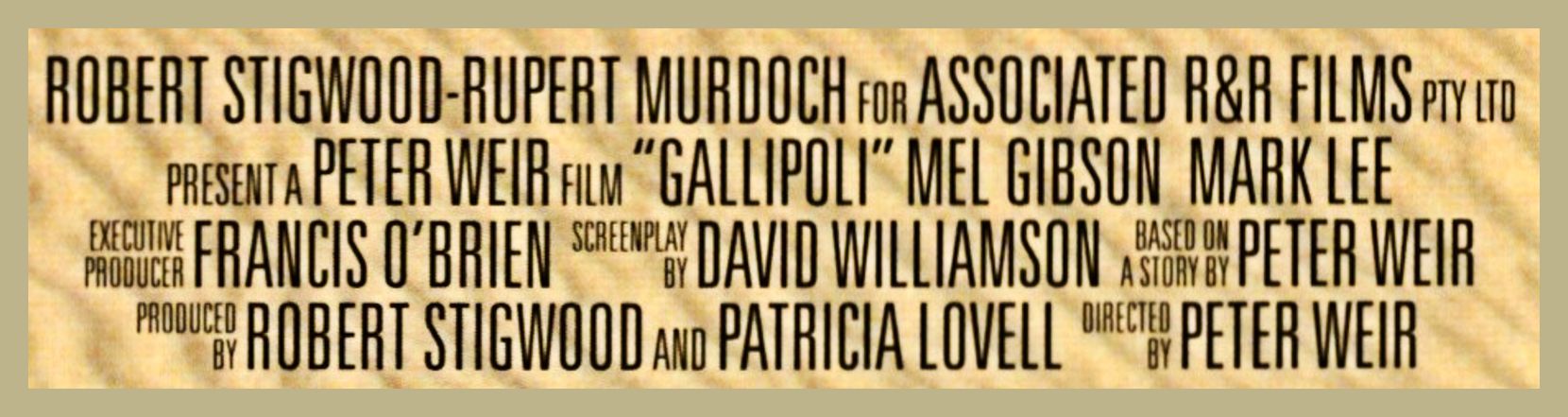
Credits (Click to expand)
Trailer:
iReview:
Last Thursday, 25 April, was Anzac Day, the day Australians and New Zealanders acknowledge the sacrifice of all those who have served in war and peacekeeping. It also commemorates the men and women who have died in that service.
Anzac Day coincides with the landing of ANZAC (Australian and New Zealand Army Corps), French, British and other British Empire troops at Gallipoli in south west Turkey in 1915. The objective was to secure the Dardanelles to provide a sea route to reach the Russian allies and ultimately to take Constantinople (Istanbul) and knock Germany’s ally, Turkey, out of the war.
The eight month campaign that followed cost the lives of 53,000 allied (including almost 12,000 Anzacs) and 56,000 Turks with total casualties reaching almost half a million. Many thousands more, suffered from dysentary, a result of the appalling sanitary conditions encountered by the troops.
Despite the campaign’s ultimate failure, media reports reaching Australia extolled the heroism of the Anzac troops and stirred national pride in the young country which had federated as Australia only 14 years earlier. Albany, the south coast port city in my home state of Western Australia, was the embarkation point for the thousands of troops who left Australia for Gallipoli. Albany also has a special significance for my family as it was my children’s maternal grandmother who, 15 years ago, uncovered the evidence that confirmed Albany as the location for the nation’s first iconic Anzac Day “Dawn Service”.
Learn more:
• Albany and the Anzacs
• Albany historian reflects on nations first Anzac dawn service
Listen to their discussion:
• Albany historian reflects on nations first Anzac dawn service
The way Australians relate to Anzac Day has evolved over the years and has not always been as robustly and reverentially marked as it is today. I remember Anzac Day in the 1970s, as a holiday celebrated largely as a day off from work and school, with a sideshow parade of old soldiers who got together once a year to swap tales of war, gamble a little and imbibe a little too much. The Gallipoli Campaign that sporned the day of remembrance as well as the world wars that were commemorated, were remote, little known and of scant significance to many. At that time, many Australians were also disaffected with all things military as a result of the country’s involvement in the disastrous Vietnam War.
In 1981, that all changed with the release of Peter Weir’s Gallipoli. The New Wave renaissance of the Australian film industry had seen acclaimed films like Wake in Fright (1971), The Cars That Ate Paris (1974), Picnic at Hanging Rock (1975), Sunday Too Far Away (1975), The Last Wave (1977), Mad Max (1979), My Brilliant Career (1979), and Breaker Morant (1980), whet the Australian appetite for home grown cinema. The New Wave reached its zenith with Gallipoli (1981) which was a phenomenon in Australia with huge box office and critical success. The film also sparked a resurgent interest in the Anzac tradition which has grown steadily since. In 2013, a record 40,000 people attended the Dawn Service at the War Memorial in Perth, Western Australia’s state capital. Thousands more attended services in other cities and towns all over Australia, including Albany.
To acknowledge the significance of the day, I thought I’d revisit this best loved of Australia’s War cinema: Gallipoli.
What Happens:
Eighteen year-old Western Australian champion sprinter Archy Hamilton (Mark Lee) could be an Olympic contender, but he disappoints his trainer Jack (Bill Kerr) when he instead enlists in the elite Australian Light Horse cavalry. He’s accompanied by talented sprinter Frank Dunne (Mel Gibson), who also attempts to join but can’t ride a horse and is relegated to the infantry with his other friends.
Training in Cairo, the Anzac cavalrymen are converted to infantry so Archy persuades his Major, Barton (Bill Hunter) to allow Frank to transfer to the regiment.
At Gallipoli in 1915, the Anzacs find that they’re being used as cannon fodder as a ‘diversion’ for British landings elsewhere, and the entire unit realizes that they must obey suicidal orders and charge Turkish machine guns, a lunatic event among a litany of incompetent military planning.
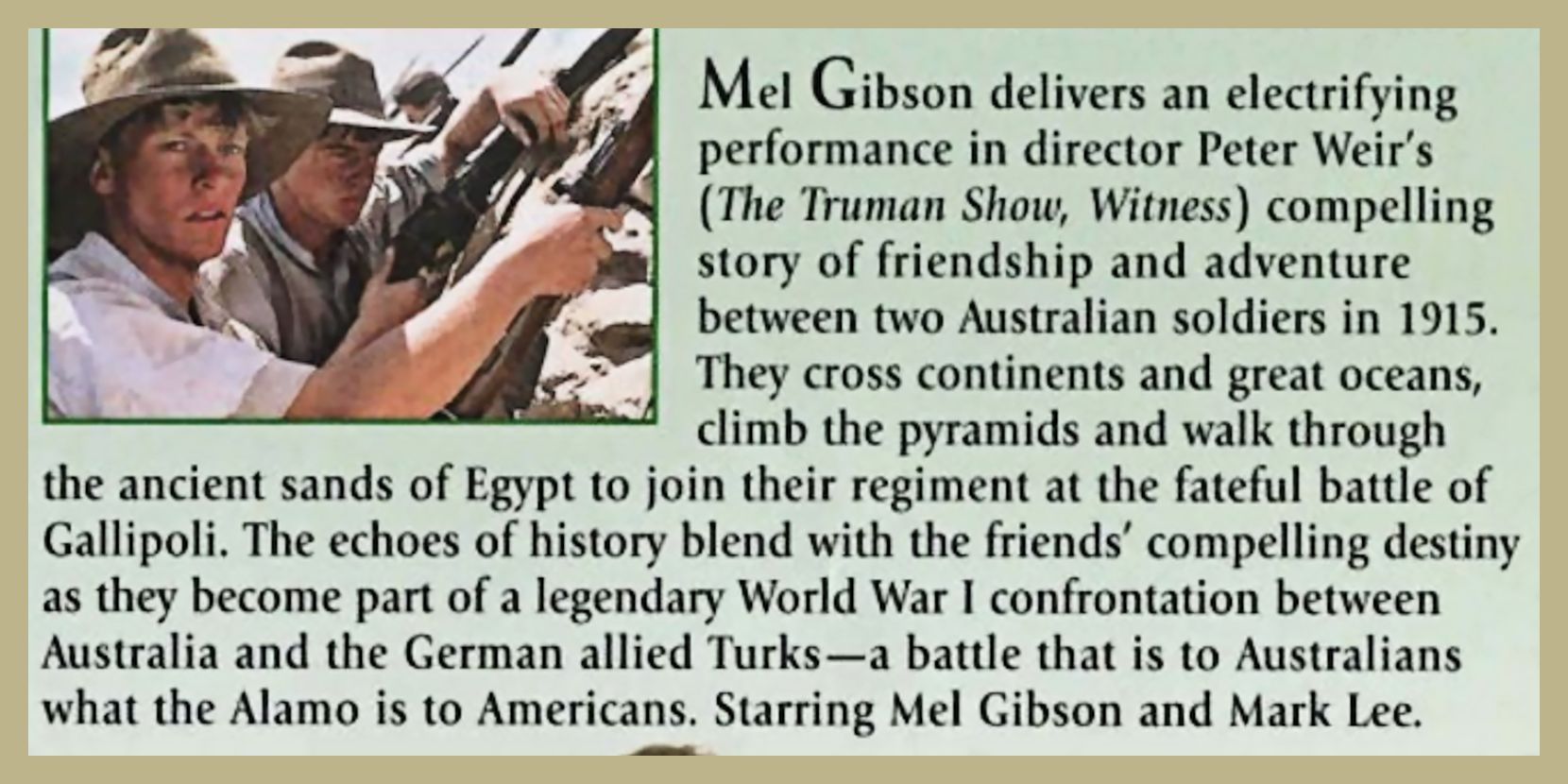
Story (Click to expand)
Since I last saw this movie many years ago, I’d forgotten that it starts out as a boy’s own adventure featuring a very young, very Australian and not so weird Mel Gibson. With the benefit of hindsight, it’s interesting to reflect on this nascent star and his subsequent and controversial career. It’s also interesting to reflect on the very different career trajectories of the two stars. Gibson, we know went on a stellar rise to the A-list in Hollywood while Mark Lee (Archy Hamilton) moved into relative obscurity.
The outback scenes that open the film are spectacularly shot with the heat, dust and desolation radiating off the screen. The stark monochromatic beauty of Australia’s hot, dry interior is a place best admired from the air-conditioned comfort of a 4 wheel drive. That many Australians willingly endured life in these and other hostile environs was the steel that forged the myth of the tough Anzac warrior. Williamson’s script is cloaked in this mythology and he uses it well to set up the main protagonists in this yarn.
Archy is a naive young man and a very talented runner who yearns for the adventure of Gallipoli that he has read and heard about. His sprinting rival, Frank (Mel Gibson) is a cynical descendant of Irish nationalists, and as such, has no desire to fight Britain’s war. At the time, Irish nationalists and unionists were in a bitter struggle over the future independence of Ireland from Britain. The speed with which Frank and Archy are transformed from rivals to such good friends that Frank is prepared to enlist with him, almost stretches my credulity and that’s despite the device of the desert trek bonding ordeal they endure that cements their close mateship. If Weir had taken more time to develop these characters, perhaps this wouldn’t have seemed such a stretch.
Learn more:
• Ireland and World War I
Generally, the performances of the cast, particularly, Mel Gibson are strong. Newcomer, Mark Lee also convinced, despite apparently having a particularly nervous time on set.
David Williamson’s script also moves the story well and although calculated to draw strong emotion, it doesn’t overindulge in overt tearjerking.
Although half the movie is set in Western Australia, none of it was filmed there. Lake Torrens in South Australia represented the desert in WA and Adelaide Railway Station stood in for Perth. The Marble Hall at the station also provided the set for the Cairo ball, before the troops shipped out to Gallipoli. Various beaches in South Australia, including Gallipoli Beach, were also used to depict the Gallipoli theater. On the other hand, the Cairo pyramid footage was actually shot on location and provides an interesting, and sometimes amusing, leg of the boy’s own adventure. The behaviour of the Aussies in Egypt as they mocked their British counterparts, also provided a neat metaphor for the rebellious teenager relationship, Australia shared with the mother country.
One of the film’s most memorable scenes was the eerily quiet and beautiful night arrival at Gallipoli; the looming terror juxtaposed with the brightly festooned and other worldly hospital ship offshore. And although for a time it looked like the boys were approaching a fun day at the seaside, the blood in the water, as they abandoned their cares and clothes and went swimming, reminded us of the deadly import of their endeavour.
The final scenes in the trenches were laden with the dread of what was coming, interspersed with the evocative strains of Giazotto’s Adagio in G minor. Major Barton’s attempt to shut out the war raging around him, listening to the duet from Bizet’s famed The Pearl Fishers opera, also provided a poignant moment in the buildup to the horrible climax.
On the morning of 7 August 1915, the Australian 8th and 10th Light Horse Regiments were to attack Turkish lines a mere 30 metres from their own. The attack in 4 waves, was to be immediately preceded by an artillery suppression barrage that fatefully ended 7 minutes early as a result of unsynchronised watches. The troops had already been instructed to remove ammunition from their rifles and fix bayonets. So hopeless was their position after the Turks were alerted by the barrage, that many went over the top without even their rifle. I’ll never forget the image of a bayonet being thrust into the wall of the trench to act as a hanger for a doomed soldier’s precious wedding ring. Knowing the terror that those boys must have felt as wave after wave went over the top to a certain death, enraged me today even as it did 32 years ago.
The futile attempts to get the 4 insanely suicidal charges of this Battle of the Nek called off, provided the closing argument in Weir’s prosecution case that: the Gallipoli Campaign was a cruel waste of talented young lives sacrificed by stupid and incompetent leaders. On a larger scale, it also symbolised the generation lost to the insanity that was World War I.
The final freeze-frame which evokes Robert Capa’s famous 1936 Spanish Civil War photograph The Falling Soldier, had me uncomfortably riveted to my seat with tears streaming, the first time round. Seeing it again, all these years later had exactly the same impact.
The Picture:
This is a film crying out for a Blu-ray release. The grainy, artifact laden sky in the early outback scenes, reminded me how disappointing the old DVD format picture can be. Russell Boyd’s wonderful cinematography, particularly in the early scenes, needs to be showcased in high definition.
The Audio:
I would have liked a DTS 5.1 audio track but the Dolby Digital 5.1 track was reasonably serviceable. However, the mix was heavily biased towards a simple front stereo with little distribution to surround or subwoofer channels. Frankly there was little difference between the quality of the output from my receiver and the sound generated by the surround speakers on the Panasonic 140cm flat screen monitor.
Verdict:
When I first saw this movie in 1981 it was very much a creature of its time, coming so soon after Breaker Morant and the widening scrutiny of Australia’s past as well as its relationship with Britain and the British Empire. So, with its huge success, this was also a triumph of its time. I’m pleased to say, it is still a wonderful and deeply affecting landmark in Australian Cinema.
iRate:: 4½ out of 5.
4Movie Tragics
Extras:
Disk One:
• Cast and Crew Bios and Filmography (interactive bio. & filmography text screens).
• Theatrical Trailer.
Disk Two:
• Interview with Peter Weir (interesting retrospective interview) – 15min.
• Interview with Mel Gibson (reflective interview filmed in 2005) – 12min.
• Boys Of The Dardanelles: Australian War Memorial Documentary (produced by the War Memorial to commemorate the men who fought and died at Gallipoli) – 22min.
• The Keith Murdoch Letter: The Letter That Changed History (a facsimile of the letter Murdoch wrote to his friend, Australian prime minister Andrew Fisher, which led to the removal of the Campaign commander, General Sir Ian Hamilton and the eventual withdrawal from Gallipoli. Note: Sir Keith was the father of Gallipoli producer and media mogul, Rupert Murdoch).
• Photo Gallery (30 production stills) – 2min.
• In Depth Gallipoli Material (library of interesting information stills).
• DVD-Rom Teaching Aids including a printable version of The Keith Murdoch Letter: The Letter That Changed History.
You want More!
Gallipoli – IMDb (Internet Movie Database)
Gallipoli – Rotten Tomatoes
Gallipoli – allmovie.com
Gallipoli – Wikipedia
Is this one of the best anti-war movies yet produced or am I just biased?
:: Please leave a comment ::
 Zak From Downunder