Tags
1970s, Abandon All Hope, Adventure, Adventure Drama, Albert Hall, Anti-War Film, Apocalypse Now, Apocalypse Now Redux, Cambodia, Cold War Film, Dennis Hopper, Drama, Epic, Film, film review, Francis Ford Coppola, Frederic Forrest, Guy Movie, iRate:: 5 / 5, John Milius, Jungle Film, Laurence Fishburne, Marlon Brando, Martin Sheen, Modern Classic, Robert Duvall, Roger Ebert, Sam Bottoms, Slow Burn, Starpower, Sunday Screening Session, Vietnam, Vietnam War Era, War, War Epic
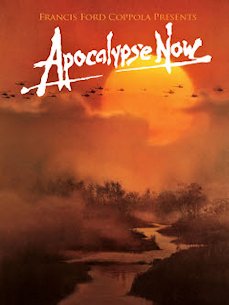
Apocalypse Now (1979) (196 min)
iReview: Version: Apocalypse Now: Full Disclosure Edition (Blu-ray);
Video: AVC 1080p; Audio: DTS 5.1.
Genre:: Adventure | Drama | Epic | War |
Sub-Genre/Type:: Adventure Drama | Anti-War Film |
Cold War Film | Jungle Film | Modern Classic | War Epic |
Settings:: 1970s | Cambodia | Vietnam | Vietnam War Era.
Mood?:: Abandon All Hope | Guy Movie |
Slow Burn | Starpower.
iRate:: 5 / 5 (One of my top 10)
Director:: Francis Ford Coppola.
Writers:: Joseph Conrad (novella: Heart of Darkness); Michael Herr (narration); Francis Ford Coppola & John Milius (screenplay).
Cast:: Marlon Brando, Martin Sheen, Robert Duvall, Frederic Forrest, Sam Bottoms, Albert Hall, Laurence Fishburne, Dennis Hopper, Harrison Ford, G. D. Spradlin, Jerry Ziesmer, Scott Glenn.

Credits (Click to expand)
Trailer (HD):
iReview:
With the death of famed Chicago Sun-Times critic, Roger Ebert (see my earlier Ebert post), I thought I’d have a look at one of his and my top 10 movies, Apocalypse Now. I recently obtained the 3 disc Full Disclosure Blu-ray Edition which includes the movie tragics must-have Hearts of Darkness: A Filmmaker’s Apocalypse, the 1991 documentary chronicling the making of the film. The package also includes the 1979 cut of Apocalypse Now and an ammo dump full of interesting extras. I wasn’t able to source this set in-store so I was forced to find it online (I’ve included convenient links to search on eBay and Amazon (UK) below).
What Happens:
Francis Ford Coppola adapted the Joseph Conrad novella Heart of Darkness (set in the Belgian Congo, Africa) to depict the Vietnam War as a descent into primal madness. Capt. Benjamin Willard (Martin Sheen), already on the edge, is assigned a secret mission to find and deal with AWOL Col. Kurtz (Marlon Brando), who has set himself up in the Cambodian jungle as a cult warlord. Along the way up-river, Willard encounters: the lover of napalm and Wagner, Col. Kilgore (Robert Duvall); soldiers who prefer to surf and do drugs: a troupe of USO Playboy Bunnies, whose show turns into a riot; and a manic photographer (Dennis Hopper), who tells wild, reverential stories about Kurtz. By the time Willard sees the scattering of heads at Kurtz’s compound, he knows Kurtz has gone insane…

Story (Click to expand)
It’s been many years since I saw the 2001 Redux version of this film and a year or so since my last visit with the original 1979 cut, so I arrived for this marathon sitting of Redux with relatively fresh eyes.
Now that I know Martin Sheen (Capt. Benjamin Willard) was actually very drunk when filming the first bedroom scene in which he did his best to destroy the set, the scene has acquired added significance. The blood was also real as Sheen cut his hand in the process. This scene becomes emblematic of the production chaos of the Philippines’ shoot, with a typhoon destroying the set and Sheen’s near fatal heart attack (which was kept secret, with his hospitalization ascribed to ‘heat exhaustion’). The intrigue surrounding the production is one of the things that makes the warts-and-all Hearts of Darkness: A Filmmaker’s Apocalypse documentary (on disc 3), compiled from footage shot by Eleanor Coppola, so compelling. There’s the revelation that half the cast were using marijuana, speed or LSD or all three, and often while filming. Add to that, the news that Laurence Fishburne (Clean) lied about his age to get the part as he was only 14 when filming began; that a nearby Islamic insurgency resulted in the frequent and sudden departure, often while filming, of the leased Philippines military helicopters, called away to battle; that the scheduled 6 week shoot was repeatedly extended to an eventual 16 months; that shooting delays resulted in Brando pocketing his already paid $1 million advance on his $1 million per week salary and almost walking away, rather than reschedule his three weeks on set; that Brando arrived dramatically overweight and concerned about his appearance and required that only scenes showing him in shadow be included in the film; that Brando arrived completely unprepared having read neither the novel (Heart of Darkness) or the script (something he was notorious for); that Brando insisted on detailed consultation with Coppola, sometimes lasting days, before improvising scenes, all while the cast and crew were waiting on standby; and that the budget blew out to $40 million, a record at the time. There’s also the shocking and highly confronting footage of the ritual, brutal killing of pigs and the hacking to death of the water buffalo that appears at film’s end (I think its eyes will haunt me for a very long time). The documentary also brilliantly illuminates the insanity of the shoot which seemed to mirror the insanity of the Vietnam War and the madness on screen. If you don’t want your viewing of the film to be tainted, I’d recommend you leave this documentary ’til last.
Apocalypse Now was always episodic, as road movies often are, with set pieces revealed as Willard and the river patrol boat crew, progress up the Nung River towards Cambodia. But in Redux, this aspect of the story is accentuated with the addition of scenes featuring the stranded ‘Bunnies’ and the French colonial plantation compound.
After so many previous viewings, there’s still the pleasure of anticipation, waiting for the arrival of Colonel Bill Kilgore (Robert Duvall) who leads his airborne chopper cavalry and is surfing obsessed, seemingly invulnerable, and just loves “the smell of napalm in the morning”. He also has a lust for mass carnage, accompanied by a bellowing rendition of “Ride of the Valkyries” by Wagner.
Next up the river, there’s the USO show featuring the troupe of Playboy Bunnies, who arrive by chopper, parade provocatively, get mobbed in a riotous scramble, and retreat to their chopper in a cloud of smoke.
By the time I’d arrived at the chaotic MedEvac station with the stranded ‘Bunnies’, the first major departure from the 1979 version, I realized I needed to see the original again to put Redux into perspective (hence the delay in publishing this post). And frankly, while the original stand-alone USO Bunnies show scene, illustrates the detachment of US resolve and ineffectiveness in war fighting, the added MedEvac scene seems an unnecessary adjunct which muddies (excuse the pun) the thread of the story and adds only a negative aesthetic to the movie.
Moving up the river, Chief (Albert Hall) spots a sampan and, against Willard’s advice, they stop and search the boat. As Chef (Frederic Forrest) belligerently searches the sampan, Clean (Laurence Fishburne) unexpectedly opens fire on the boat. What ensues is the My Lai Massacre moment of the movie.
With each encounter, as they progress further from civilization, the crew’s grip on sanity wavers a little more. By the time they reach the chaotic Do Long bridge outpost with its precarious suspension bridge and no discernible chain of command, Willard and his men seem like an island of calm in a swirling nightmare.
I’m neutral about the efficacy of the added French colonials scene in Redux. At the time of the release of the 1979 cut, the Vietnam War was still extremely raw in the American Psyche, having ended only 4 years earlier. It’s perhaps understandable then, that Coppola decided not to pollute the ‘descent into the madness of America’s Vietnam War‘ theme with a discourse on the colonial era. Thirty four years later, that anti-Vietnam War focus of the film, perhaps, doesn’t need to be so sharply defined, so the departure into French colonial history adds an interesting side-track. Filming it at all may have been a subtle nod to Conrad’s original Heart of Darkness, set in the French speaking, Belgian Congo colony.
The horrific scenes awaiting what’s left of the crew, when they arrive at Kurtz’s compound, seem entirely appropriate, given the portents that accompanied their journey.
Coppola’s additional Kurtz Compound scenes in Redux, add another layer of insight along with subtle changes to Kurtz’s character. In the original, Kurtz was made more poetically enigmatic by his shadowy illumination. In Redux, Kurtz is just plain mad. At the time of production, Marlon Brando was something of an actor demi-god, so it was understandable that he and Coppola were concerned that his obesity might be an unwelcome distraction, hence the noirish camera work. With Brando’s immensity no longer a novelty, it’s interesting to see the additional ‘lit’ scenes as they ‘flesh’ out Kurtz’s personality (stop with the puns, already!).
This intense week-long immersion into the Apocalypse Now universe has been fascinating for me and has led to the conclusion that on balance, I marginally prefer the original cut to Redux. However, they each stand, in their own right, as monumentally stunning achievements in film-making. Watching both films in reasonably close proximity, also gave me an unexpected look behind the curtain to the art behind movie-making, as I was able to see great examples of the editor’s craft. That for me was worth the price of admission (in this case the cost of the Blu-ray set).
The Picture:
I’m pleased that Coppola prevailed with the 2.35:1 aspect ratio rather than Cinematographer, Vittorio Storaro’s preferred 2.0:1 (used on previous releases) which chopped the frame and occasionally caused oddly skewed shot framing and pans.
This transfer to Blu-ray while not quite as stunning as some I’ve seen recently (I’ve been spoilt), is nevertheless beautifully rendered and a pleasure to watch. It might just have been me, but this new Blu-ray palette also seems to have a slightly heavier yellow hue than previous versions, giving the image a warmer look than I’d like (it’s OK, I’m already kicking myself for nit-picking).
Overall, the screen image is clean and well defined with Kurtz’s disembodied head brilliantly defined and contrasted against deep black. Also look out for the way Willard’s face is lit while he reads the Kurtz dossier on the deck of the patrol boat. And let’s face it, Storaro’s photography is breathtakingly sumptuous, especially in the film’s first half. I’m also conscious of the fact that Coppola needed to incorporate previously discarded footage, which can’t have been easy, and then colour grade both films for consistency. To have created such a seamless result is astonishing. If you need confirmation of just how good it is, check out Richard Donner’s 2006 cut of Superman II which is good but not nearly as consistent as Apocalypse.
The Audio:
The Blu-ray DTS 5.1 sound track is one of the best I’ve heard, particularly the woofer’s rumbling bass. The balance and sweep of the sound effects mix is awesome with helicopters tracking seamlessly from monitor to monitor. The sound field is completely immersive, especially at higher volume (I hope the neighbours weren’t too annoyed).
My only complaint about the soundtrack is an issue of personal taste: I would have much preferred a score without the heavy and dated synthesizer. A completely contemporary rock track or even an orchestral score would have been fine. Unfortunately, the mix of great ’60s and ’70s rock tracks interspersed with nondescript synth. just didn’t do it for me.
Verdict:
This movie was already in my top ten so my expectations of this release were high. I’m so pleased that Coppola has allowed his two versions of Apocalypse Now to co-exist as they are each wonderful in their own way. I’d say, if anything, this new Blu-ray package with its incomparable set of extras, has enhanced my impression of the films. So hats off to the guys who took such care putting this together.
iRate:: 5 out of 5 (One of my top 10).
Buy:
• Apocalypse Now: Full Disclosure Blu-ray Edition (at eBay)
• look for Apocalypse Now: Full Disclosure Blu-ray Edition / 3-disc Special Edition (at Amazon UK).
(note: Any UK Blu-ray is playable in Australia as they share the same region code ‘B‘ (USA code is ‘A‘). Just to confuse things though, be aware that their DVD region codes are different – Region: 2 (UK), 4 (Aus), 1 (USA). But many UK DVDs are coded for both regions (2 & 4), so check.)
Extras:
• Feature Commentary by Director Francis Ford Coppola (complements the Hearts of Darkness: A Filmmaker’s Apocalypse documentary quite well. I’d be inclined to listen to the commentary on Redux, as it’s full of interesting production notes and anecdotes. As well, the commentary track for the original version was edited down from this one).
Disc Two:
• A Conversation With Martin Sheen
(Sheen and Coppola reminisce about the casting, drugs, alcohol, tigers, the heart attack, and much more… interesting) – 59min;
• An Interview With John Milius (here Coppola and Milius discuss their writing process and the script’s evolution as they drill deeply into the screenplay. They also briefly touch on Milius’ own military ambitions and how that played into the screenplay… one for the geeks and illuminating and enjoyable) – 50min;
• Fred Roos: Casting Apocalypse (includes screen test footage and features the film’s casting director, Roos, talking about the hundreds of actors tested for various roles) – 12min;
• ‘Apocalypse’ Then and Now (has some brief snippets from Roger Ebert’s Cannes interview with Francis Ford Coppola) – 4min;
• 2001 Cannes Film Festival: Francis Ford Coppola (the entire Ebert Cannes interview) – 39min;
• PBR Streetgang (profiles and reflections from the actors playing Willard’s patrol boat crew: Laurence Fishburne, Sam Bottoms, Albert Hall, and Frederic Forrest) – 4min;
• “Monkey Sampan” Deleted Scene (a disturbing deleted segment featuring a boat overrun with monkeys and natives singing “Light My Fire”) – 3min;
• Additional Scenes (12 timecoded scenes including Lt. Richard M. Colby (Scott Glenn) dialogue and undoctored footage where the name of Brando’s original character name, Col. Leighley, can be heard) – 26min;
• Destruction of the Kurtz Compound (the jettisoned final credits sequence which Coppola ultimately rejected when he feared audiences were misinterpreting it) – 6min;
• The Birth of 5.1 Sound
(a fascinating Dolby Labs presentation which looks at how Apocalypse Now led to a revolution in film surround sound design) – 6min;
• Ghost Helicopter Flyover
(sound engineer, Richard Beggs, explains how the surround sound design for the opening helicopter sequence was created) – 4min;
• The Music of Apocalypse Now (looks at how the various musical elements: The Doors, synthesizer music, orchestral and percussion work were integrated together) – 15min.
• The Synthesizer Soundtrack (a text screen reprint of a Bob Moog article from Keyboard magazine);
• Heard Any Good Movies Lately? The Sound Design of ‘Apocalypse Now‘ (Coppola, Walter Murch, Richard Beggs, and post-production recordist Randy Thom talk about and show us how the revolutionary sound design for the film was created) – 15min;
• A Million Feet of Film: The Editing of ‘Apocalypse Now‘ (a great look at how Coppola and editor Walter Murch pulled a coherant film together from the immense stock of scripted, experimental and improvised footage) – 18min;
• The Final Mix (Randy Thom introduces some great footage of the multi-room setup which was necessary to achieve the final mix for the film) – 3min;
• The Color Palette of ‘Apocalypse Now‘ (Vittorio Storaro attempts to explain the technical aspects of the three strip dye transfer Technicolor process utilized on the film) – 4min.
• The Hollow Men (an odd little period (circa 1979) featurette with Brando reciting Eliot’s poem with scenes from the film and the shoot) – 17min;
• Mercury Theater Production of ‘Heart of Darkness’ (audio presentation of Orson Welles production of Joseph Conrad’s novella… some of the audio quality has suffered with time.) – 37min.
Disc Three:
• Hearts of Darkness: A Filmmaker’s Apocalypse (the fascinating behind-the-scenes documentary compiled from home movie footage shot by Coppola’s wife Eleanor. The film includes audio from tapes she recorded without Francis’ knowledge for what she, at the time, expected to turn into a diary. The chaos and intrigue surrounding the making of the film, makes this compelling viewing. As if that’s not enough, there’s also an optional and very interesting commentary track from the Coppola’s.) – 99min.
• John Milius Script Selections with Notes by Francis Ford Coppola
(text screens);
• Storyboard Gallery (with more than 200 screens);
• Photo Archive (a huge trove of production and candid stills together with some Mary Ellen Mark photography);
• Marketing Archive (featuring the 1979 trailer, radio spots, theatrical program, lobby cards, press kit photos, and a poster gallery).
Printed Material:
• A 48-page Full Disclosure booklet which features a written introduction from Francis Ford Coppola, script excerpts (with notes scrawled over them), production photos, storyboards, sketches, and other production art.
• An Apocalypse Now booklet with production notes, credits and cast and crew biographies.
• 5 Black & White postcards.
You want More!
Apocalypse Now – IMDb (Internet Movie Database)
Apocalypse Now – Rotten Tomatoes
Apocalypse Now Redux – Rotten Tomatoes
Apocalypse Now – allmovie.com
Apocalypse Now Redux – allmovie.com
Apocalypse Now – Wikipedia
Apocalypse Now Redux – Wikipedia
Is this the best war film ever made?
:: Please leave a comment ::


 Zak From Downunder