
Tags
1839-1889, Adventure, American Civil War Era, Classic, Debbie Reynolds, Drama, Epic, Epic Western, Film, film review, Frontier Region, George Marshall, George Peppard, Gregory Peck, Henry Fonda, Henry Hathaway, History, History Fiction, How the West Was Won, iRate:: 4 / 5, James Stewart, John Ford, John Wayne, Karl Malden, Romance, Rural Setting, Slice Of History, Spencer Tracy, Sunday Screening Session, Tough Guys, USA, Western, Wild West Era
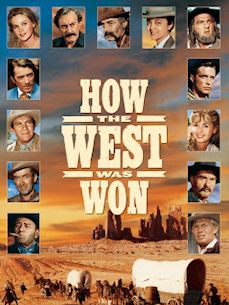
How the West Was Won (1962) (159 min)
iReview: Version: How the West Was Won: 2 Disc Edition (Blu-ray);
Video: VC-1 1080p; Audio: Dolby Digital (AC3) 5.1.
Genre:: Adventure | Drama | Epic | History | Romance | Western |
Sub-Genre/Type:: Classic | Epic Western | History Fiction |
Settings:: 1839-1889 | American Civil War Era | Frontier Region |
Rural Setting | USA | Wild West Era.
Mood?:: Slice Of History | Tough Guys.
iRate:: 4 / 5
Directors:: John Ford
(segment “The Civil War”);
Henry Hathaway
(segments “The Rivers”, “The Plains”
and “The Outlaws”);
George Marshall
(segment “The Railroad”).
Writer:: James R. Webb (screenplay).
Cast:: Henry Fonda, Karl Malden, Gregory Peck, James Stewart, Debbie Reynolds, John Wayne (General William T. Sherman), Eli Wallach, Lee J. Cobb, Richard Widmark, George Peppard, Spencer Tracy (narrator), Harry Morgan (General Ulysses S. Grant), Carroll Baker, Carolyn Jones, Robert Preston, Walter Brennan, Andy Devine, Raymond Massey (President Abraham Lincoln), Agnes Moorehead, Thelma Ritter, Russ Tamblyn.

Credits (Click to expand)
Trailer:
(Note: The vertical bands that appear in this theatrical release trailer, have been digitally removed in the Blu-ray release of the film)
iReview:
In this week’s Sunday Screening, I’ve gone back 51 years to 1962 to seek out films in my library worthy of another look. 1962 was awash with more than 2,000 films released but after a quick scan, I was humbled by my few representatives from that year. But, my small sample does include some notable films: Dr. No, the first Bond film; To Kill a Mockingbird, with Gregory Peck’s outstanding portrayal as Atticus Finch, the lawyer who defends a black man against an undeserved rape charge; Lawrence of Arabia, the story of T.E. Lawrence’s desert war (my favourite film); Lolita, a story of forbidden infatuation by my favourite director, Stanley Kubrick; The Longest Day, the story of D-Day (6th June 1944); The Manchurian Candidate, with a brilliant Frank Sinatra as a brainwashed former captive of North Korea; Mutiny on the Bounty, starring Marlon Brando in an overwrought remake of the 1935 classic; and How the West Was Won. It’s the Blu-ray version of the last of these that I’ve selected for this week’s screening. I’ll be having another look at the rest of this eclectic bunch of 1962 films soon.
How the West Was Won is a curiosity in that it was one of only two narrative films produced using the Cinerama three lens camera system; the other being The Wonderful World of the Brothers Grimm (1962). And, given the complexity of filming in this format and the cost of building theatres capable of screening them, it’s not surprising. Cinerama required three projectors for the three screens used in the curved ultra widescreen presentation. Where the three projected images overlapped, there were thin blurred join-lines, but given the impact of the overall experience as projected onto the unique and enormous screen construction, this was a small infraction. As well as the stunning surround visuals, the system was also one of the first to employ 5.1 audio, giving an unparalleled audio-visual experience.

Story (Click to expand)
For this epic western, three legendary directors, Henry Hathaway, John Ford, and George Marshall, were employed to shoot different segments of the stories of three generations of the Prescott family and their travels from east to west across America between 1839 and 1889. The film chronicles the family’s triumphs and tragedies as they encounter river pirates, suffer drownings and make and lose a fortune in California after travelling the plains together in a wagon train.
This all-star ensemble includes Karl Malden as pioneer Zebulon Prescott who sets out west with his wife (Agnes Moorehead) and their children, Lilith (Debbie Reynolds) and Eve (Carroll Baker). They travel down river and along the way, encounter mountain man and fur trader, Linus Rawlings (James Stewart), who marries Eve.
Lilith continues west after joining a wagon train led by Roger Morgan (Robert Preston), and is accompanied by roguish gambler Cleve Van Valen (Gregory Peck), who saves her during an Indian attack.
These first two vivid segments, dubbed ‘The Rivers (1840)’ and ‘The Plains (1850s)’, were directed by Henry Hathaway.
Moving into the 1860s, the Civil War erupts and Linus and Eve’s son, Zeb (George Peppard), enthusiastically follows his father into the Union army. However, after the Battle of Shiloh, he becomes disillusioned and contemplates a different path. This ‘Civil War (1861-1865)’ segment was directed by John Ford
Richard Widmark also stars as railroad boss Mike King, building the transcontinental railroad, who wants to cut a line straight through Indian territory but is resisted by mountain man, Jethro (Henry Fonda). Zeb, who has rejoined the army as a lieutenant in the U.S. cavalry, is tasked to secure a peace treaty with the Arapaho to allow the railroad construction to proceed peacefully. This segment, titled ‘The Railroad (1868)’, was directed by George Marshall and includes his famous buffalo stampede sequence.
In the final segment, The Outlaws (1880s), directed by Henry Hathaway, Lilith who made it as far west as California, has done well for herself in San Francisco but, after a change in circumstances, auctions most of her possessions and relocates to her ranch in Arizona, inviting Zeb to join her. However, Zeb, now a marshal, has a run-in with an old foe, Charlie Gant (Eli Wallach).
Many more characters and stories are woven throughout this epic film which also features appearances from Raymond Massey as President Abraham Lincoln, John Wayne as General William T. Sherman, and Harry Morgan as General Ulysses S. Grant.
In my earlier description of the plot, I’ve tried to limit the spoilers, so I don’t give everything away. I hope I haven’t just made the story completely obtuse in the process.
As a dramatic narrative, How the West Was Won works more like a travelogue, with emblematic scenic locations providing a visual feast, interrupted by action and dramatic set pieces. The characters are not on screen long enough to develop their identities but that is often a drawback of films that seek to cover an epic story over such a daunting time-span. And with so much visual splendour on offer, it’s only a minor criticism.
The technical restrictions of shooting with three fixed 27mm lenses meant that depth of field variations and close-ups, employed on traditional single lens films were not possible. One of the inadvertent benefits of this constriction is a vivid screen image with the incredible clarity of waving blades of prairie grass in the foreground against crisply defined mountain peaks in the distance. The fact that everything in shot is always in focus, also means that the entire image, including background action is invariably in motion, adding to the window-on-the-world quality of this film. As breath-taking as the magnificent vistas are, the shortcomings of the format are evident. The 400kg Cinerama camera was entirely mechanically rooted and most of the action is front-on because shots needed to be framed in such a way as to avoid foreground actors moving quickly across the boundary between one lens-view and another. These limitations, though, forced directors to become creative in the way shots were constructed and so, there are many wonderful and inventive tracking shots as the camera gracefully glided along its tracks.
When How the West Was Won was first released on VHS and DVD, the presentation was marred by the butchery required to crop the frame for display on the old 4:3 TVs. This compromise also negated one of the film’s main viewing attraction, its wonderful cinematography, rendering the movie barely watchable. Thankfully, for the three disc Special Edition DVD and Blu-ray releases, the film has been painstakingly restored with almost all evidence of the vertical three-panel join lines, digitally eliminated. The stunning result is an image that is brilliantly saturated and a joy to watch. The restoration has also left just enough occasional evidence of the vertical panel lines to demonstrate the ingenuity of the directors in utilising aspects of sets, like doorways, poles and building uprights as well as natural features like trees, to obscure the boundary lines.
For me, the work of John Ford, who filmed the short ‘Civil War (1861-1865)’ segment, is the most evocative and beautifully constructed. In its three scenes, there is the battlefield at Shiloh which ebbs into night with wonderfully lit horizon shots that stretch over and brilliantly amplify the ultra widescreen image. The shots beautifully juxtapose a war scene with the liberal ornamentation of Cherry blossoms, giving the night the look of Christmas decoration. The battle’s aftermath also reveals the short but effective scene with two disheveled Generals, Ulysses S. Grant and William Tecumseh Sherman. The quiet rhythm of the scene moves into the next, when Zeb returns home. The pacing and atmosphere of these scenes is exquisite.
Dave Kehr of the New York Times, in his 2008 review, wrote: “The best reason for buying a Blu-ray player right now is Warner Home Video’s high-definition version of “How the West Was Won,” a film made 46 years ago in the highest-definition moving picture medium the world had seen: Cinerama”. He continued, “Not even the finest home theater installation will be able to reproduce the scale and resolution of the Cinerama experience, or anything close to it. But moving from standard-definition DVD to Blu-ray generates a shock analogous to what the audiences of 1962 must have felt when the curtains parted to reveal the panoramic screen.”
Films like How the West Was Won and Ford’s other western masterpiece, The Searchers (1956), have languished in VHS hell for too long, waiting for the advent of Blu-ray and a big wide home screen on which to showcase their brilliance. This result is a riveting revelation and richly recommended.
iRate:: 4 out of 5.
4Movie Tragics
Extras:
• Feature Commentary by: Filmmaker David Strohmaier; Director of Cinerama, Inc. John Sittig; Film Historian Rudy Behlmer; Music Historian Jon Burlingame; and Stuntman Loren James (This informative and interesting track appears on both the Blu-ray and Special Edition 3-disc DVD versions).
• Cinerama Adventure (This fascinating 93 minute documentary tells you everything you didn’t know you needed to know about the revolutionary Cinerama format and appears on both the Blu-ray and Special Edition 3-disc DVD versions).
• The 2-disc Blu-ray version also offers a Smilebox version of the film, which attempts to mimic the curved screen of the original Cinerama process. The effect is hard to describe so you’ll need to get it to see it.
You want More!
How the West Was Won – IMDb (Internet Movie Database)
How the West Was Won – Rotten Tomatoes
How the West Was Won – allmovie.com
How the West Was Won – Wikipedia
I’d love to hear your impressions of this film. Am I wrong to rate it so highly despite its shallow plot and dialogue? I’d also welcome your impressions and anecdotes, if you’ve been one of the lucky few to have seen this at a Cinerama cinema.
:: Please leave a comment ::
 Zak From Downunder