• About

Zak From Downunder

~ Zak de Courcy's sometimes incendiary thoughts about politics, life and religion.

Zak From Downunder

Tag Archives: Modern Classic

The Sunday Screening Session….. No Country For Old Men (2007)

21 Sunday Apr 2013

Posted by Zak de Courcy in Film

≈ 2 Comments

Tags

1980, Abandon All Hope, Beth Grant, Carter Burwell, Chase Movie, Coen Brothers, Cormac McCarthy, Crime, Crime Thriller, Drama, El Paso, Ethan and Joel Coen, Film, film review, Garret Dillahunt, In A Minor Key, iRate:: 4½ / 5, Javier Bardem, Joel and Ethan Coen, Josh Brolin, Modern Classic, Nail Biter, No Country for Old Men, Roger Deakins, Roger Ebert, Sunday Screening Session, Texas, Thriller, Tommy Lee Jones, USA, Woody Harrelson

No Country For Old Men (2007) (122 min)
iReview: Version: No Country For Old Men: Blu-ray Edition (Blu-ray);
Video: AVC 1080p; Audio: LPCM 5.1.
Genre:: Crime | Drama | Thriller |
Sub-Genre/Type:: Chase Movie | Crime Thriller |
Modern Classic |
Settings:: 1980 | El Paso, Texas | Texas, USA.
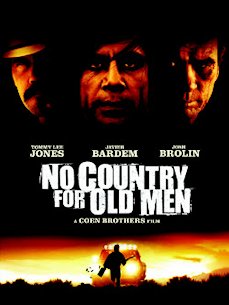
No Country For Old Men
Mood?:: Abandon All Hope |
In A Minor Key | Nail Biter.
iRate:: 4½ / 5
Directors:: Ethan and Joel Coen.
Writers:: Cormac McCarthy (novel: No Country for Old Men);
Ethan and Joel Coen (screenplay).
Cinematography:: Roger Deakins.
Editor:: Roderick Jaynes (Ethan and Joel Coen).
Music:: Carter Burwell.
Cast:: Tommy Lee Jones, Javier Bardem, Josh Brolin, Woody Harrelson, Kelly MacDonald, Beth Grant, Garret Dillahunt, Stephen Root, Jason Douglas, Kit Gwin, Tess Harper, Barry Corbin.
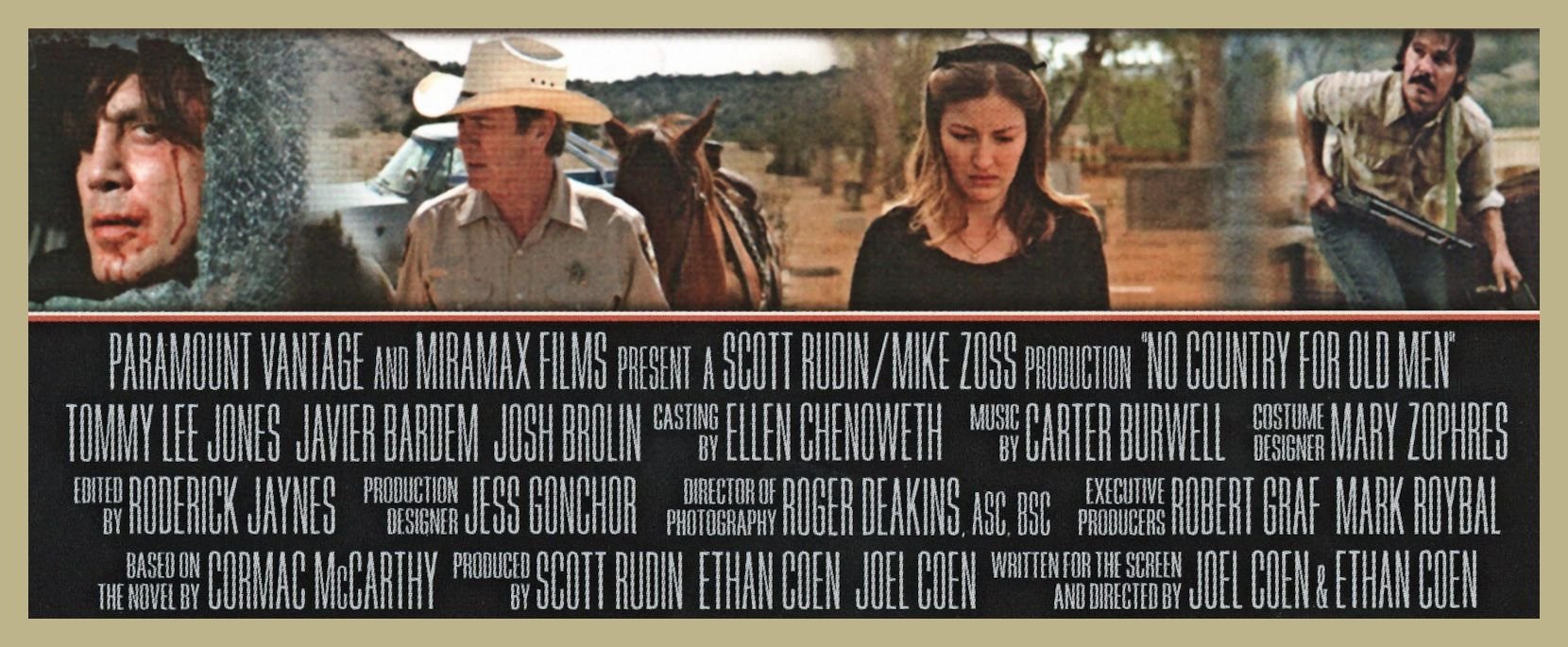
Click for Credits Enlargement
Credits (Click to expand)

Trailer (HD):

iReview:
This week I decided to check out a movie I hadn’t seen before (unbelievably lame, I know), and also from this century: No Country For Old Men (2007). Universally praised and hailed as a filmmakers masterpiece, this movie also attracted an avalanche of awards. Joel and Ethan Coen share the record of four Oscar nominations for the same film with Orson Welles for Citizen Kane (1941) and Warren Beatty for Reds (1981). The Coens’ four nominations are for Best Picture (won as producers with Scott Rudin), Best Director (won), Best Adapted Screenplay (won), and Best Editing (under the pseudonym Roderick Jaynes).

What Happens:
Acclaimed filmmakers Joel and Ethan Coen deliver their most gripping and ambitious film yet in this sizzling and supercharged crime thriller.

When Llewelyn Moss (Josh Brolin) stumbles on a bloody crime scene, a pickup truck loaded with heroin, and two million dollars in irresistible cash, his decision to take the money sets off an unstoppable chain reaction of violence and his pursuit by a nerveless psychopath, Anton Chigurh (Javier Bardem). Not even West Texas lawman, Sheriff Bell (Tommy Lee Jones), can contain it.

“This magnificent film represents the best work the Coen Brothers have done since Fargo. Like that movie classic, this is a cold-blooded thriller with a darkly humorous edge… Hitchcock wouldn’t have done the suspense better.”
(David Stratton, ABC Australia, At The Movies)

“No Country for Old Men is as good a film as the Coen brothers, Joel and Ethan, have ever made, and they made Fargo.”
(Roger Ebert, Chicago Sun-Times)

Click for Story Enlargement
Story (Click to expand)

While this is recognized as the Coen brothers darkest and most tense film, it is not lacking in their signature deadpan humour. I love the way they play with Cormac McCarthy’s language in this script (yes they directed, adapted and edited the whole thing). Here’s an exchange between Deputy Wendell (Garret Dillahunt) and Sheriff Bell (Tommy Lee Jones):
Wendell
“Well, it’s a mess, ain’t it, sheriff?”
Sheriff Bell
“If it ain’t, it’ll do till the mess gets here.”

McCarthy’s writing was clearly destined for the Coens’ delightful and mischievous adaptation. I can imagine the brothers glee as they saw these words; they and Cormac are kindred spirits.

The three main characters are all beautifully drawn: Vietnam vet. Llewelyn Moss (Josh Brolin), is an expert hunter who happens upon an unhappy scene with perhaps, happy consequence – a slew of bullet-strewn bodies, bullet-ridden trucks, a truckload of drugs and 2 million dollars in cash; Sheriff Ed Tom Bell (Jones), a very competent veteran lawman, the last in this family business, who seems slightly out of his time; and recovery guy, Anton Chigurh (Javier Bardem), the unflinching psychopath who carves a murderous path across Texas with his gas bottle and cattle stun-gun.

Brolin is entirely believable as Moss, a man who might just be able to stay one step ahead of the unstoppable Chigurh (pronounced chugar). Tommy Lee Jones, as the slightly world weary Bell, acts his socks off in this. He utterly inhabits the role with exquisite timing and tone, and an understated delivery that tells you he’s at the top of his craft. He also wears the vernacular like a Texas native (oh, hang on a moment, he is). Bardem was born to play Chigurh and he does so with pitch perfect characterization. You just know that if you bumped into Javier on an L.A. street, you’d regret the experience; he’s that good. The three story-anchors are ably supported by Scottish actor, Kelly MacDonald, as Moss’ wife Carla, who had me completely fooled – of course she was a Texan; Woody Harrelson plays himself delivering us Carson Wells, who was sent to end the out of control murder spree and recover the money; and Beth Grant, who gives us a short but memorable turn as Carla’s abrasive mother.

From the stunning red sky silhouette that stamps Roger Deakins’ entry into the film, you know there’s some wonderful photography ahead and he doesn’t disappoint. In much the same way as cinematographer, Tom Stern has become the right hand of director, Clint Eastwood, Deakins has come to exemplify the Coen brothers films. His framing is very precise and in almost all ways, I couldn’t imagine it done better. You only need to watch the featurette: The Making of No Country for Old Men (see extras), to see the contrast between the behind-the-scenes footage, and the finished shots.

The music from Carter Burwell, another staple of the Coen universe, is unobtrusive but appropriate, leaving space for the sound of the wind to weave its magic throughout the film.

I’ve left the best for last… The work of the brothers as directors, writers and editors is near faultless. None of the plot seems forced or contrived, even though the effect of the whole is completely quirky (as you’d expect from a Coen film). The stories of the three central intertwining characters rarely fully intersect yet they are told in such a way that you’re never left wondering. The dialogue is fluid and deliberate without anything superfluous or corny. The tension built by the direction and editing is perfectly fit for purpose with so many near misses and moments of possible discovery which keep us on the edge of the seat. The hotel/motel scenes where Moss and Chigurh never meet, are exercises in pure dread. Add to that, the device of the coin toss which creates another layer of delicious tension. And, like a cat toying with its prey, the Coen brothers leave us guessing which way the coin fell, the final time, until we see Chigurh check the soles of his boots on the path out front.

The luxury of having almost complete control of the film making process is a creative advantage few directors are afforded. Even fewer filmmakers, I suspect, would be able to handle these multiple disciplines with as much finesse as the Coens. Steven Soderbergh has often photographed (as Peter Andrews) and edited (as Mary Ann Bernard) the films he’s directed, with excellent results. However, I wouldn’t rate him quite in the same class as Joel and Ethan Coen. Here, the Coens have employed their extra limb (Deakins) on camera while they have control of every other major aspect of the look of the film. The combination of their shooting script, their dialogue, their direction and their precision editing, is a rhythm that is almost musical. I became conscious of this as I mused over their many cuts and cutaways and realized they were part of a dance which also included the delivery of the dialogue. It’s very clever and something only really achievable if you control the whole shebang as they did.

This would have been an impressive genre movie even if it had a conventional conclusion. But the ending that presents itself here, was so satisfying and original that I found myself laughing completely inappropriately. If you’re one of the other three people who haven’t yet seen this movie then I’m not going to spoil it by telling you.

The Academy got it completely right in awarding the filmmakers their Oscars for this movie; as a lesson in film making it is peerless.

As a critic, Roger Ebert, regularly placed himself in the seat of a genre fan, so he would not necessarily grade on an absolute scale (according to his taste) but rather gave a relative score. Thus on Ebert’s scale, if Superman (1978) scores 4 within the superhero genre, then Hellboy (2004) gets a pretty good 3 (even though Ebert really disliked the film) and The Punisher (2004) only a 2. If I were putting myself in someone else’s seat then, like Ebert (who scored this a 4/4), I’d have to give this 5/5. But, because I want to keep a perfect 5/5 for rare movies that completely blow me away, I am awarding this a 4½ / 5. Jeez, after an explanation like that, it might have been easier just to go the 5.

The Picture:
As you would hope, with a movie of this recent vintage, the screen image is superb. Every craggy wrinkle line, every speck of blood (and there’s a lot of that) and every bullet hole crack in the glass of Moss’ truck, is displayed in brilliant detail. The colours are rich and true and the image, clean with no visible noise.

The Audio:
I wish I’d had the foresight to have bought the Collector’s Edition with its possibly superior DTS 5.1 audio track. As it happens, this Blu-ray LPCM 5.1 sound track is more than adequate. As well, as this isn’t an action flick, the quality of audio reproduction isn’t quite as critical. There were times when the balance between speakers fell short of ideal. For example, occasionally, the right front and left surround channels dominated, leaving the left front unbalanced and slightly out of the mix. Apart from these occasional anomalies, though, the audio field sounded fine.

Verdict:
I’m embarrassed that it has taken me this long to see this movie, especially as I’ve had it in the library for some time. In a way though, I’m glad I waited because I think I can now appreciate the virtuosity of its construction a lot more than I would have only a few years ago. It’s a filmmakers tour de force and a film I’ll likely learn more from with each viewing.

iRate:: 4½ out of 5.

4Movie Tragics

Extras:
• The Making of No Country for Old Men (as well as the usual filmmaker discussion about inspiration and script development, there’s some interesting behind-the-scenes action from the set… an interesting featurette) – 24min.
• Working with the Coens (this is pretty much a PR gushfest) – 8min;
• Diary of a Country Sheriff (this character featurette looks at Sheriff Bell from a number of angles and compares him with Chigurh… enjoyable without being essential) – 7min;

You want More!
No Country For Old Men – IMDb (Internet Movie Database)
No Country For Old Men – Rotten Tomatoes
No Country For Old Men – allmovie.com
No Country For Old Men – Wikipedia


Is this the best movie by the Coen brothers or does Fargo still top the list?
Have I got it completely wrong and has Stephen Hunter got it right in his Washington Post review, when he abruptly states, “I just don’t like it very much”?


:: Please leave a comment ::
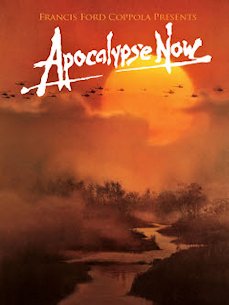

The Sunday Screening Session….. Apocalypse Now (1979)

14 Sunday Apr 2013

Posted by Zak de Courcy in Film

≈ 3 Comments

Tags

1970s, Abandon All Hope, Adventure, Adventure Drama, Albert Hall, Anti-War Film, Apocalypse Now, Apocalypse Now Redux, Cambodia, Cold War Film, Dennis Hopper, Drama, Epic, Film, film review, Francis Ford Coppola, Frederic Forrest, Guy Movie, iRate:: 5 / 5, John Milius, Jungle Film, Laurence Fishburne, Marlon Brando, Martin Sheen, Modern Classic, Robert Duvall, Roger Ebert, Sam Bottoms, Slow Burn, Starpower, Sunday Screening Session, Vietnam, Vietnam War Era, War, War Epic

Apocalypse Now (1979) (196 min)
iReview: Version: Apocalypse Now: Full Disclosure Edition (Blu-ray);
Video: AVC 1080p; Audio: DTS 5.1.
Genre:: Adventure | Drama | Epic | War |
Sub-Genre/Type:: Adventure Drama | Anti-War Film |
Cold War Film | Jungle Film | Modern Classic | War Epic |
Settings:: 1970s | Cambodia | Vietnam | Vietnam War Era.
Apocalypse-Now-305
Mood?:: Abandon All Hope | Guy Movie |
Slow Burn | Starpower.
iRate:: 5 / 5 (One of my top 10)
Director:: Francis Ford Coppola.
Writers:: Joseph Conrad (novella: Heart of Darkness); Michael Herr (narration); Francis Ford Coppola & John Milius (screenplay).
Cast:: Marlon Brando, Martin Sheen, Robert Duvall, Frederic Forrest, Sam Bottoms, Albert Hall, Laurence Fishburne, Dennis Hopper, Harrison Ford, G. D. Spradlin, Jerry Ziesmer, Scott Glenn.

Click for Credits Enlargement
Credits (Click to expand)

Trailer (HD):
https://youtu.be/apo6_iOe0Jw

iReview:
With the death of famed Chicago Sun-Times critic, Roger Ebert (see my earlier Ebert post), I thought I’d have a look at one of his and my top 10 movies, Apocalypse Now. I recently obtained the 3 disc Full Disclosure Blu-ray Edition which includes the movie tragics must-have Hearts of Darkness: A Filmmaker’s Apocalypse, the 1991 documentary chronicling the making of the film. The package also includes the 1979 cut of Apocalypse Now and an ammo dump full of interesting extras. I wasn’t able to source this set in-store so I was forced to find it online (I’ve included convenient links to search on eBay and Amazon (UK) below).

What Happens:
Francis Ford Coppola adapted the Joseph Conrad novella Heart of Darkness (set in the Belgian Congo, Africa) to depict the Vietnam War as a descent into primal madness. Capt. Benjamin Willard (Martin Sheen), already on the edge, is assigned a secret mission to find and deal with AWOL Col. Kurtz (Marlon Brando), who has set himself up in the Cambodian jungle as a cult warlord. Along the way up-river, Willard encounters: the lover of napalm and Wagner, Col. Kilgore (Robert Duvall); soldiers who prefer to surf and do drugs: a troupe of USO Playboy Bunnies, whose show turns into a riot; and a manic photographer (Dennis Hopper), who tells wild, reverential stories about Kurtz. By the time Willard sees the scattering of heads at Kurtz’s compound, he knows Kurtz has gone insane…

Click for Story Enlargement
Story (Click to expand)

It’s been many years since I saw the 2001 Redux version of this film and a year or so since my last visit with the original 1979 cut, so I arrived for this marathon sitting of Redux with relatively fresh eyes.

Now that I know Martin Sheen (Capt. Benjamin Willard) was actually very drunk when filming the first bedroom scene in which he did his best to destroy the set, the scene has acquired added significance. The blood was also real as Sheen cut his hand in the process. This scene becomes emblematic of the production chaos of the Philippines’ shoot, with a typhoon destroying the set and Sheen’s near fatal heart attack (which was kept secret, with his hospitalization ascribed to ‘heat exhaustion’). The intrigue surrounding the production is one of the things that makes the warts-and-all Hearts of Darkness: A Filmmaker’s Apocalypse documentary (on disc 3), compiled from footage shot by Eleanor Coppola, so compelling. There’s the revelation that half the cast were using marijuana, speed or LSD or all three, and often while filming. Add to that, the news that Laurence Fishburne (Clean) lied about his age to get the part as he was only 14 when filming began; that a nearby Islamic insurgency resulted in the frequent and sudden departure, often while filming, of the leased Philippines military helicopters, called away to battle; that the scheduled 6 week shoot was repeatedly extended to an eventual 16 months; that shooting delays resulted in Brando pocketing his already paid $1 million advance on his $1 million per week salary and almost walking away, rather than reschedule his three weeks on set; that Brando arrived dramatically overweight and concerned about his appearance and required that only scenes showing him in shadow be included in the film; that Brando arrived completely unprepared having read neither the novel (Heart of Darkness) or the script (something he was notorious for); that Brando insisted on detailed consultation with Coppola, sometimes lasting days, before improvising scenes, all while the cast and crew were waiting on standby; and that the budget blew out to $40 million, a record at the time. There’s also the shocking and highly confronting footage of the ritual, brutal killing of pigs and the hacking to death of the water buffalo that appears at film’s end (I think its eyes will haunt me for a very long time). The documentary also brilliantly illuminates the insanity of the shoot which seemed to mirror the insanity of the Vietnam War and the madness on screen. If you don’t want your viewing of the film to be tainted, I’d recommend you leave this documentary ’til last.

Apocalypse Now was always episodic, as road movies often are, with set pieces revealed as Willard and the river patrol boat crew, progress up the Nung River towards Cambodia. But in Redux, this aspect of the story is accentuated with the addition of scenes featuring the stranded ‘Bunnies’ and the French colonial plantation compound.

After so many previous viewings, there’s still the pleasure of anticipation, waiting for the arrival of Colonel Bill Kilgore (Robert Duvall) who leads his airborne chopper cavalry and is surfing obsessed, seemingly invulnerable, and just loves “the smell of napalm in the morning”. He also has a lust for mass carnage, accompanied by a bellowing rendition of “Ride of the Valkyries” by Wagner.

Next up the river, there’s the USO show featuring the troupe of Playboy Bunnies, who arrive by chopper, parade provocatively, get mobbed in a riotous scramble, and retreat to their chopper in a cloud of smoke.

By the time I’d arrived at the chaotic MedEvac station with the stranded ‘Bunnies’, the first major departure from the 1979 version, I realized I needed to see the original again to put Redux into perspective (hence the delay in publishing this post). And frankly, while the original stand-alone USO Bunnies show scene, illustrates the detachment of US resolve and ineffectiveness in war fighting, the added MedEvac scene seems an unnecessary adjunct which muddies (excuse the pun) the thread of the story and adds only a negative aesthetic to the movie.

Moving up the river, Chief (Albert Hall) spots a sampan and, against Willard’s advice, they stop and search the boat. As Chef (Frederic Forrest) belligerently searches the sampan, Clean (Laurence Fishburne) unexpectedly opens fire on the boat. What ensues is the My Lai Massacre moment of the movie.

With each encounter, as they progress further from civilization, the crew’s grip on sanity wavers a little more. By the time they reach the chaotic Do Long bridge outpost with its precarious suspension bridge and no discernible chain of command, Willard and his men seem like an island of calm in a swirling nightmare.

I’m neutral about the efficacy of the added French colonials scene in Redux. At the time of the release of the 1979 cut, the Vietnam War was still extremely raw in the American Psyche, having ended only 4 years earlier. It’s perhaps understandable then, that Coppola decided not to pollute the ‘descent into the madness of America’s Vietnam War‘ theme with a discourse on the colonial era. Thirty four years later, that anti-Vietnam War focus of the film, perhaps, doesn’t need to be so sharply defined, so the departure into French colonial history adds an interesting side-track. Filming it at all may have been a subtle nod to Conrad’s original Heart of Darkness, set in the French speaking, Belgian Congo colony.

The horrific scenes awaiting what’s left of the crew, when they arrive at Kurtz’s compound, seem entirely appropriate, given the portents that accompanied their journey.

Coppola’s additional Kurtz Compound scenes in Redux, add another layer of insight along with subtle changes to Kurtz’s character. In the original, Kurtz was made more poetically enigmatic by his shadowy illumination. In Redux, Kurtz is just plain mad. At the time of production, Marlon Brando was something of an actor demi-god, so it was understandable that he and Coppola were concerned that his obesity might be an unwelcome distraction, hence the noirish camera work. With Brando’s immensity no longer a novelty, it’s interesting to see the additional ‘lit’ scenes as they ‘flesh’ out Kurtz’s personality (stop with the puns, already!).

This intense week-long immersion into the Apocalypse Now universe has been fascinating for me and has led to the conclusion that on balance, I marginally prefer the original cut to Redux. However, they each stand, in their own right, as monumentally stunning achievements in film-making. Watching both films in reasonably close proximity, also gave me an unexpected look behind the curtain to the art behind movie-making, as I was able to see great examples of the editor’s craft. That for me was worth the price of admission (in this case the cost of the Blu-ray set).

The Picture:
I’m pleased that Coppola prevailed with the 2.35:1 aspect ratio rather than Cinematographer, Vittorio Storaro’s preferred 2.0:1 (used on previous releases) which chopped the frame and occasionally caused oddly skewed shot framing and pans.

This transfer to Blu-ray while not quite as stunning as some I’ve seen recently (I’ve been spoilt), is nevertheless beautifully rendered and a pleasure to watch. It might just have been me, but this new Blu-ray palette also seems to have a slightly heavier yellow hue than previous versions, giving the image a warmer look than I’d like (it’s OK, I’m already kicking myself for nit-picking).

Overall, the screen image is clean and well defined with Kurtz’s disembodied head brilliantly defined and contrasted against deep black. Also look out for the way Willard’s face is lit while he reads the Kurtz dossier on the deck of the patrol boat. And let’s face it, Storaro’s photography is breathtakingly sumptuous, especially in the film’s first half. I’m also conscious of the fact that Coppola needed to incorporate previously discarded footage, which can’t have been easy, and then colour grade both films for consistency. To have created such a seamless result is astonishing. If you need confirmation of just how good it is, check out Richard Donner’s 2006 cut of Superman II which is good but not nearly as consistent as Apocalypse.

The Audio:
The Blu-ray DTS 5.1 sound track is one of the best I’ve heard, particularly the woofer’s rumbling bass. The balance and sweep of the sound effects mix is awesome with helicopters tracking seamlessly from monitor to monitor. The sound field is completely immersive, especially at higher volume (I hope the neighbours weren’t too annoyed).

My only complaint about the soundtrack is an issue of personal taste: I would have much preferred a score without the heavy and dated synthesizer. A completely contemporary rock track or even an orchestral score would have been fine. Unfortunately, the mix of great ’60s and ’70s rock tracks interspersed with nondescript synth. just didn’t do it for me.

Verdict:
This movie was already in my top ten so my expectations of this release were high. I’m so pleased that Coppola has allowed his two versions of Apocalypse Now to co-exist as they are each wonderful in their own way. I’d say, if anything, this new Blu-ray package with its incomparable set of extras, has enhanced my impression of the films. So hats off to the guys who took such care putting this together.

iRate:: 5 out of 5 (One of my top 10).


4Movie Tragics

Buy:
• Apocalypse Now: Full Disclosure Blu-ray Edition (at eBay)
• look for Apocalypse Now: Full Disclosure Blu-ray Edition / 3-disc Special Edition (at Amazon UK).
(note: Any UK Blu-ray is playable in Australia as they share the same region code ‘B‘ (USA code is ‘A‘). Just to confuse things though, be aware that their DVD region codes are different – Region: 2 (UK), 4 (Aus), 1 (USA). But many UK DVDs are coded for both regions (2 & 4), so check.)

Extras:
• Feature Commentary by Director Francis Ford Coppola (complements the Hearts of Darkness: A Filmmaker’s Apocalypse documentary quite well. I’d be inclined to listen to the commentary on Redux, as it’s full of interesting production notes and anecdotes. As well, the commentary track for the original version was edited down from this one).

Disc Two:
• A Conversation With Martin Sheen
(Sheen and Coppola reminisce about the casting, drugs, alcohol, tigers, the heart attack, and much more… interesting) – 59min;
• An Interview With John Milius (here Coppola and Milius discuss their writing process and the script’s evolution as they drill deeply into the screenplay. They also briefly touch on Milius’ own military ambitions and how that played into the screenplay… one for the geeks and illuminating and enjoyable) – 50min;
• Fred Roos: Casting Apocalypse (includes screen test footage and features the film’s casting director, Roos, talking about the hundreds of actors tested for various roles) – 12min;
• ‘Apocalypse’ Then and Now (has some brief snippets from Roger Ebert’s Cannes interview with Francis Ford Coppola) – 4min;
• 2001 Cannes Film Festival: Francis Ford Coppola (the entire Ebert Cannes interview) – 39min;
• PBR Streetgang (profiles and reflections from the actors playing Willard’s patrol boat crew: Laurence Fishburne, Sam Bottoms, Albert Hall, and Frederic Forrest) – 4min;
• “Monkey Sampan” Deleted Scene (a disturbing deleted segment featuring a boat overrun with monkeys and natives singing “Light My Fire”) – 3min;
• Additional Scenes (12 timecoded scenes including Lt. Richard M. Colby (Scott Glenn) dialogue and undoctored footage where the name of Brando’s original character name, Col. Leighley, can be heard) – 26min;
• Destruction of the Kurtz Compound (the jettisoned final credits sequence which Coppola ultimately rejected when he feared audiences were misinterpreting it) – 6min;
• The Birth of 5.1 Sound
(a fascinating Dolby Labs presentation which looks at how Apocalypse Now led to a revolution in film surround sound design) – 6min;
• Ghost Helicopter Flyover
(sound engineer, Richard Beggs, explains how the surround sound design for the opening helicopter sequence was created) – 4min;
• The Music of Apocalypse Now (looks at how the various musical elements: The Doors, synthesizer music, orchestral and percussion work were integrated together) – 15min.
• The Synthesizer Soundtrack (a text screen reprint of a Bob Moog article from Keyboard magazine);
• Heard Any Good Movies Lately? The Sound Design of ‘Apocalypse Now‘ (Coppola, Walter Murch, Richard Beggs, and post-production recordist Randy Thom talk about and show us how the revolutionary sound design for the film was created) – 15min;
• A Million Feet of Film: The Editing of ‘Apocalypse Now‘ (a great look at how Coppola and editor Walter Murch pulled a coherant film together from the immense stock of scripted, experimental and improvised footage) – 18min;
• The Final Mix (Randy Thom introduces some great footage of the multi-room setup which was necessary to achieve the final mix for the film) – 3min;
• The Color Palette of ‘Apocalypse Now‘ (Vittorio Storaro attempts to explain the technical aspects of the three strip dye transfer Technicolor process utilized on the film) – 4min.
• The Hollow Men (an odd little period (circa 1979) featurette with Brando reciting Eliot’s poem with scenes from the film and the shoot) – 17min;
• Mercury Theater Production of ‘Heart of Darkness’ (audio presentation of Orson Welles production of Joseph Conrad’s novella… some of the audio quality has suffered with time.) – 37min.

Disc Three:
• Hearts of Darkness: A Filmmaker’s Apocalypse (the fascinating behind-the-scenes documentary compiled from home movie footage shot by Coppola’s wife Eleanor. The film includes audio from tapes she recorded without Francis’ knowledge for what she, at the time, expected to turn into a diary. The chaos and intrigue surrounding the making of the film, makes this compelling viewing. As if that’s not enough, there’s also an optional and very interesting commentary track from the Coppola’s.) – 99min.
• John Milius Script Selections with Notes by Francis Ford Coppola
(text screens);
• Storyboard Gallery (with more than 200 screens);
• Photo Archive (a huge trove of production and candid stills together with some Mary Ellen Mark photography);
• Marketing Archive (featuring the 1979 trailer, radio spots, theatrical program, lobby cards, press kit photos, and a poster gallery).

Printed Material:
• A 48-page Full Disclosure booklet which features a written introduction from Francis Ford Coppola, script excerpts (with notes scrawled over them), production photos, storyboards, sketches, and other production art.
• An Apocalypse Now booklet with production notes, credits and cast and crew biographies.
• 5 Black & White postcards.

You want More!
Apocalypse Now – IMDb (Internet Movie Database)
Apocalypse Now – Rotten Tomatoes
Apocalypse Now Redux – Rotten Tomatoes
Apocalypse Now – allmovie.com
Apocalypse Now Redux – allmovie.com
Apocalypse Now – Wikipedia
Apocalypse Now Redux – Wikipedia


Is this the best war film ever made?

:: Please leave a comment ::


The Sunday Screening Session….. Star Wars: Episode VI – Return Of The Jedi (1983)

31 Sunday Mar 2013

Posted by Zak de Courcy in Film

≈ 1 Comment

Tags

Action, Action & Adventure, Adrenaline Rush, Adventure, Alec Guinness, Billy Dee Williams, Carrie Fisher, Ensemble Film, Epic, Fantasy, Film, film review, Frank Oz, George Lucas, Guy Movie, Harrison Ford, iRate:: 4½ / 5, John Williams, Lawrence Kasdan, Mark Hamill, Master Villain Film, Modern Classic, Other Dimensions, Out In Space, Richard Marquand, Sci-Fi Action, Sci-Fi Adventure, Science Fiction, Science Fiction Epic, Space Adventure, Star Wars, Star Wars Episode VI Return of the Jedi, Sunday Screening Session

Star Wars:
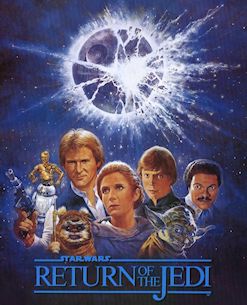
Episode VI Return Of The Jedi (1983)
 (135 min)

iReview: Version: Star Wars: The Complete Saga (Blu-ray);
Video: AVC 1080p; Audio: DTS 5.1.
Genre:: Action | Adventure | Epic | Fantasy | Science Fiction |
Sub-Genre/Type:: Action & Adventure | Ensemble Film |
Master Villain Film | Modern Classic | Sci-Fi Action |
Sci-Fi Adventure | Science Fiction Epic | Space Adventure |
Settings:: Out In Space.
Image
Mood?:: Adrenaline Rush |
Guy Movie | Other Dimensions.
iRate:: 4½ / 5
Director:: Richard Marquand.
Writers:: George Lucas (story); Lawrence Kasdan & George Lucas (screenplay).
Cast:: Mark Hamill, Harrison Ford, Carrie Fisher, Frank Oz, Billy Dee Williams, Alec Guinness, Anthony Daniels, Kenny Baker, Peter Mayhew, David Prowse, James Earl Jones, Sebastian Shaw, Ian McDiarmid, Michael Pennington.

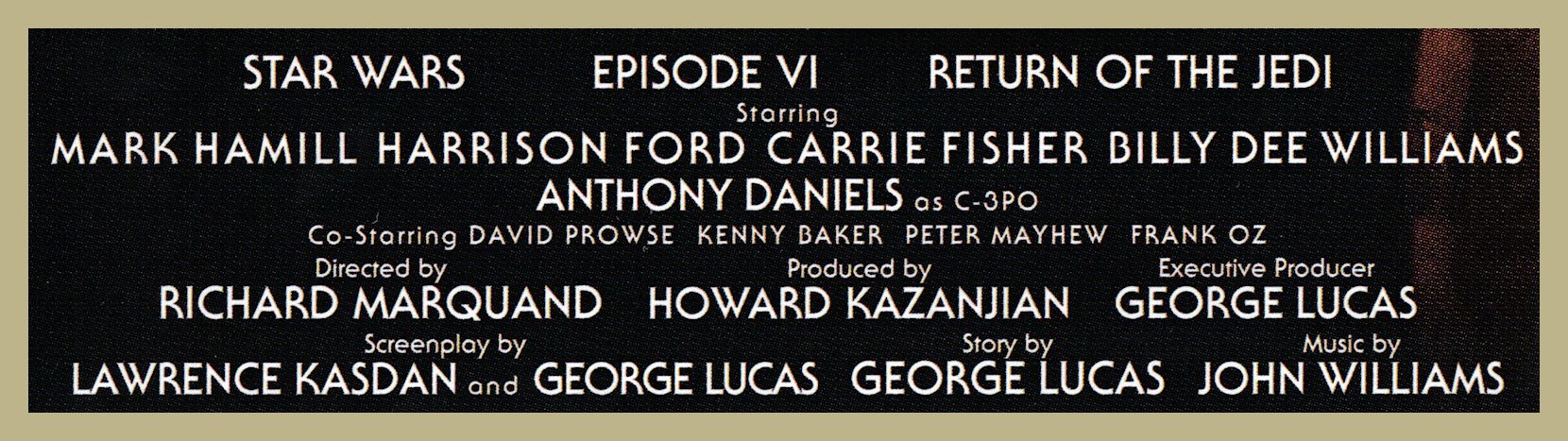
Click for Credits Enlargement
Credits (Click to expand)

Trailer (HD):

iReview:
This week’s selection was a no-brainer, as a happy coincidence of events made the choice very easy. Today is the 30th birthday of all-round-good-bloke and son in law, Morgan, who shares a birthday with the final chapter of one of his favourite film franchises, Star Wars: Episode VI – Return Of The Jedi. It’s hard to believe, I know, that it’s been that long. I had intended to set aside a whole weekend to view the entire Star Wars: The Complete Saga Blu-ray set, with its 6 movie and 3 Extras discs. But that’s going to have to wait. In the meantime, and in honour of Morgan’s birthday, I’m going to enjoy revisiting this much loved film.

What Happens:
In the epic conclusion of the saga, the Empire prepares to crush the Rebellion with a more powerful Death Star.

Han Solo (Harrison Ford) emerges intact from the carbonite casing in which he’d been sealed, after rescue by R2-D2 (Kenny Baker), C-3PO (Anthony Daniels), Chewbacca (Peter Mayhew), Lando Calrissian (Billy Dee Williams), Princess Leia (Carrie Fisher), disguised as a bounty hunter, and Luke Skywalker (Mark Hamill). Then they must escape the clutches of the grotesque Jabba the Hutt.

On the forest moon Endor, the reunited team enlist the help of the Ewoks as the rebellion reaches its decisive stage.

Meanwhile, Luke Skywalker confronts Darth Vader (David Prowse & voiced by James Earl Jones) in a final climactic duel before the evil Emperor Palpatine (Ian McDiarmid). As he enters into this spirited battle with his light saber-wielding enemy, some surprising revelations await the young warrior…

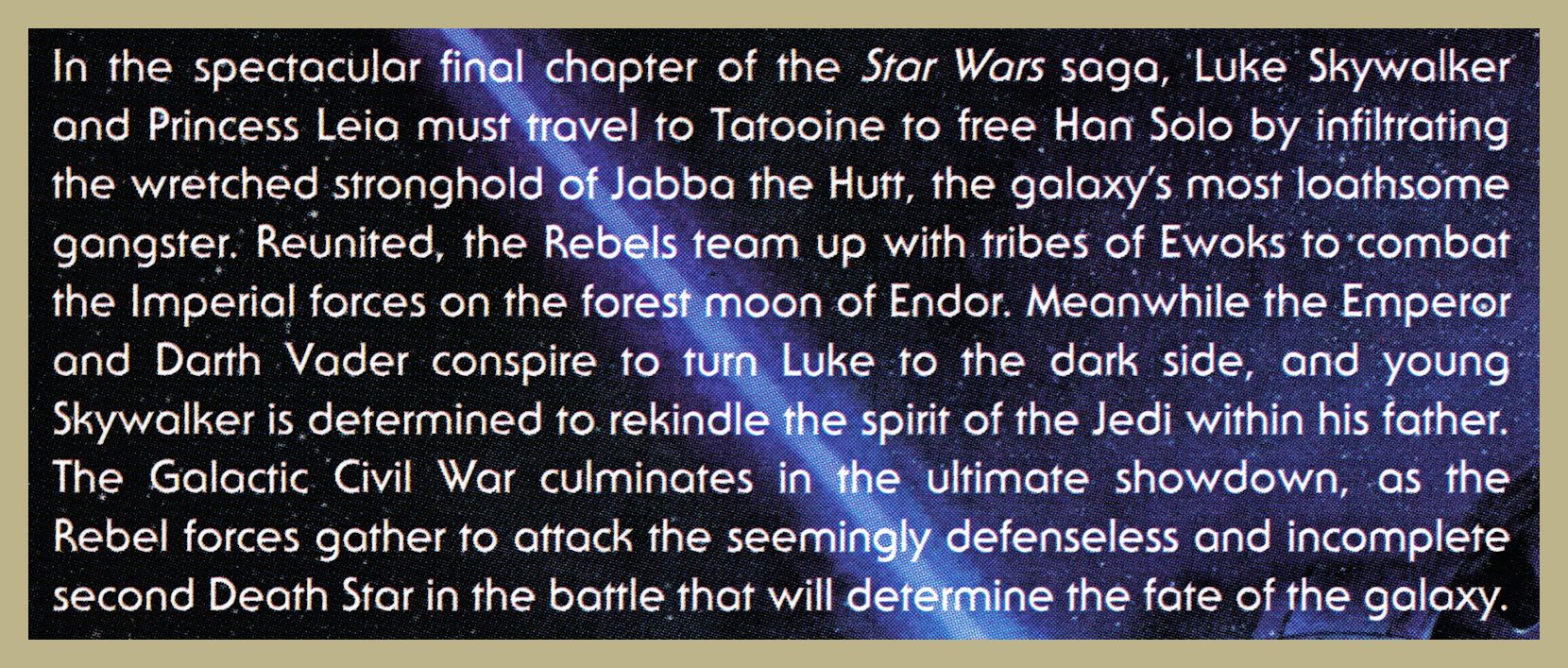
Story
Story (Click to expand)

With the plot safely secured back in my memory, I sat down with a little unease; this was the first time I’d watched Jedi in isolation and also in glorious 1080p HD. How would the movie stand up without its usual crutches, Star Wars and The Empire Strikes Back to lend it support? I wanted it to be great, and you know what, I wasn’t disappointed.

In my memory, Jedi was the least impressive of the original trilogy. That may still be true but I get the feeling that by its release in 1983, we’d become very familiar with the Star Wars universe. I still remember the goose bumps I felt on that day in 1977, when I first saw the mighty Imperial Stardestroyer emerge from above and gradually fill the huge dark screen. The sequence was made perfect by the accompanying deep rumble of the sound track and John Williams’ opening of the Star Wars Symphony. When I first saw it, everything about Star Wars was new for me. I’d seen and been perplexed by 2001: A Space Odyssey (1968) but I’d never seen a space fable like Star Wars. The special effects were not a compromise of Flash Gordon model spacecraft darting drunkenly in front of an obviously painted matte space. They were believable and very real in a way I’d never seen before. I remember that very quickly, Star Wars had been integrated into my life to the extent that the sound-track vinyl album got frequent play even though it was completely out of place next to my Led Zeppelin, Deep Purple and Fleetwood Mac.

With the second installment, The Empire Strikes Back, in the hands of Irvin Kershner, the continuing story transcended the novel appeal of its predecessor and emerged as a cinematic triumph with a great story, great effects, and most importantly, none of Lucas’ dreadful dialogue. I recall seeing Jedi for the first time as a much anticipated closure to the story and with a very high bar set by the first two films, it didn’t disappoint.

The Picture:
In this high definition version of Jedi, the image is brilliantly saturated and crisply defined, with no discernible noise. I don’t remember Endor being quite as lush and beautiful as it appears here. As well, the battle between the Imperial and Rebel fleets fills the screen spectacularly and with a pitch-perfect DTS 5.1 audio track. The final confrontation between Vader and Luke also has all the drama and visual excitement I’d hoped for and remembered.

The Audio:
The Blu-ray DTS 5.1 sound track is stonkingly brilliant and that’s with no ifs, buts or maybes. The mix of sound effects and music score is pristine. The discretion of spacecraft rumble and other mechanical noises together with the subtlety and richness of the sounds of the Endorian natural environment, are a joy to hear. John Williams’ Star Wars theme has been waiting patiently for 30 years for the exposition of this Blu-ray set. And, never has Darth Vader’s respirator assisted voice sounded so menacing and the swoosh and hum of the lightsaber, so threatening.

Verdict:
My only criticism of this edition of Jedi, and it’s very minor; I wish someone had held Lucas back when he decided to tinker with the later releases of the film, including this one. Look out for the CGI soul singer with suitably silly alien backing group singing Jedi Rocks. I found myself mildly irritated that George thought the addition of this turgid song and its inconsequential CGI would somehow elevate the movie. Also, some of the other cosmetic CGI changes that Lucas has brought to the movie seem to stand out even more in HD, especially the not so successful additions of some obviously CGI building structures.

Coming back to the film in isolation, did also highlight how much merchandising Lucas was able to attach to these movies. I’d never been so conscious of how cute, kid friendly and stuffed toy-like the Ewoks were.

Overall though, this has been a wholly satisfying return to one of my favourite movie sagas and one I’m really looking forward to completing. I also have a sneaky feeling that once I’ve seen the rest of this Star Wars: The Complete Saga Blu-ray pack, the old DVD box-set (with the exception of the Special Features disc), might reluctantly have to migrate to Cash Converters.

Anyone looking to augment Morgan’s (if you know him, that is) Blu-ray collection can use these convenient links:
Star Wars: The Complete Saga Blu-ray (at eBay)
Star Wars: The Complete Saga Blu-ray (at JB HiFi)

iRate:: 4½ out of 5.

4Movie Tragics

Extras:
• Feature Commentary by Director George Lucas, actor Carrie Fisher, and crew, Ben Burtt and Dennis Muren (this is a surprisingly interesting and informative track, dominated, as you might expect, by George Lucas, which also appears on previous releases. If you’re new to this then I’d urge you to remember that Lucas is the creator and curator of the Star Wars mythology and so treat his recollections of fact with due caution.)
• Audio commentary from archival interviews with cast and crew.

You want More!
Star Wars: Return Of The Jedi – IMDb (Internet Movie Database)
Star Wars: Return Of The Jedi – Rotten Tomatoes
Star Wars: Return Of The Jedi – allmovie.com
Star Wars: Return Of The Jedi – Wikipedia


Where does “Return of the Jedi” fall on your list of favourite Star Wars flix? A lot of critics were unenthusiastic about this when it was released. Were they wrong? I love it, what about you?

:: Please leave a comment ::


The Sunday Screening Session….. Platoon (1986)

24 Sunday Mar 2013

Posted by Zak de Courcy in Film

≈ 2 Comments

Tags

1867-68, Action, Anti-War Film, Blood and Gore, Charlie Sheen, Cold War Film, Combat Film, Drama, Ensemble Film, Film, film review, Food For Thought, Forest Whitaker, Francesco Quinn, iRate:: 4½ / 5, John C. McGinley, Johnny Depp, Jungle Film, Keith David, Kevin Dillon, Modern Classic, Oliver Stone, Platoon, Richard Edson, Southeast Asia, Sunday Screening Session, Tom Berenger, Tough Guys, Vietnam, Vietnam War Era, War, War Drama, Willem Dafoe

Platoon (1986) (120 min)
iReview: Version: Platoon: 25th Anniversary (Blu-ray);
Video: AVC 1080p; Audio: DTS 5.1.
Genre:: Action | Drama | War |
Sub-Genre/Type:: Anti-War Film | Cold War Film | Combat Film |
Ensemble Film | Jungle Film | Modern Classic | War Drama |
Settings:: 1867-68 | Southeast Asia | Vietnam | Vietnam War Era.
Image

Mood?:: Blood and Gore |
Food For Thought | Tough Guys.
iRate:: 4½ / 5
Director:: Oliver Stone.
Writer:: Oliver Stone (screenplay).

Cast:: Tom Berenger, Willem Dafoe, Charlie Sheen, Forest Whitaker, Francesco Quinn, John C. McGinley, Richard Edson, Kevin Dillon, Reggie Johnson, Keith David, Johnny Depp, David Neidorf.

Click for Credits Enlargement
Credits (Click to expand)

Trailer (HD):

iReview:
I was scratching around my library trying to settle on a film for this week’s screening but found myself spoiled for choice. I asked a few friends for help and suggested they consider titles from science fiction, gangster or graphic novel adaptation. So after extensive consultation within the strict parameters provided, I’m Screening Platoon in this Sunday Session. Umm, yes I know, it’s a war movie. I hadn’t seen this film for more than 10 years and that was the less than stellar, 2000 DVD release, which I viewed on an old 80cm 4:3 TV. So I was looking forward to the opportunity to see the recent 25th Anniversary Blu-ray release, on a 140cm 1080p widescreen.

Throughout the soundtrack, Samuel Barber’s hauntingly beautiful Adagio for Strings, interjects to add a note of melancholy. It’s unfortunate, that after Platoon, overuse has turned such a wonderful feature of this film into a cliche. Nevertheless, I’d still recommend listening to the track while reading this as it sets a darkly appropriate tone.

After a very brief introduction and without fanfare or warning, the audience descends into an impenetrable jungle. The camera at eye level draws us into a patrol alongside the newest member of Bravo Company, Chris Taylor (Charlie Sheen), who is confronted by the claustrophobic thick lush brush, with rough fronds brushing and irritating his fresh face. We experience the gut-wrenching physical exertion of the terrain as he hacks frustrated and incompetently with his machete, dry reaches and is harassed by ants, leaches, and mud. And we sense the contagious and overwhelming fatigue.

“Somebody once wrote: ‘Hell is the impossibility of reason.’ That’s what this place feels like: Hell.” So says the bewildered Taylor as he writes a letter to his grandma.

Most of us could identify with Taylor’s disillusionment. He’s a kid from a good family who dropped out of college because he felt the call to do his patriotic duty and “Live up to what Grandpa did in the first war, and Dad did in the second.”. And, as he put it, “…why should just the poor kids go off to war.” He soon realizes that in ‘Nam the drafted men are largely uneducated, “They’re poor. They’re unwanted… They’re the bottom of the barrel, and they know it.”.

Through Taylor, Oliver Stone stipulates that war has always been fought by the poor and “rich kids always get away with it.”. He’s right of course, You need look no further than the last president and vice-president of the USA, George W. Bush and Dick Cheney. It’s reported that Bush went AWOL (absent without leave) from the National Guard from 1972-’73, while Cheney applied for and received five Vietnam War draft deferments. When asked about his deferments, he reportedly said, “I had other priorities in the ’60s than military service”.

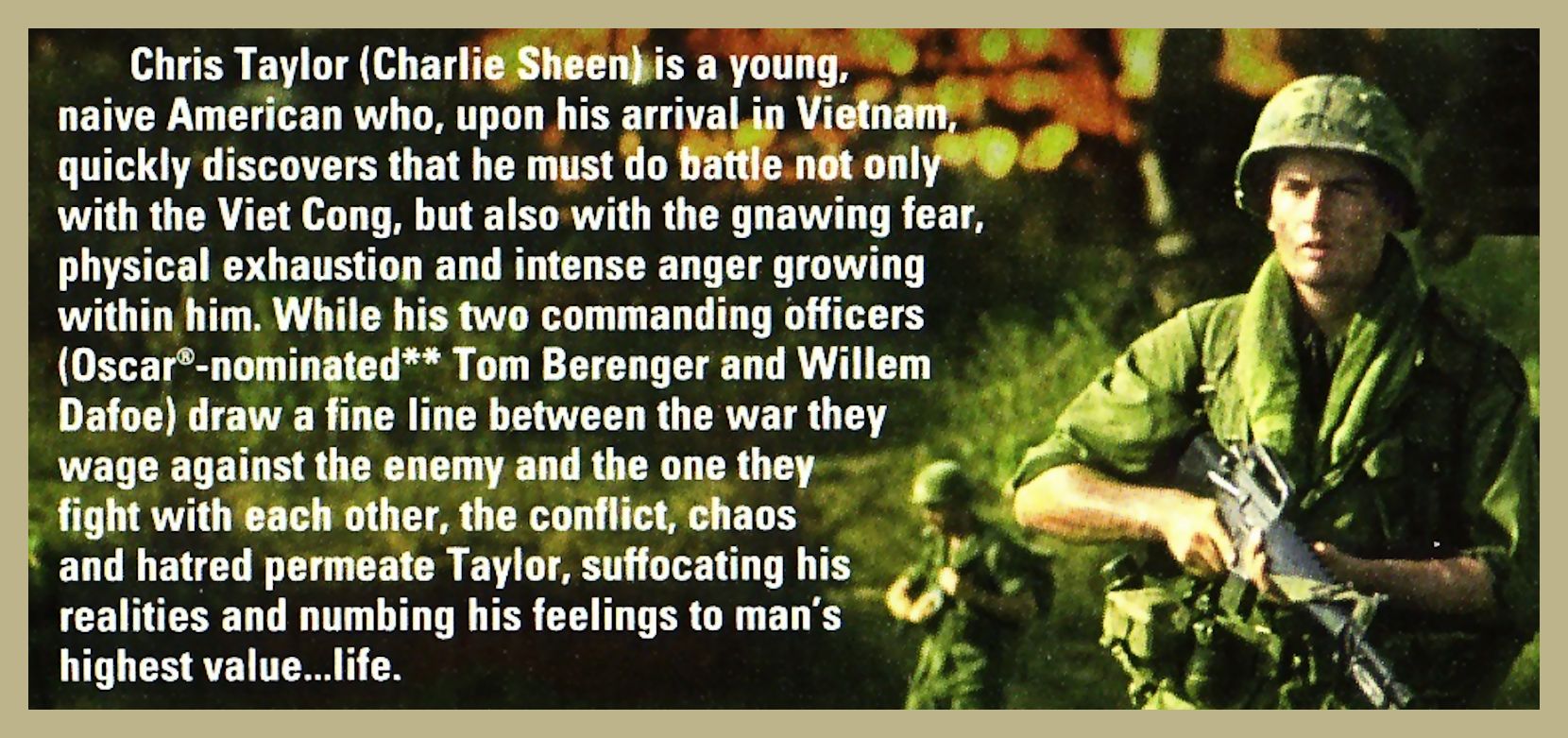
Story
Story (Click to expand)

Platoon is set in a remote area of Vietnam’s east, near the Cambodian border, during 1967-’68. The men of Bravo Company live in barely tolerable conditions, rarely sleep and frequently go out on nerve-jangling ‘ambush’ patrols where they lie in wait for an ethereal enemy, who only seems to emerge from the mist as an apparition. We, like the rest of the patrol, intently watch the dense, steaming wet brush, looking for any movement. Like them, we have no idea if they will appear but sense the danger. Alongside the patrol, we also learn that veteran leaders, Sgt. Elias Grodin (Willem Dafoe) and Sgt. Bob Barnes (Tom Berenger), can spot the seemingly invisible source of much of the danger and uncertainty, the tunnels below them that the VC (Viet Cong) disappear into. Their sense of siege is heightened by the suspicion that the enemy are also the civilians, young and old in local villages. This paranoia and contempt for the Vietnamese results in the most shocking and viscerally disturbing scenes in the film.

In Stone’s vision of the Vietnam War, there are no heroics, just a very real sense that at any time, one of us could be thrown into that hell and how might we react; perhaps just like one of them.

Some of Oliver Stone’s other films, like Salvador, JFK and Natural Born Killers, almost blow the horn before coming down the street, so transparent is their intent; not so Platoon. Here, the plot doesn’t meander and yet, it is brilliantly disorienting, creating a palpable unease. Nor does it telegraph its trajectory and because the whole story is told from the point of view of the camera lens as a member of the squad, there’s no predictability or safe foxhole for us to rest and little indication what we might expect through the next bush.

While the wisps of the enemy provide the danger and uncertainty that keeps us riveted from the first frame, the narrative arc is provided by the tension within the squad. Sgt. Barnes, a scarred battle veteran sees every Vietnamese as the enemy and fosters an attitude among his acolytes that manifests in depraved violence. At the other pole, Sgt. Elias, who acts as mentor to Taylor, blunts his cynicism by shotgunning smoke in the old-fashioned way with his ‘hippy’ friends. He also acts to mitigate the excesses of Barnes. These two characters could easily have been caricatured but in Stone’s writing they are utterly convincing.

The screenplay has been wonderfully crafted and has the polish that often characterises a song-writer’s first album that’s been percolating for years. And knowing that Stone had been working this script for 18 years, seems to confirm that. Watching the result seems like witnessing Stone’s own catharsis, reliving his own experience in Vietnam.

The performances of all the ensemble are authentic and enhanced by the realism constructed in the locations and uniforms that show the effects of constant wear, as well as copious mud and grime that attaches to bodies that are seldom washed.

Before filming began in the Philippines, the cast was sent on a two-week boot-camp. The actors were given military haircuts, required to stay in character, required to dig foxholes, ate only military rations, not allowed to shower, camped in the jungle, had rotations for night watch, and were subjected to forced marches and nighttime “ambushes” with special-effects explosions. Stone explained that he was trying to break them down, “to mess with their heads so we could get that dog-tired, don’t give a damn attitude, the anger, the irritation… the casual approach to death”. In a Bombsite interview, Willem Dafoe said,
“the training was very important to the making of the film… It wasn’t boot camp with lots of push-ups. It was serious, getting no sleep; doing activities at night where you were attacked by real people. Certainly you weren’t going to die, but you did know exhaustion and confusion… the training was important because it gave us a relationship to soldiering… By the time you got through the training and through the film, you had a relationship to the weapon. It wasn’t going to kill people, but you felt comfortable with it.”

This preparation obviously paid off in the delivery of the cast. If anyone were to ask me how an actor is directed, I’d point to one of the worst I can remember as a contrast: George Lucas’ Star Wars: The Phantom Menace. There, fine actors, like Ewan McGregor, appear to be delivering lines with the care of a first Script Read-Through. in a Daily Express interview, McGregor even said,
“Quite honestly, after my initial excitement, the film-making process turned out to be the epitome of tedium,” he said. “There was no spontaneity. Your job, as an actor, was just to get it out. I was frowning a lot. It just became a frowning exercise.”
Now come back to Platoon, and while it’s not the finest bit of actor performance direction, it’s still very good. The acting of this ensemble is delivered with assurity and an easy familiarity. The performances are also understated even though the actions portrayed might be shocking and seem almost implausible at times. This restraint adds to the believability and menace of the scenario with very ordinary people doing inexplicable things.

One of the Vietnam War movies that’s frequently held up in comparison with Platoon, is Apocalypse Now by Francis Ford Coppola which was released seven years earlier. Where Apocalypse Now is epic in its bombast and artifice, Platoon is intimate but a lot more confronting. Where Coppola orchestrated a well crafted Wagnerian opera, Stone has unselfconsciously delivered a frank and unmannered masterpiece.

Francois Truffaut is often quoted as saying, “There is no such thing as an anti-war film”, reasoning that in a good war film, explosions and great cinematography always excite, and there’s always some sense of adventure. Well, I think Platoon goes a long way towards refuting Truffaut; this is a great anti-war film.

iRate:: 4½ out of 5.

4Movie Tragics

Extras:
• Feature Commentary by Director Oliver Stone (This filmmaker enjoys talking and this informative track relates just how personal this film was to him).
• Feature Commentary by Military Advisor Dale Dye (In this interesting track Dye details his training regimen for the cast and how he and the director worked to achieve authenticity. He also relates his own wartime experience).
• Deleted & Extended Scenes (12 scenes) – 12 minutes.
• On the Flashback to Platoon Menu, you’ll find 3 featurettes:
• • Snapshot in Time:1967-1968 (this featurette includes movie clips and interviews with Stone, Dye and others and recalls the Cold War political climate at that time) – 19 minutes.
• • Creating the ‘Nam (this production featurette looks at the design, effects and locations) – 12 minutes.
• • Raw Wounds: The Legacy of ‘Platoon’ (this piece looks at the healing process after the war and how American veterans reacted to the film) – 17 minutes.
• One War, Many Stories (veterans react to a screening of the film and relate how their own experiences compared with that depicted) – 26 minutes.
• Preparing for ‘Nam (war veterans recall their enlistment and basic training) – 7 minutes.
• On the Vignettes Menu there are 3 short elements:
• • Caputo & the 7th Fleet (recollections of the 1975 evacuation of Saigon) – 2mins.
• • Dye Training Method (the technical advisor, Dale Dye discusses his process for turning actors into soldiers) – 3mins.
• • Gordon Gekko (recalls how the name was hatched during a Platoon brainstorming session) – 1min.
• The DVD copy (this is the disappointing dvd version released in 2000 and a questionable addition to this set)

You want More!
Platoon – IMDb (Internet Movie Database)
Platoon – Rotten Tomatoes
Platoon – allmovie.com
Platoon – Wikipedia


In my mind, this film ranks right up with All Quiet on the Western Front (1930) as one of the two or three best anti-war films yet produced. What do you think about the film?

:: Please leave a comment ::


Subscribe

  • Entries (RSS)
  • Comments (RSS)

Archives

  • March 2022
  • May 2019
  • January 2019
  • January 2017
  • June 2016
  • March 2016
  • September 2015
  • January 2015
  • October 2014
  • August 2013
  • June 2013
  • May 2013
  • April 2013
  • March 2013

Categories

  • Australian Politics
    • Aus Pol. Posts Index
  • Film
    • Film Posts Index (All)
    • Reviews Index (Alpha)
  • Gotta Life
    • Gotta Life Posts Index
  • International Politics
    • Int Pol. Posts Index
  • Religion
    • Religion Posts Index
  • Science
    • Science Posts Index
  • Uncategorized
  • WA Politics
    • WA Pol. Posts Index

Meta

  • Create account
  • Log in

Blog at WordPress.com.

Privacy & Cookies: This site uses cookies. By continuing to use this website, you agree to their use.
To find out more, including how to control cookies, see here: Cookie Policy
  • Subscribe Subscribed
    • Zak From Downunder
    • Already have a WordPress.com account? Log in now.
    • Zak From Downunder
    • Subscribe Subscribed
    • Sign up
    • Log in
    • Report this content
    • View site in Reader
    • Manage subscriptions
    • Collapse this bar
 

Loading Comments...