
Tags
1867-68, Action, Anti-War Film, Blood and Gore, Charlie Sheen, Cold War Film, Combat Film, Drama, Ensemble Film, Film, film review, Food For Thought, Forest Whitaker, Francesco Quinn, iRate:: 4½ / 5, John C. McGinley, Johnny Depp, Jungle Film, Keith David, Kevin Dillon, Modern Classic, Oliver Stone, Platoon, Richard Edson, Southeast Asia, Sunday Screening Session, Tom Berenger, Tough Guys, Vietnam, Vietnam War Era, War, War Drama, Willem Dafoe
Platoon (1986) (120 min)
iReview: Version: Platoon: 25th Anniversary (Blu-ray);
Video: AVC 1080p; Audio: DTS 5.1.
Genre:: Action | Drama | War |
Sub-Genre/Type:: Anti-War Film | Cold War Film | Combat Film |
Ensemble Film | Jungle Film | Modern Classic | War Drama |
Settings:: 1867-68 | Southeast Asia | Vietnam | Vietnam War Era.

Mood?:: Blood and Gore |
Food For Thought | Tough Guys.
iRate:: 4½ / 5
Director:: Oliver Stone.
Writer:: Oliver Stone (screenplay).
Cast:: Tom Berenger, Willem Dafoe, Charlie Sheen, Forest Whitaker, Francesco Quinn, John C. McGinley, Richard Edson, Kevin Dillon, Reggie Johnson, Keith David, Johnny Depp, David Neidorf.

Credits (Click to expand)
Trailer (HD):
iReview:
I was scratching around my library trying to settle on a film for this week’s screening but found myself spoiled for choice. I asked a few friends for help and suggested they consider titles from science fiction, gangster or graphic novel adaptation. So after extensive consultation within the strict parameters provided, I’m Screening Platoon in this Sunday Session. Umm, yes I know, it’s a war movie. I hadn’t seen this film for more than 10 years and that was the less than stellar, 2000 DVD release, which I viewed on an old 80cm 4:3 TV. So I was looking forward to the opportunity to see the recent 25th Anniversary Blu-ray release, on a 140cm 1080p widescreen.
Throughout the soundtrack, Samuel Barber’s hauntingly beautiful Adagio for Strings, interjects to add a note of melancholy. It’s unfortunate, that after Platoon, overuse has turned such a wonderful feature of this film into a cliche. Nevertheless, I’d still recommend listening to the track while reading this as it sets a darkly appropriate tone.
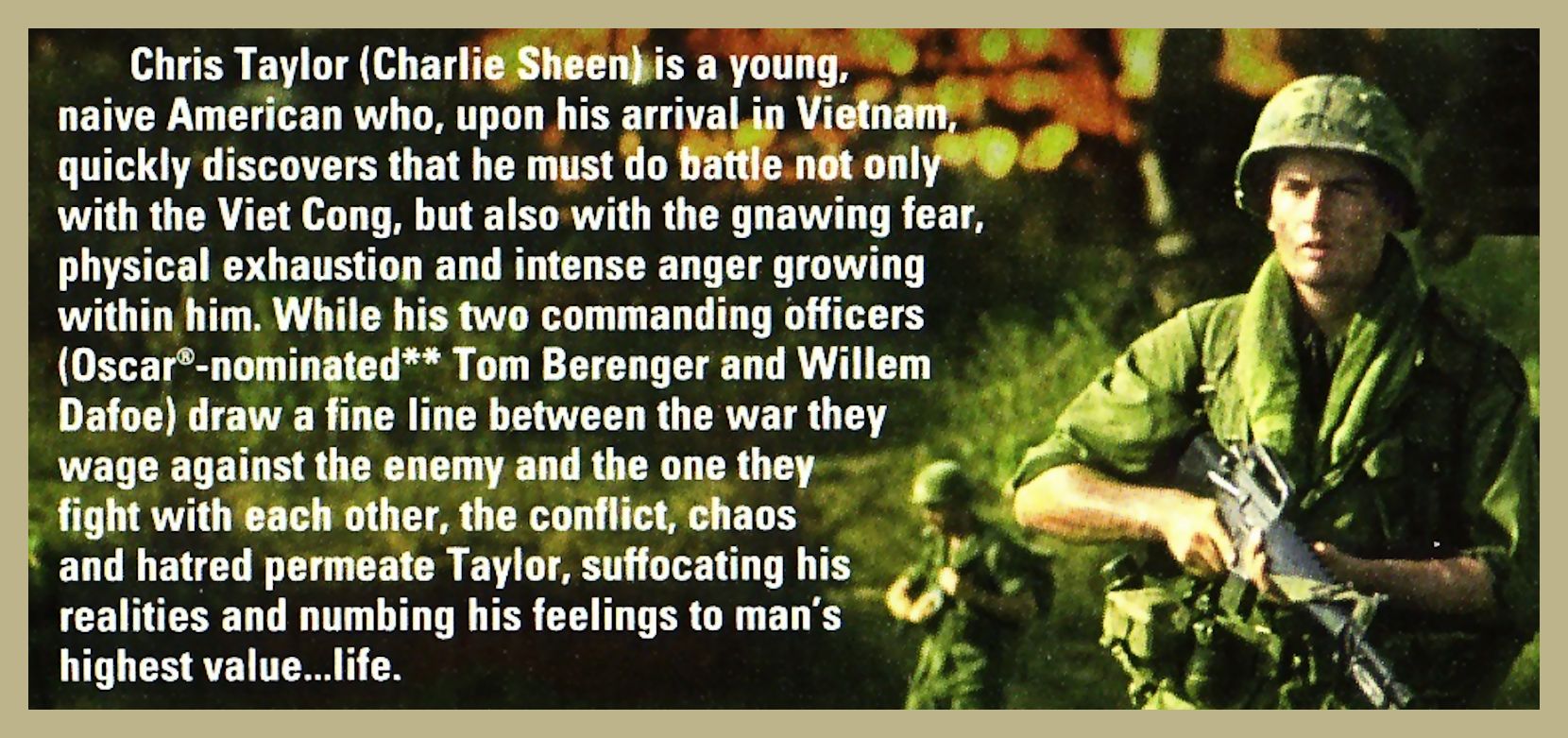
After a very brief introduction and without fanfare or warning, the audience descends into an impenetrable jungle. The camera at eye level draws us into a patrol alongside the newest member of Bravo Company, Chris Taylor (Charlie Sheen), who is confronted by the claustrophobic thick lush brush, with rough fronds brushing and irritating his fresh face. We experience the gut-wrenching physical exertion of the terrain as he hacks frustrated and incompetently with his machete, dry reaches and is harassed by ants, leaches, and mud. And we sense the contagious and overwhelming fatigue.
“Somebody once wrote: ‘Hell is the impossibility of reason.’ That’s what this place feels like: Hell.” So says the bewildered Taylor as he writes a letter to his grandma.
Most of us could identify with Taylor’s disillusionment. He’s a kid from a good family who dropped out of college because he felt the call to do his patriotic duty and “Live up to what Grandpa did in the first war, and Dad did in the second.”. And, as he put it, “…why should just the poor kids go off to war.” He soon realizes that in ‘Nam the drafted men are largely uneducated, “They’re poor. They’re unwanted… They’re the bottom of the barrel, and they know it.”.
Through Taylor, Oliver Stone stipulates that war has always been fought by the poor and “rich kids always get away with it.”. He’s right of course, You need look no further than the last president and vice-president of the USA, George W. Bush and Dick Cheney. It’s reported that Bush went AWOL (absent without leave) from the National Guard from 1972-’73, while Cheney applied for and received five Vietnam War draft deferments. When asked about his deferments, he reportedly said, “I had other priorities in the ’60s than military service”.
Story (Click to expand)
Platoon is set in a remote area of Vietnam’s east, near the Cambodian border, during 1967-’68. The men of Bravo Company live in barely tolerable conditions, rarely sleep and frequently go out on nerve-jangling ‘ambush’ patrols where they lie in wait for an ethereal enemy, who only seems to emerge from the mist as an apparition. We, like the rest of the patrol, intently watch the dense, steaming wet brush, looking for any movement. Like them, we have no idea if they will appear but sense the danger. Alongside the patrol, we also learn that veteran leaders, Sgt. Elias Grodin (Willem Dafoe) and Sgt. Bob Barnes (Tom Berenger), can spot the seemingly invisible source of much of the danger and uncertainty, the tunnels below them that the VC (Viet Cong) disappear into. Their sense of siege is heightened by the suspicion that the enemy are also the civilians, young and old in local villages. This paranoia and contempt for the Vietnamese results in the most shocking and viscerally disturbing scenes in the film.
In Stone’s vision of the Vietnam War, there are no heroics, just a very real sense that at any time, one of us could be thrown into that hell and how might we react; perhaps just like one of them.
Some of Oliver Stone’s other films, like Salvador, JFK and Natural Born Killers, almost blow the horn before coming down the street, so transparent is their intent; not so Platoon. Here, the plot doesn’t meander and yet, it is brilliantly disorienting, creating a palpable unease. Nor does it telegraph its trajectory and because the whole story is told from the point of view of the camera lens as a member of the squad, there’s no predictability or safe foxhole for us to rest and little indication what we might expect through the next bush.
While the wisps of the enemy provide the danger and uncertainty that keeps us riveted from the first frame, the narrative arc is provided by the tension within the squad. Sgt. Barnes, a scarred battle veteran sees every Vietnamese as the enemy and fosters an attitude among his acolytes that manifests in depraved violence. At the other pole, Sgt. Elias, who acts as mentor to Taylor, blunts his cynicism by shotgunning smoke in the old-fashioned way with his ‘hippy’ friends. He also acts to mitigate the excesses of Barnes. These two characters could easily have been caricatured but in Stone’s writing they are utterly convincing.
The screenplay has been wonderfully crafted and has the polish that often characterises a song-writer’s first album that’s been percolating for years. And knowing that Stone had been working this script for 18 years, seems to confirm that. Watching the result seems like witnessing Stone’s own catharsis, reliving his own experience in Vietnam.
The performances of all the ensemble are authentic and enhanced by the realism constructed in the locations and uniforms that show the effects of constant wear, as well as copious mud and grime that attaches to bodies that are seldom washed.
Before filming began in the Philippines, the cast was sent on a two-week boot-camp. The actors were given military haircuts, required to stay in character, required to dig foxholes, ate only military rations, not allowed to shower, camped in the jungle, had rotations for night watch, and were subjected to forced marches and nighttime “ambushes” with special-effects explosions. Stone explained that he was trying to break them down, “to mess with their heads so we could get that dog-tired, don’t give a damn attitude, the anger, the irritation… the casual approach to death”. In a Bombsite interview, Willem Dafoe said,
“the training was very important to the making of the film… It wasn’t boot camp with lots of push-ups. It was serious, getting no sleep; doing activities at night where you were attacked by real people. Certainly you weren’t going to die, but you did know exhaustion and confusion… the training was important because it gave us a relationship to soldiering… By the time you got through the training and through the film, you had a relationship to the weapon. It wasn’t going to kill people, but you felt comfortable with it.”
This preparation obviously paid off in the delivery of the cast. If anyone were to ask me how an actor is directed, I’d point to one of the worst I can remember as a contrast: George Lucas’ Star Wars: The Phantom Menace. There, fine actors, like Ewan McGregor, appear to be delivering lines with the care of a first Script Read-Through. in a Daily Express interview, McGregor even said,
“Quite honestly, after my initial excitement, the film-making process turned out to be the epitome of tedium,” he said. “There was no spontaneity. Your job, as an actor, was just to get it out. I was frowning a lot. It just became a frowning exercise.”
Now come back to Platoon, and while it’s not the finest bit of actor performance direction, it’s still very good. The acting of this ensemble is delivered with assurity and an easy familiarity. The performances are also understated even though the actions portrayed might be shocking and seem almost implausible at times. This restraint adds to the believability and menace of the scenario with very ordinary people doing inexplicable things.
One of the Vietnam War movies that’s frequently held up in comparison with Platoon, is Apocalypse Now by Francis Ford Coppola which was released seven years earlier. Where Apocalypse Now is epic in its bombast and artifice, Platoon is intimate but a lot more confronting. Where Coppola orchestrated a well crafted Wagnerian opera, Stone has unselfconsciously delivered a frank and unmannered masterpiece.
Francois Truffaut is often quoted as saying, “There is no such thing as an anti-war film”, reasoning that in a good war film, explosions and great cinematography always excite, and there’s always some sense of adventure. Well, I think Platoon goes a long way towards refuting Truffaut; this is a great anti-war film.
iRate:: 4½ out of 5.
4Movie Tragics
Extras:
• Feature Commentary by Director Oliver Stone (This filmmaker enjoys talking and this informative track relates just how personal this film was to him).
• Feature Commentary by Military Advisor Dale Dye (In this interesting track Dye details his training regimen for the cast and how he and the director worked to achieve authenticity. He also relates his own wartime experience).
• Deleted & Extended Scenes (12 scenes) – 12 minutes.
• On the Flashback to Platoon Menu, you’ll find 3 featurettes:
• • Snapshot in Time:1967-1968 (this featurette includes movie clips and interviews with Stone, Dye and others and recalls the Cold War political climate at that time) – 19 minutes.
• • Creating the ‘Nam (this production featurette looks at the design, effects and locations) – 12 minutes.
• • Raw Wounds: The Legacy of ‘Platoon’ (this piece looks at the healing process after the war and how American veterans reacted to the film) – 17 minutes.
• One War, Many Stories (veterans react to a screening of the film and relate how their own experiences compared with that depicted) – 26 minutes.
• Preparing for ‘Nam (war veterans recall their enlistment and basic training) – 7 minutes.
• On the Vignettes Menu there are 3 short elements:
• • Caputo & the 7th Fleet (recollections of the 1975 evacuation of Saigon) – 2mins.
• • Dye Training Method (the technical advisor, Dale Dye discusses his process for turning actors into soldiers) – 3mins.
• • Gordon Gekko (recalls how the name was hatched during a Platoon brainstorming session) – 1min.
• The DVD copy (this is the disappointing dvd version released in 2000 and a questionable addition to this set)
You want More!
Platoon – IMDb (Internet Movie Database)
Platoon – Rotten Tomatoes
Platoon – allmovie.com
Platoon – Wikipedia
In my mind, this film ranks right up with All Quiet on the Western Front (1930) as one of the two or three best anti-war films yet produced. What do you think about the film?
:: Please leave a comment ::
 Zak From Downunder