
• About

Zak From Downunder

~ Zak de Courcy's sometimes incendiary thoughts about politics, life and religion.

Zak From Downunder

Tag Archives: USA

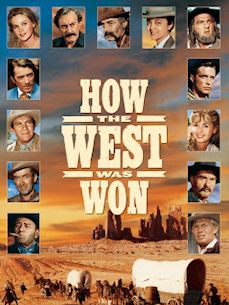
The Sunday Screening Session….. How the West Was Won (1962)

17 Sunday Mar 2013

Posted by Zak de Courcy in Film

≈ 2 Comments

Tags

1839-1889, Adventure, American Civil War Era, Classic, Debbie Reynolds, Drama, Epic, Epic Western, Film, film review, Frontier Region, George Marshall, George Peppard, Gregory Peck, Henry Fonda, Henry Hathaway, History, History Fiction, How the West Was Won, iRate:: 4 / 5, James Stewart, John Ford, John Wayne, Karl Malden, Romance, Rural Setting, Slice Of History, Spencer Tracy, Sunday Screening Session, Tough Guys, USA, Western, Wild West Era

How the West Was Won (1962) (159 min)
iReview: Version: How the West Was Won: 2 Disc Edition (Blu-ray);
Video: VC-1 1080p; Audio: Dolby Digital (AC3) 5.1.
Genre:: Adventure | Drama | Epic | History | Romance | Western |
Sub-Genre/Type:: Classic | Epic Western | History Fiction |
Settings:: 1839-1889 | American Civil War Era | Frontier Region |
Rural Setting | USA | Wild West Era.
Image

Mood?:: Slice Of History | Tough Guys.
iRate:: 4 / 5
Directors:: John Ford
(segment “The Civil War”);
Henry Hathaway
(segments “The Rivers”, “The Plains”
and “The Outlaws”);
George Marshall
(segment “The Railroad”).
Writer:: James R. Webb (screenplay).
Cast:: Henry Fonda, Karl Malden, Gregory Peck, James Stewart, Debbie Reynolds, John Wayne (General William T. Sherman), Eli Wallach, Lee J. Cobb, Richard Widmark, George Peppard, Spencer Tracy (narrator), Harry Morgan (General Ulysses S. Grant), Carroll Baker, Carolyn Jones, Robert Preston, Walter Brennan, Andy Devine, Raymond Massey (President Abraham Lincoln), Agnes Moorehead, Thelma Ritter, Russ Tamblyn.

Click for Credits Enlargement
Credits (Click to expand)

Trailer:

(Note: The vertical bands that appear in this theatrical release trailer, have been digitally removed in the Blu-ray release of the film)

iReview:
In this week’s Sunday Screening, I’ve gone back 51 years to 1962 to seek out films in my library worthy of another look. 1962 was awash with more than 2,000 films released but after a quick scan, I was humbled by my few representatives from that year. But, my small sample does include some notable films: Dr. No, the first Bond film; To Kill a Mockingbird, with Gregory Peck’s outstanding portrayal as Atticus Finch, the lawyer who defends a black man against an undeserved rape charge; Lawrence of Arabia, the story of T.E. Lawrence’s desert war (my favourite film); Lolita, a story of forbidden infatuation by my favourite director, Stanley Kubrick; The Longest Day, the story of D-Day (6th June 1944); The Manchurian Candidate, with a brilliant Frank Sinatra as a brainwashed former captive of North Korea; Mutiny on the Bounty, starring Marlon Brando in an overwrought remake of the 1935 classic; and How the West Was Won. It’s the Blu-ray version of the last of these that I’ve selected for this week’s screening. I’ll be having another look at the rest of this eclectic bunch of 1962 films soon.

How the West Was Won is a curiosity in that it was one of only two narrative films produced using the Cinerama three lens camera system; the other being The Wonderful World of the Brothers Grimm (1962). And, given the complexity of filming in this format and the cost of building theatres capable of screening them, it’s not surprising. Cinerama required three projectors for the three screens used in the curved ultra widescreen presentation. Where the three projected images overlapped, there were thin blurred join-lines, but given the impact of the overall experience as projected onto the unique and enormous screen construction, this was a small infraction. As well as the stunning surround visuals, the system was also one of the first to employ 5.1 audio, giving an unparalleled audio-visual experience.

Story
Story (Click to expand)

For this epic western, three legendary directors, Henry Hathaway, John Ford, and George Marshall, were employed to shoot different segments of the stories of three generations of the Prescott family and their travels from east to west across America between 1839 and 1889. The film chronicles the family’s triumphs and tragedies as they encounter river pirates, suffer drownings and make and lose a fortune in California after travelling the plains together in a wagon train.

This all-star ensemble includes Karl Malden as pioneer Zebulon Prescott who sets out west with his wife (Agnes Moorehead) and their children, Lilith (Debbie Reynolds) and Eve (Carroll Baker). They travel down river and along the way, encounter mountain man and fur trader, Linus Rawlings (James Stewart), who marries Eve.

Lilith continues west after joining a wagon train led by Roger Morgan (Robert Preston), and is accompanied by roguish gambler Cleve Van Valen (Gregory Peck), who saves her during an Indian attack.

These first two vivid segments, dubbed ‘The Rivers (1840)’ and ‘The Plains (1850s)’, were directed by Henry Hathaway.

Moving into the 1860s, the Civil War erupts and Linus and Eve’s son, Zeb (George Peppard), enthusiastically follows his father into the Union army. However, after the Battle of Shiloh, he becomes disillusioned and contemplates a different path. This ‘Civil War (1861-1865)’ segment was directed by John Ford

Richard Widmark also stars as railroad boss Mike King, building the transcontinental railroad, who wants to cut a line straight through Indian territory but is resisted by mountain man, Jethro (Henry Fonda). Zeb, who has rejoined the army as a lieutenant in the U.S. cavalry, is tasked to secure a peace treaty with the Arapaho to allow the railroad construction to proceed peacefully. This segment, titled ‘The Railroad (1868)’, was directed by George Marshall and includes his famous buffalo stampede sequence.

In the final segment, The Outlaws (1880s), directed by Henry Hathaway, Lilith who made it as far west as California, has done well for herself in San Francisco but, after a change in circumstances, auctions most of her possessions and relocates to her ranch in Arizona, inviting Zeb to join her. However, Zeb, now a marshal, has a run-in with an old foe, Charlie Gant (Eli Wallach).

Many more characters and stories are woven throughout this epic film which also features appearances from Raymond Massey as President Abraham Lincoln, John Wayne as General William T. Sherman, and Harry Morgan as General Ulysses S. Grant.

In my earlier description of the plot, I’ve tried to limit the spoilers, so I don’t give everything away. I hope I haven’t just made the story completely obtuse in the process.

As a dramatic narrative, How the West Was Won works more like a travelogue, with emblematic scenic locations providing a visual feast, interrupted by action and dramatic set pieces. The characters are not on screen long enough to develop their identities but that is often a drawback of films that seek to cover an epic story over such a daunting time-span. And with so much visual splendour on offer, it’s only a minor criticism.

The technical restrictions of shooting with three fixed 27mm lenses meant that depth of field variations and close-ups, employed on traditional single lens films were not possible. One of the inadvertent benefits of this constriction is a vivid screen image with the incredible clarity of waving blades of prairie grass in the foreground against crisply defined mountain peaks in the distance. The fact that everything in shot is always in focus, also means that the entire image, including background action is invariably in motion, adding to the window-on-the-world quality of this film. As breath-taking as the magnificent vistas are, the shortcomings of the format are evident. The 400kg Cinerama camera was entirely mechanically rooted and most of the action is front-on because shots needed to be framed in such a way as to avoid foreground actors moving quickly across the boundary between one lens-view and another. These limitations, though, forced directors to become creative in the way shots were constructed and so, there are many wonderful and inventive tracking shots as the camera gracefully glided along its tracks.

When How the West Was Won was first released on VHS and DVD, the presentation was marred by the butchery required to crop the frame for display on the old 4:3 TVs. This compromise also negated one of the film’s main viewing attraction, its wonderful cinematography, rendering the movie barely watchable. Thankfully, for the three disc Special Edition DVD and Blu-ray releases, the film has been painstakingly restored with almost all evidence of the vertical three-panel join lines, digitally eliminated. The stunning result is an image that is brilliantly saturated and a joy to watch. The restoration has also left just enough occasional evidence of the vertical panel lines to demonstrate the ingenuity of the directors in utilising aspects of sets, like doorways, poles and building uprights as well as natural features like trees, to obscure the boundary lines.

For me, the work of John Ford, who filmed the short ‘Civil War (1861-1865)’ segment, is the most evocative and beautifully constructed. In its three scenes, there is the battlefield at Shiloh which ebbs into night with wonderfully lit horizon shots that stretch over and brilliantly amplify the ultra widescreen image. The shots beautifully juxtapose a war scene with the liberal ornamentation of Cherry blossoms, giving the night the look of Christmas decoration. The battle’s aftermath also reveals the short but effective scene with two disheveled Generals, Ulysses S. Grant and William Tecumseh Sherman. The quiet rhythm of the scene moves into the next, when Zeb returns home. The pacing and atmosphere of these scenes is exquisite.

Dave Kehr of the New York Times, in his 2008 review, wrote: “The best reason for buying a Blu-ray player right now is Warner Home Video’s high-definition version of “How the West Was Won,” a film made 46 years ago in the highest-definition moving picture medium the world had seen: Cinerama”. He continued, “Not even the finest home theater installation will be able to reproduce the scale and resolution of the Cinerama experience, or anything close to it. But moving from standard-definition DVD to Blu-ray generates a shock analogous to what the audiences of 1962 must have felt when the curtains parted to reveal the panoramic screen.”

Films like How the West Was Won and Ford’s other western masterpiece, The Searchers (1956), have languished in VHS hell for too long, waiting for the advent of Blu-ray and a big wide home screen on which to showcase their brilliance. This result is a riveting revelation and richly recommended.

iRate:: 4 out of 5.

4Movie Tragics

Extras:
• Feature Commentary by: Filmmaker David Strohmaier; Director of Cinerama, Inc. John Sittig; Film Historian Rudy Behlmer; Music Historian Jon Burlingame; and Stuntman Loren James (This informative and interesting track appears on both the Blu-ray and Special Edition 3-disc DVD versions).
• Cinerama Adventure (This fascinating 93 minute documentary tells you everything you didn’t know you needed to know about the revolutionary Cinerama format and appears on both the Blu-ray and Special Edition 3-disc DVD versions).
• The 2-disc Blu-ray version also offers a Smilebox version of the film, which attempts to mimic the curved screen of the original Cinerama process. The effect is hard to describe so you’ll need to get it to see it.

You want More!
How the West Was Won – IMDb (Internet Movie Database)
How the West Was Won – Rotten Tomatoes
How the West Was Won – allmovie.com
How the West Was Won – Wikipedia


I’d love to hear your impressions of this film. Am I wrong to rate it so highly despite its shallow plot and dialogue? I’d also welcome your impressions and anecdotes, if you’ve been one of the lucky few to have seen this at a Cinerama cinema.

:: Please leave a comment ::


Why Obama can’t do a deal with Congress:

08 Friday Mar 2013

Posted by Zak de Courcy in International Politics

≈ 2 Comments

Tags

Barack Obama, David Brooks, economy, GOP, Grover Norquist, Harry Reid, international politics, John Boehner, Lyndon Johnson, Mitch McConnell, politics, Sequester, Tea Party, Theodore Roosevelt, US Congress, USA, USA politics

House of Representatives Speaker, John Boehner seems to be quite an amiable fellow (and certainly sensitive, judging from his frequent tears). He also has a hell of a job with the lunatic fringe comprising 1 in 3 of his caucus. This makes his task of leading his party and the House through a legislative program very difficult. House Democrat Leader, Nancy Pelosi’s got it easy by comparison… Her liberal wing (the left of the party, Jay Rockefeller, Barbara Boxer etc) is only 1 in 10.

Speaker Boehner can’t get anything reasonable through his present caucus with such a large chunk of his members (Tea Party and fanatical Ron Paul-like libertarians) locked into uncompromising, fantasy positions that prevent him reaching any compromise with President Obama and/or Congressional Democrats.

It must have been humiliating for Boehner to handball the new year ‘Fiscal Cliff’ temporary fix to Senate Democrat Majority Leader, Harry Reid and Republican Minority Leader, Mitch McConnell, knowing that his only chance of getting a deal was a tacit alliance between a small rump of Republicans and the overwhelming majority of Democrats when the fix came back to the House from the Senate.
Unfortunatley for him, this inability to make deals and legislate, renders his hold on the Speakership pretty shaky.

The parties (in particular the GOP) are now so entrenched in their own version of the Battle of Flanders, that even a Christmas Truce would be impossible because anyone venturing out of the trench with a hint of Christmas goodwill towards the enemy would be cut down with a hail of bullets from his own side (Tea Party Primaries and the enemy of reasonable, Grover Norquist).

So, I can’t see any ‘big deals’ being done between President Obama and the Congressional G.O.P., in the near future, unless it’s done by Boehner using the deflection device to the Senate, outlined above.

I think that’s one of the main reasons why Obama has adopted the long-term ‘Theodore Roosevelt’ strategy of taking his message out on the road and through ‘Oganizing for Action’ (which is still filling my in-box) instead of going the traditional ‘Lyndon Johnson’ legislative route. I think Obama knows that the possibility of doing ‘Johnson’ type deals in this Congress is nill. Instead, Obama is hoping to discredit the Tea Party and Norquist from outside, by slowly changing the current ‘Deficit Hawk’ media narrative and moving the conversation back to the middle and away from the current ‘slash government spending and burn the economy’ political orthodoxy that seems prevalent in the USA (and which has resulted in a triple-dip recession in one country where it was unleashed, the UK under Cameron). It was this continuing campaign strategy that President Theodore Roosevelt adopted, at the turn of the last century, to fundamentally change the way Americans saw corporate regulation and the promotion of the interests of the average citizen instead of powerful political and wealthy elites.

Encouragingly, talk of the need for investment in the future (education, R&D, infrastructure etc) coupled with revenue increases – eliminating some industry subsidies (corn, oil etc), closing some tax  loop-holes for the rich, and means-testing safety net welfare for the wealthy (Social Security and Medicare payments) – and long-term deficit reduction (instead of the Sequester’s ‘Shock and Awe’), is already beginning to gain traction.

That the Sequester is a very blunt, indiscriminate instrument that is going to cause a shock to the US and World Economy, is almost beyond question. And, In the short term, there’s not much that can be hoped to wind it back. Obama’s strategy of continuing the ‘fairness’ tour campaigning, banging on about Republican’s protecting generous tax loop-holes for the rich while demanding cuts in programs benefiting the poor and middle-class, might just provide enough media cover to force a narrative change.

So, although a chorus of commentators, including the New York Times’ David Brooks, are urging Obama to quit his campaigning and get back to deal-making and governing, I think Obama is doing precisely what he needs to do to win the long game. He’s not thinking of the next 10 minutes (like Congress, commentators and the media), he’s thinking of the next 10 years and a possible seachange in America. I hope he succeeds.

Gee that boy can prattle on…. Enough!

Check out Nobel Economics Prize-winner, Paul Krugman’s New York Times Column and his piece on the Sequester:
• Sequester of Fools by Paul Krugman
(NYT, 22 Feb. 2013)

For the geeks:
* Although Theodore Roosevelt was a successful president, his long-term legacy was tarnished by his successors who ensured he was the last of the progressive Republican Presidents. From Taft on, the GOP became the ‘cut government’ conservative party of the rich and powerful and the hitherto generally conservative Democrats became the progressive party under the presidency of the husband of Theodore Roosevelt’s niece, Eleanor Roosevelt.
* Yes indeed folks, Franklin Roosevelt was a distant cousin of Eleanor, niece of President Theodore Roosevelt, who in 1918 launched her career as the most powerful political spouse in American History, before or since, with the possible exception of Edith Wilson, who in late 1919 effectively and secretly assumed the Presidency after Woodrow’s catastrophic stroke.


Is there any hope that Congress can get anything done on issues like immigration, gun slaughter, the budget, the sequester?

:: Please leave a comment ::


Washington’s Political Sclerosis:

08 Friday Mar 2013

Posted by Zak de Courcy in International Politics

≈ 2 Comments

Tags

Chuck Hagel, gerrymander, GOP, international politics, Lindsey Graham, Perry-mander, politics, primary, Tea Party, US Congress, USA, USA politics

I was reading a recent Washington Post report about the redoubtable Sth. Carolina Senator Lindsey Graham’s threat to ‘put a hold’ on the confirmation of nominees, Secretary of Defence, Chuck Hagel and CIA Chief, John Brennan. At first glance, I wondered… Are you a right-wing lunatic hiding beneath a relatively moderate Republican skin?… But then I remembered that the competition, these days, isn’t between Republicans and Democrats at elections but within the parties at Primaries; meaning that Graham was pitching to the rabid base to shore up his position against a primary attack. The new reality is, the enemy within is more dangerous than the foe across the aisle.

How has this anomaly of the democratic process arisen that has made compromise between parties, impossible and government, sclerotic?
In the 2012 elections, 85% of House seats and 60% of Senate races, were considered Safe (a winning margin of at least 10%). In the past, staking a claim to these prized pieces of Congressional real estate could give the holder a job for life. Many incumbents took the opportunity to grow fat and comfortable while many others took the relative safety of their position to carve out meaningful and illustrious legislative careers. Until the recent past, ‘lunatic fringe’ primary challenges were rarely successful but with the rise of the rabid right-wing Tea Party within the G.O.P., that all changed. The threat from this intractable faction has led previously rational Republican legislative negotiators to behave like cornered Rottweilers. That coupled with the ludicrous 60% Senate vote (close to that often required to change a national constitution elsewhere in the world) now needed to enact simple legislation; and national government, in any meaningful sense, has ceased to exist in the USA.

It is grievously frustrating to see the lurch from crisis to crisis of Congress’ own design. The members don’t seem chastened by the flirtation with recession, in last quarter 2012, said to be the result of uncertainty generated by Congressional brinkmanship over the ‘Fiscal Cliff’ or the sledgehammer surgery applied to the US economy by the ‘Sequester’ as a result of Congressional failure to act last month.

Republican House members and Senators seem only to be concerned, like Senator Graham, with potential Primary challenges from Tea Party fanatics. And why need they care how low the esteem of the G.O.P in Congress sinks in the eyes of electors, when the only threat to their Congressional survival lies within their own ranks.

Until the threat of a party losing a seat becomes greater than a Primary loss, this sorry state appears destined to continue. In Australia, seat (district) boundaries and redistricting is established by an independent Federal Commission rather than the incumbent majority party in each State. With the Republicans in the ascendancy in ‘State engineered redistricting’ in recent years, the electoral map greatly favours the G.O.P. I noted with interest that at the November election, Democrats won millions more votes than Republicans but 33 fewer seats; a product of majority party redistricting, the Texas Perry-mander etc.

I remember looking at gerrymandering in my political science classes at university and discussing it as a quaint relic of the 19th century ‘rotten borough’ era in England and 1812 Massachusetts (where the term originated). But then I became interested in modern USA politics… Such a glaring and catastrophic democratic flaw would be an amusing subject of harmless banter if the country in question was Chad but when manufactured crises in the Congress of the USA, such as the 2011 ‘Debt Ceiling’ and the recent ‘Fiscal Cliff’, and ‘Sequester’, can cause the US credit-rating to be downgraded and other financial ripples around the world then it becomes a worry for the rest of us.

I just watched Casino Jack and the United States of Money, a documentary about Jack Abramoff and the way he allegedly bought the Republican Party. It was horrifying.

Read New York Times Columnist, Sam Wang’s piece on the 2012 Election:
• The Great Gerrymander of 2012 by Sam Wang
(NYT, 3 Feb. 2013)


I can see China with its booming economy, looking on with envy at the remarkable excercise of democracy in the USA, with its sensible Senate rules that prevent anything getting done. Will any other American organisation adopt the requirment of a 60% vote in favour of any action or would they just laugh? Would any democratic institution anywhere in the world, outside the USA, ever adopt a 60% rule to get anything done? Will the Congressional gerrymander ever be exposed and fixed?

:: Please leave a comment ::


Newer posts →

Subscribe

  • Entries (RSS)
  • Comments (RSS)

Archives

  • March 2022
  • May 2019
  • January 2019
  • January 2017
  • June 2016
  • March 2016
  • September 2015
  • January 2015
  • October 2014
  • August 2013
  • June 2013
  • May 2013
  • April 2013
  • March 2013

Categories

  • Australian Politics
    • Aus Pol. Posts Index
  • Film
    • Film Posts Index (All)
    • Reviews Index (Alpha)
  • Gotta Life
    • Gotta Life Posts Index
  • International Politics
    • Int Pol. Posts Index
  • Religion
    • Religion Posts Index
  • Science
    • Science Posts Index
  • Uncategorized
  • WA Politics
    • WA Pol. Posts Index

Meta

  • Create account
  • Log in

Create a free website or blog at WordPress.com.

Privacy & Cookies: This site uses cookies. By continuing to use this website, you agree to their use.
To find out more, including how to control cookies, see here: Cookie Policy
  • Subscribe Subscribed
    • Zak From Downunder
    • Already have a WordPress.com account? Log in now.
    • Zak From Downunder
    • Subscribe Subscribed
    • Sign up
    • Log in
    • Report this content
    • View site in Reader
    • Manage subscriptions
    • Collapse this bar
 

Loading Comments...