This opinion piece by Pulitzer Prize winning New York Times columnist Thomas Friedman, eloquently outlines what I think has been the biggest single blunder of the West, in its relationship with Russia, since the end of the First Cold War in 1989: the expansion of NATO to the doorstep of Russia.
This expansion championed by the Clinton administration in the late 1990s, tweaked a long held, and after the Nazi invasion of 1941 which resulted in 20 million Soviet deaths, an easily understood paranoia of Russians to perceived encroachment from the West.
That, despite protest from Moscow, the USA and Europe pushed NATO into former Soviet and Warsaw Pact states bordering Russia, was an act of hubris that is now reaping the blowback that everyone should have expected.
This is not to excuse Putin, who owns his own despicable place in history, but it has provided him with an all too Trumpian looking nationalist fig leaf to justify his tantrum smackdown of Ukraine, for daring to want to leave his putrid umbrella of influence.
ps. In light of Putin’s own fascistic behavior at home and in invading Ukraine, it’s ironic that he claims to be doing it to ‘deNazify’ Ukraine; which unlike Russia, at least has the seeds of a democratic future…
iReview:
Last Thursday, 25 April, was Anzac Day, the day Australians and New Zealanders acknowledge the sacrifice of all those who have served in war and peacekeeping. It also commemorates the men and women who have died in that service.
Anzac Day coincides with the landing of ANZAC (Australian and New Zealand Army Corps), French, British and other British Empire troops at Gallipoli in south west Turkey in 1915. The objective was to secure the Dardanelles to provide a sea route to reach the Russian allies and ultimately to take Constantinople (Istanbul) and knock Germany’s ally, Turkey, out of the war.
The eight month campaign that followed cost the lives of 53,000 allied (including almost 12,000 Anzacs) and 56,000 Turks with total casualties reaching almost half a million. Many thousands more, suffered from dysentary, a result of the appalling sanitary conditions encountered by the troops.
Despite the campaign’s ultimate failure, media reports reaching Australia extolled the heroism of the Anzac troops and stirred national pride in the young country which had federated as Australia only 14 years earlier. Albany, the south coast port city in my home state of Western Australia, was the embarkation point for the thousands of troops who left Australia for Gallipoli. Albany also has a special significance for my family as it was my children’s maternal grandmother who, 15 years ago, uncovered the evidence that confirmed Albany as the location for the nation’s first iconic Anzac Day “Dawn Service”.
The way Australians relate to Anzac Day has evolved over the years and has not always been as robustly and reverentially marked as it is today. I remember Anzac Day in the 1970s, as a holiday celebrated largely as a day off from work and school, with a sideshow parade of old soldiers who got together once a year to swap tales of war, gamble a little and imbibe a little too much. The Gallipoli Campaign that sporned the day of remembrance as well as the world wars that were commemorated, were remote, little known and of scant significance to many. At that time, many Australians were also disaffected with all things military as a result of the country’s involvement in the disastrous Vietnam War.
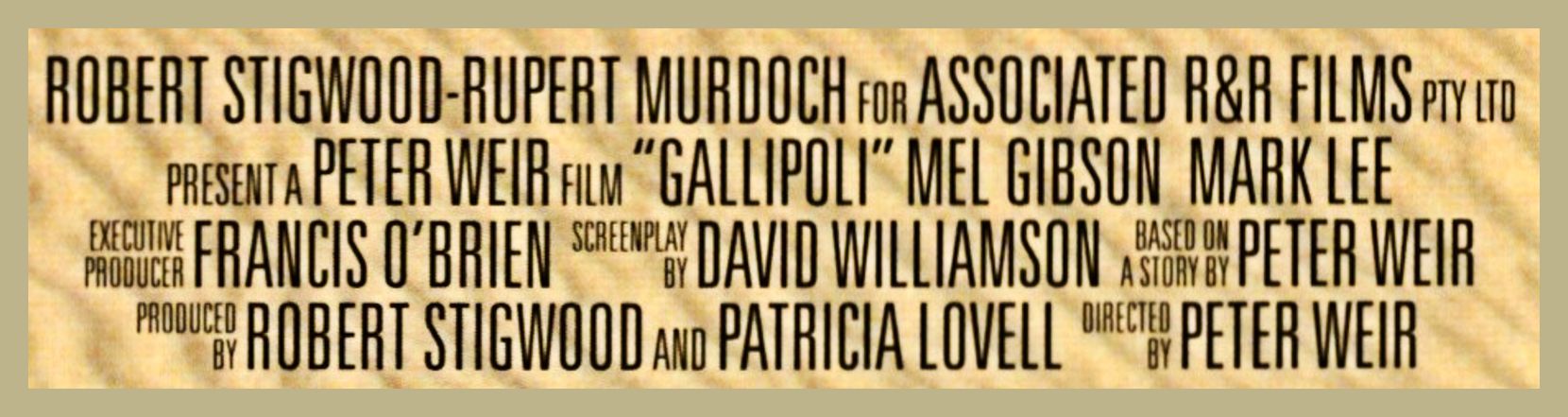
To acknowledge the significance of the day, I thought I’d revisit this best loved of Australia’s War cinema: Gallipoli.
What Happens:
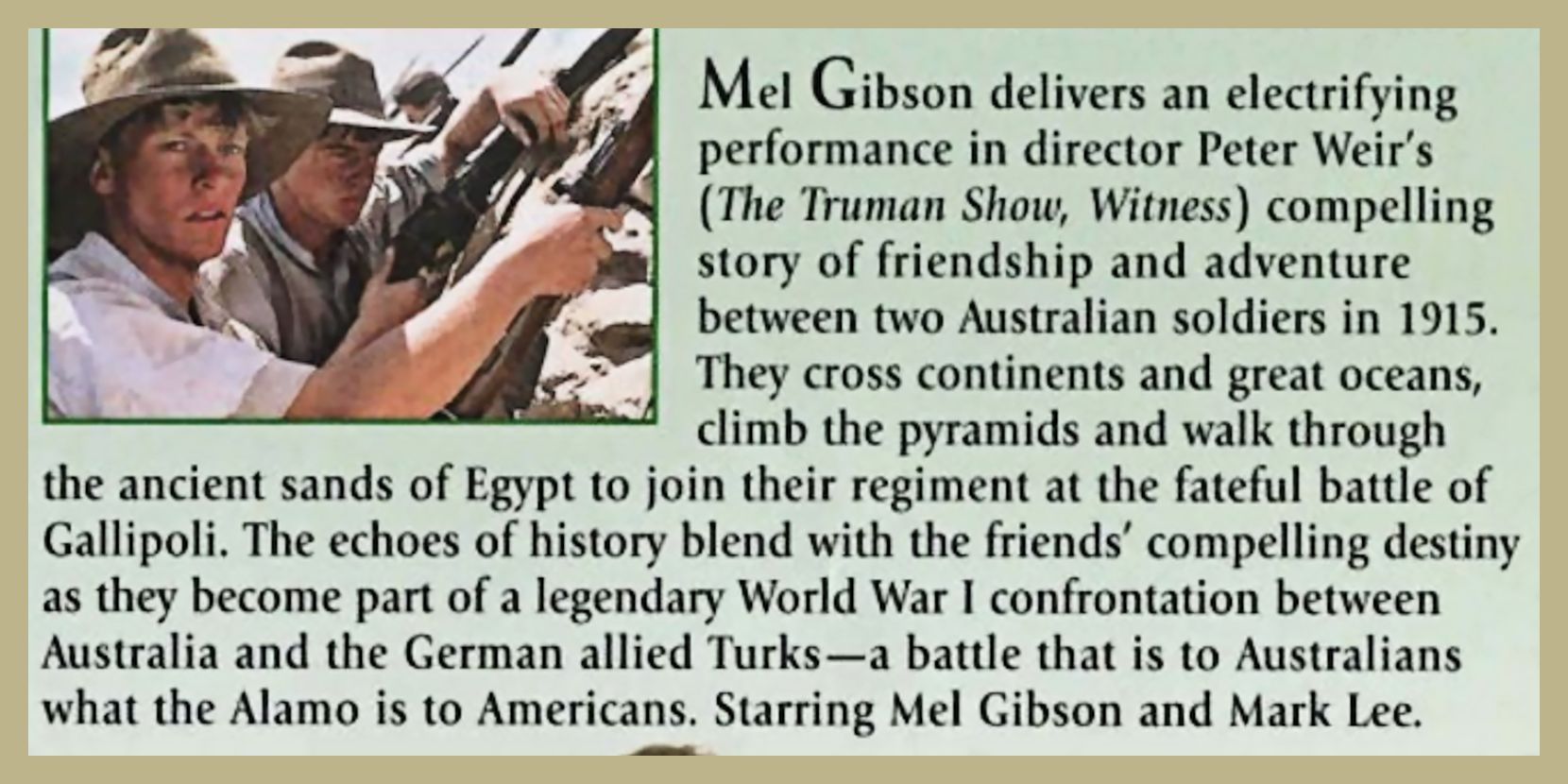
Eighteen year-old Western Australian champion sprinter Archy Hamilton (Mark Lee) could be an Olympic contender, but he disappoints his trainer Jack (Bill Kerr) when he instead enlists in the elite Australian Light Horse cavalry. He’s accompanied by talented sprinter Frank Dunne (Mel Gibson), who also attempts to join but can’t ride a horse and is relegated to the infantry with his other friends.
Training in Cairo, the Anzac cavalrymen are converted to infantry so Archy persuades his Major, Barton (Bill Hunter) to allow Frank to transfer to the regiment.
At Gallipoli in 1915, the Anzacs find that they’re being used as cannon fodder as a ‘diversion’ for British landings elsewhere, and the entire unit realizes that they must obey suicidal orders and charge Turkish machine guns, a lunatic event among a litany of incompetent military planning.
Story (Click to expand)
Since I last saw this movie many years ago, I’d forgotten that it starts out as a boy’s own adventure featuring a very young, very Australian and not so weird Mel Gibson. With the benefit of hindsight, it’s interesting to reflect on this nascent star and his subsequent and controversial career. It’s also interesting to reflect on the very different career trajectories of the two stars. Gibson, we know went on a stellar rise to the A-list in Hollywood while Mark Lee (Archy Hamilton) moved into relative obscurity.
The outback scenes that open the film are spectacularly shot with the heat, dust and desolation radiating off the screen. The stark monochromatic beauty of Australia’s hot, dry interior is a place best admired from the air-conditioned comfort of a 4 wheel drive. That many Australians willingly endured life in these and other hostile environs was the steel that forged the myth of the tough Anzac warrior. Williamson’s script is cloaked in this mythology and he uses it well to set up the main protagonists in this yarn.
Archy is a naive young man and a very talented runner who yearns for the adventure of Gallipoli that he has read and heard about. His sprinting rival, Frank (Mel Gibson) is a cynical descendant of Irish nationalists, and as such, has no desire to fight Britain’s war. At the time, Irish nationalists and unionists were in a bitter struggle over the future independence of Ireland from Britain. The speed with which Frank and Archy are transformed from rivals to such good friends that Frank is prepared to enlist with him, almost stretches my credulity and that’s despite the device of the desert trek bonding ordeal they endure that cements their close mateship. If Weir had taken more time to develop these characters, perhaps this wouldn’t have seemed such a stretch.
Generally, the performances of the cast, particularly, Mel Gibson are strong. Newcomer, Mark Lee also convinced, despite apparently having a particularly nervous time on set.
David Williamson’s script also moves the story well and although calculated to draw strong emotion, it doesn’t overindulge in overt tearjerking.
Although half the movie is set in Western Australia, none of it was filmed there. Lake Torrens in South Australia represented the desert in WA and Adelaide Railway Station stood in for Perth. The Marble Hall at the station also provided the set for the Cairo ball, before the troops shipped out to Gallipoli. Various beaches in South Australia, including Gallipoli Beach, were also used to depict the Gallipoli theater. On the other hand, the Cairo pyramid footage was actually shot on location and provides an interesting, and sometimes amusing, leg of the boy’s own adventure. The behaviour of the Aussies in Egypt as they mocked their British counterparts, also provided a neat metaphor for the rebellious teenager relationship, Australia shared with the mother country.
One of the film’s most memorable scenes was the eerily quiet and beautiful night arrival at Gallipoli; the looming terror juxtaposed with the brightly festooned and other worldly hospital ship offshore. And although for a time it looked like the boys were approaching a fun day at the seaside, the blood in the water, as they abandoned their cares and clothes and went swimming, reminded us of the deadly import of their endeavour.
The final scenes in the trenches were laden with the dread of what was coming, interspersed with the evocative strains of Giazotto’s Adagio in G minor. Major Barton’s attempt to shut out the war raging around him, listening to the duet from Bizet’s famed The Pearl Fishers opera, also provided a poignant moment in the buildup to the horrible climax.
On the morning of 7 August 1915, the Australian 8th and 10th Light Horse Regiments were to attack Turkish lines a mere 30 metres from their own. The attack in 4 waves, was to be immediately preceded by an artillery suppression barrage that fatefully ended 7 minutes early as a result of unsynchronised watches. The troops had already been instructed to remove ammunition from their rifles and fix bayonets. So hopeless was their position after the Turks were alerted by the barrage, that many went over the top without even their rifle. I’ll never forget the image of a bayonet being thrust into the wall of the trench to act as a hanger for a doomed soldier’s precious wedding ring. Knowing the terror that those boys must have felt as wave after wave went over the top to a certain death, enraged me today even as it did 32 years ago.
The futile attempts to get the 4 insanely suicidal charges of this Battle of the Nek called off, provided the closing argument in Weir’s prosecution case that: the Gallipoli Campaign was a cruel waste of talented young lives sacrificed by stupid and incompetent leaders. On a larger scale, it also symbolised the generation lost to the insanity that was World War I.
The final freeze-frame which evokes Robert Capa’s famous 1936 Spanish Civil War photograph The Falling Soldier, had me uncomfortably riveted to my seat with tears streaming, the first time round. Seeing it again, all these years later had exactly the same impact.
The Picture:
This is a film crying out for a Blu-ray release. The grainy, artifact laden sky in the early outback scenes, reminded me how disappointing the old DVD format picture can be. Russell Boyd’s wonderful cinematography, particularly in the early scenes, needs to be showcased in high definition.
The Audio:
I would have liked a DTS 5.1 audio track but the Dolby Digital 5.1 track was reasonably serviceable. However, the mix was heavily biased towards a simple front stereo with little distribution to surround or subwoofer channels. Frankly there was little difference between the quality of the output from my receiver and the sound generated by the surround speakers on the Panasonic 140cm flat screen monitor.
Verdict:
When I first saw this movie in 1981 it was very much a creature of its time, coming so soon after Breaker Morant and the widening scrutiny of Australia’s past as well as its relationship with Britain and the British Empire. So, with its huge success, this was also a triumph of its time. I’m pleased to say, it is still a wonderful and deeply affecting landmark in Australian Cinema.
iRate:: 4½ out of 5.
4Movie Tragics
Extras:
Disk One:
• Cast and Crew Bios and Filmography (interactive bio. & filmography text screens).
• Theatrical Trailer.
Disk Two:
• Interview with Peter Weir (interesting retrospective interview) – 15min.
• Interview with Mel Gibson (reflective interview filmed in 2005) – 12min.
• Boys Of The Dardanelles: Australian War Memorial Documentary (produced by the War Memorial to commemorate the men who fought and died at Gallipoli) – 22min.
• The Keith Murdoch Letter: The Letter That Changed History (a facsimile of the letter Murdoch wrote to his friend, Australian prime minister Andrew Fisher, which led to the removal of the Campaign commander, General Sir Ian Hamilton and the eventual withdrawal from Gallipoli. Note: Sir Keith was the father of Gallipoli producer and media mogul, Rupert Murdoch).
• Photo Gallery (30 production stills) – 2min.
• In Depth Gallipoli Material (library of interesting information stills).
• DVD-Rom Teaching Aids including a printable version of The Keith Murdoch Letter: The Letter That Changed History.
iReview:
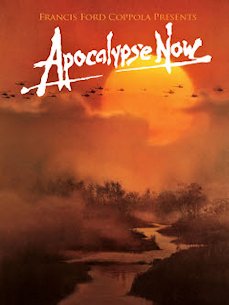
With the death of famed Chicago Sun-Times critic, Roger Ebert (see my earlier Ebert post), I thought I’d have a look at one of his and my top 10 movies, Apocalypse Now. I recently obtained the 3 disc Full Disclosure Blu-ray Edition which includes the movie tragics must-have Hearts of Darkness: A Filmmaker’s Apocalypse, the 1991 documentary chronicling the making of the film. The package also includes the 1979 cut of Apocalypse Now and an ammo dump full of interesting extras. I wasn’t able to source this set in-store so I was forced to find it online (I’ve included convenient links to search on eBay and Amazon (UK) below).
What Happens: Francis Ford Coppola adapted the Joseph Conrad novella Heart of Darkness (set in the Belgian Congo, Africa) to depict the Vietnam War as a descent into primal madness. Capt. Benjamin Willard (Martin Sheen), already on the edge, is assigned a secret mission to find and deal with AWOL Col. Kurtz (Marlon Brando), who has set himself up in the Cambodian jungle as a cult warlord. Along the way up-river, Willard encounters: the lover of napalm and Wagner, Col. Kilgore (Robert Duvall); soldiers who prefer to surf and do drugs: a troupe of USO Playboy Bunnies, whose show turns into a riot; and a manic photographer (Dennis Hopper), who tells wild, reverential stories about Kurtz. By the time Willard sees the scattering of heads at Kurtz’s compound, he knows Kurtz has gone insane…
Story (Click to expand)
It’s been many years since I saw the 2001 Redux version of this film and a year or so since my last visit with the original 1979 cut, so I arrived for this marathon sitting of Redux with relatively fresh eyes.
Now that I know Martin Sheen (Capt. Benjamin Willard) was actually very drunk when filming the first bedroom scene in which he did his best to destroy the set, the scene has acquired added significance. The blood was also real as Sheen cut his hand in the process. This scene becomes emblematic of the production chaos of the Philippines’ shoot, with a typhoon destroying the set and Sheen’s near fatal heart attack (which was kept secret, with his hospitalization ascribed to ‘heat exhaustion’). The intrigue surrounding the production is one of the things that makes the warts-and-all Hearts of Darkness: A Filmmaker’s Apocalypse documentary (on disc 3), compiled from footage shot by Eleanor Coppola, so compelling. There’s the revelation that half the cast were using marijuana, speed or LSD or all three, and often while filming. Add to that, the news that Laurence Fishburne (Clean) lied about his age to get the part as he was only 14 when filming began; that a nearby Islamic insurgency resulted in the frequent and sudden departure, often while filming, of the leased Philippines military helicopters, called away to battle; that the scheduled 6 week shoot was repeatedly extended to an eventual 16 months; that shooting delays resulted in Brando pocketing his already paid $1 million advance on his $1 million per week salary and almost walking away, rather than reschedule his three weeks on set; that Brando arrived dramatically overweight and concerned about his appearance and required that only scenes showing him in shadow be included in the film; that Brando arrived completely unprepared having read neither the novel (Heart of Darkness) or the script (something he was notorious for); that Brando insisted on detailed consultation with Coppola, sometimes lasting days, before improvising scenes, all while the cast and crew were waiting on standby; and that the budget blew out to $40 million, a record at the time. There’s also the shocking and highly confronting footage of the ritual, brutal killing of pigs and the hacking to death of the water buffalo that appears at film’s end (I think its eyes will haunt me for a very long time). The documentary also brilliantly illuminates the insanity of the shoot which seemed to mirror the insanity of the Vietnam War and the madness on screen. If you don’t want your viewing of the film to be tainted, I’d recommend you leave this documentary ’til last.
Apocalypse Now was always episodic, as road movies often are, with set pieces revealed as Willard and the river patrol boat crew, progress up the Nung River towards Cambodia. But in Redux, this aspect of the story is accentuated with the addition of scenes featuring the stranded ‘Bunnies’ and the French colonial plantation compound.
After so many previous viewings, there’s still the pleasure of anticipation, waiting for the arrival of Colonel Bill Kilgore (Robert Duvall) who leads his airborne chopper cavalry and is surfing obsessed, seemingly invulnerable, and just loves “the smell of napalm in the morning”. He also has a lust for mass carnage, accompanied by a bellowing rendition of “Ride of the Valkyries” by Wagner.
Next up the river, there’s the USO show featuring the troupe of Playboy Bunnies, who arrive by chopper, parade provocatively, get mobbed in a riotous scramble, and retreat to their chopper in a cloud of smoke.
By the time I’d arrived at the chaotic MedEvac station with the stranded ‘Bunnies’, the first major departure from the 1979 version, I realized I needed to see the original again to put Redux into perspective (hence the delay in publishing this post). And frankly, while the original stand-alone USO Bunnies show scene, illustrates the detachment of US resolve and ineffectiveness in war fighting, the added MedEvac scene seems an unnecessary adjunct which muddies (excuse the pun) the thread of the story and adds only a negative aesthetic to the movie.
Moving up the river, Chief (Albert Hall) spots a sampan and, against Willard’s advice, they stop and search the boat. As Chef (Frederic Forrest) belligerently searches the sampan, Clean (Laurence Fishburne) unexpectedly opens fire on the boat. What ensues is the My Lai Massacre moment of the movie.
With each encounter, as they progress further from civilization, the crew’s grip on sanity wavers a little more. By the time they reach the chaotic Do Long bridge outpost with its precarious suspension bridge and no discernible chain of command, Willard and his men seem like an island of calm in a swirling nightmare.
I’m neutral about the efficacy of the added French colonials scene in Redux. At the time of the release of the 1979 cut, the Vietnam War was still extremely raw in the American Psyche, having ended only 4 years earlier. It’s perhaps understandable then, that Coppola decided not to pollute the ‘descent into the madness of America’s Vietnam War‘ theme with a discourse on the colonial era. Thirty four years later, that anti-Vietnam War focus of the film, perhaps, doesn’t need to be so sharply defined, so the departure into French colonial history adds an interesting side-track. Filming it at all may have been a subtle nod to Conrad’s original Heart of Darkness, set in the French speaking, Belgian Congo colony.
The horrific scenes awaiting what’s left of the crew, when they arrive at Kurtz’s compound, seem entirely appropriate, given the portents that accompanied their journey.
Coppola’s additional Kurtz Compound scenes in Redux, add another layer of insight along with subtle changes to Kurtz’s character. In the original, Kurtz was made more poetically enigmatic by his shadowy illumination. In Redux, Kurtz is just plain mad. At the time of production, Marlon Brando was something of an actor demi-god, so it was understandable that he and Coppola were concerned that his obesity might be an unwelcome distraction, hence the noirish camera work. With Brando’s immensity no longer a novelty, it’s interesting to see the additional ‘lit’ scenes as they ‘flesh’ out Kurtz’s personality (stop with the puns, already!).
This intense week-long immersion into the Apocalypse Now universe has been fascinating for me and has led to the conclusion that on balance, I marginally prefer the original cut to Redux. However, they each stand, in their own right, as monumentally stunning achievements in film-making. Watching both films in reasonably close proximity, also gave me an unexpected look behind the curtain to the art behind movie-making, as I was able to see great examples of the editor’s craft. That for me was worth the price of admission (in this case the cost of the Blu-ray set).
The Picture:
I’m pleased that Coppola prevailed with the 2.35:1 aspect ratio rather than Cinematographer, Vittorio Storaro’s preferred 2.0:1 (used on previous releases) which chopped the frame and occasionally caused oddly skewed shot framing and pans.
This transfer to Blu-ray while not quite as stunning as some I’ve seen recently (I’ve been spoilt), is nevertheless beautifully rendered and a pleasure to watch. It might just have been me, but this new Blu-ray palette also seems to have a slightly heavier yellow hue than previous versions, giving the image a warmer look than I’d like (it’s OK, I’m already kicking myself for nit-picking).
Overall, the screen image is clean and well defined with Kurtz’s disembodied head brilliantly defined and contrasted against deep black. Also look out for the way Willard’s face is lit while he reads the Kurtz dossier on the deck of the patrol boat. And let’s face it, Storaro’s photography is breathtakingly sumptuous, especially in the film’s first half. I’m also conscious of the fact that Coppola needed to incorporate previously discarded footage, which can’t have been easy, and then colour grade both films for consistency. To have created such a seamless result is astonishing. If you need confirmation of just how good it is, check out Richard Donner’s 2006 cut of Superman II which is good but not nearly as consistent as Apocalypse.
The Audio:
The Blu-ray DTS 5.1 sound track is one of the best I’ve heard, particularly the woofer’s rumbling bass. The balance and sweep of the sound effects mix is awesome with helicopters tracking seamlessly from monitor to monitor. The sound field is completely immersive, especially at higher volume (I hope the neighbours weren’t too annoyed).
My only complaint about the soundtrack is an issue of personal taste: I would have much preferred a score without the heavy and dated synthesizer. A completely contemporary rock track or even an orchestral score would have been fine. Unfortunately, the mix of great ’60s and ’70s rock tracks interspersed with nondescript synth. just didn’t do it for me.
Verdict:
This movie was already in my top ten so my expectations of this release were high. I’m so pleased that Coppola has allowed his two versions of Apocalypse Now to co-exist as they are each wonderful in their own way. I’d say, if anything, this new Blu-ray package with its incomparable set of extras, has enhanced my impression of the films. So hats off to the guys who took such care putting this together.
Extras:
• Feature Commentary by Director Francis Ford Coppola (complements the Hearts of Darkness: A Filmmaker’s Apocalypse documentary quite well. I’d be inclined to listen to the commentary on Redux, as it’s full of interesting production notes and anecdotes. As well, the commentary track for the original version was edited down from this one).
Disc Two:
• A Conversation With Martin Sheen
(Sheen and Coppola reminisce about the casting, drugs, alcohol, tigers, the heart attack, and much more… interesting) – 59min;
• An Interview With John Milius (here Coppola and Milius discuss their writing process and the script’s evolution as they drill deeply into the screenplay. They also briefly touch on Milius’ own military ambitions and how that played into the screenplay… one for the geeks and illuminating and enjoyable) – 50min;
• Fred Roos: Casting Apocalypse (includes screen test footage and features the film’s casting director, Roos, talking about the hundreds of actors tested for various roles) – 12min;
• ‘Apocalypse’ Then and Now (has some brief snippets from Roger Ebert’s Cannes interview with Francis Ford Coppola) – 4min;
• 2001 Cannes Film Festival: Francis Ford Coppola (the entire Ebert Cannes interview) – 39min;
• PBR Streetgang (profiles and reflections from the actors playing Willard’s patrol boat crew: Laurence Fishburne, Sam Bottoms, Albert Hall, and Frederic Forrest) – 4min;
• “Monkey Sampan” Deleted Scene (a disturbing deleted segment featuring a boat overrun with monkeys and natives singing “Light My Fire”) – 3min;
• Additional Scenes (12 timecoded scenes including Lt. Richard M. Colby (Scott Glenn) dialogue and undoctored footage where the name of Brando’s original character name, Col. Leighley, can be heard) – 26min;
• Destruction of the Kurtz Compound (the jettisoned final credits sequence which Coppola ultimately rejected when he feared audiences were misinterpreting it) – 6min;
• The Birth of 5.1 Sound
(a fascinating Dolby Labs presentation which looks at how Apocalypse Now led to a revolution in film surround sound design) – 6min;
• Ghost Helicopter Flyover
(sound engineer, Richard Beggs, explains how the surround sound design for the opening helicopter sequence was created) – 4min;
• The Music of Apocalypse Now (looks at how the various musical elements: The Doors, synthesizer music, orchestral and percussion work were integrated together) – 15min.
• The Synthesizer Soundtrack (a text screen reprint of a Bob Moog article from Keyboard magazine);
• Heard Any Good Movies Lately? The Sound Design of ‘Apocalypse Now‘ (Coppola, Walter Murch, Richard Beggs, and post-production recordist Randy Thom talk about and show us how the revolutionary sound design for the film was created) – 15min;
• A Million Feet of Film: The Editing of ‘Apocalypse Now‘ (a great look at how Coppola and editor Walter Murch pulled a coherant film together from the immense stock of scripted, experimental and improvised footage) – 18min;
• The Final Mix (Randy Thom introduces some great footage of the multi-room setup which was necessary to achieve the final mix for the film) – 3min;
• The Color Palette of ‘Apocalypse Now‘ (Vittorio Storaro attempts to explain the technical aspects of the three strip dye transfer Technicolor process utilized on the film) – 4min.
• The Hollow Men (an odd little period (circa 1979) featurette with Brando reciting Eliot’s poem with scenes from the film and the shoot) – 17min;
• Mercury Theater Production of ‘Heart of Darkness’ (audio presentation of Orson Welles production of Joseph Conrad’s novella… some of the audio quality has suffered with time.) – 37min.
Disc Three:
• Hearts of Darkness: A Filmmaker’s Apocalypse (the fascinating behind-the-scenes documentary compiled from home movie footage shot by Coppola’s wife Eleanor. The film includes audio from tapes she recorded without Francis’ knowledge for what she, at the time, expected to turn into a diary. The chaos and intrigue surrounding the making of the film, makes this compelling viewing. As if that’s not enough, there’s also an optional and very interesting commentary track from the Coppola’s.) – 99min.
• John Milius Script Selections with Notes by Francis Ford Coppola
(text screens);
• Storyboard Gallery (with more than 200 screens);
• Photo Archive (a huge trove of production and candid stills together with some Mary Ellen Mark photography);
• Marketing Archive (featuring the 1979 trailer, radio spots, theatrical program, lobby cards, press kit photos, and a poster gallery).
Printed Material:
• A 48-page Full Disclosure booklet which features a written introduction from Francis Ford Coppola, script excerpts (with notes scrawled over them), production photos, storyboards, sketches, and other production art.
• An Apocalypse Now booklet with production notes, credits and cast and crew biographies.
• 5 Black & White postcards.
Platoon (1986) (120 min) iReview: Version: Platoon: 25th Anniversary (Blu-ray);
Video: AVC 1080p; Audio: DTS 5.1. Genre:: Action | Drama | War | Sub-Genre/Type:: Anti-War Film | Cold War Film | Combat Film |
Ensemble Film | Jungle Film | Modern Classic | War Drama | Settings:: 1867-68 | Southeast Asia | Vietnam | Vietnam War Era.
Mood?:: Blood and Gore |
Food For Thought | Tough Guys. iRate:: 4½ / 5 Director:: Oliver Stone. Writer:: Oliver Stone (screenplay).
iReview:
I was scratching around my library trying to settle on a film for this week’s screening but found myself spoiled for choice. I asked a few friends for help and suggested they consider titles from science fiction, gangster or graphic novel adaptation. So after extensive consultation within the strict parameters provided, I’m Screening Platoon in this Sunday Session. Umm, yes I know, it’s a war movie. I hadn’t seen this film for more than 10 years and that was the less than stellar, 2000 DVD release, which I viewed on an old 80cm 4:3 TV. So I was looking forward to the opportunity to see the recent 25th Anniversary Blu-ray release, on a 140cm 1080p widescreen.
Throughout the soundtrack, Samuel Barber’s hauntingly beautiful Adagio for Strings, interjects to add a note of melancholy. It’s unfortunate, that after Platoon, overuse has turned such a wonderful feature of this film into a cliche. Nevertheless, I’d still recommend listening to the track while reading this as it sets a darkly appropriate tone.
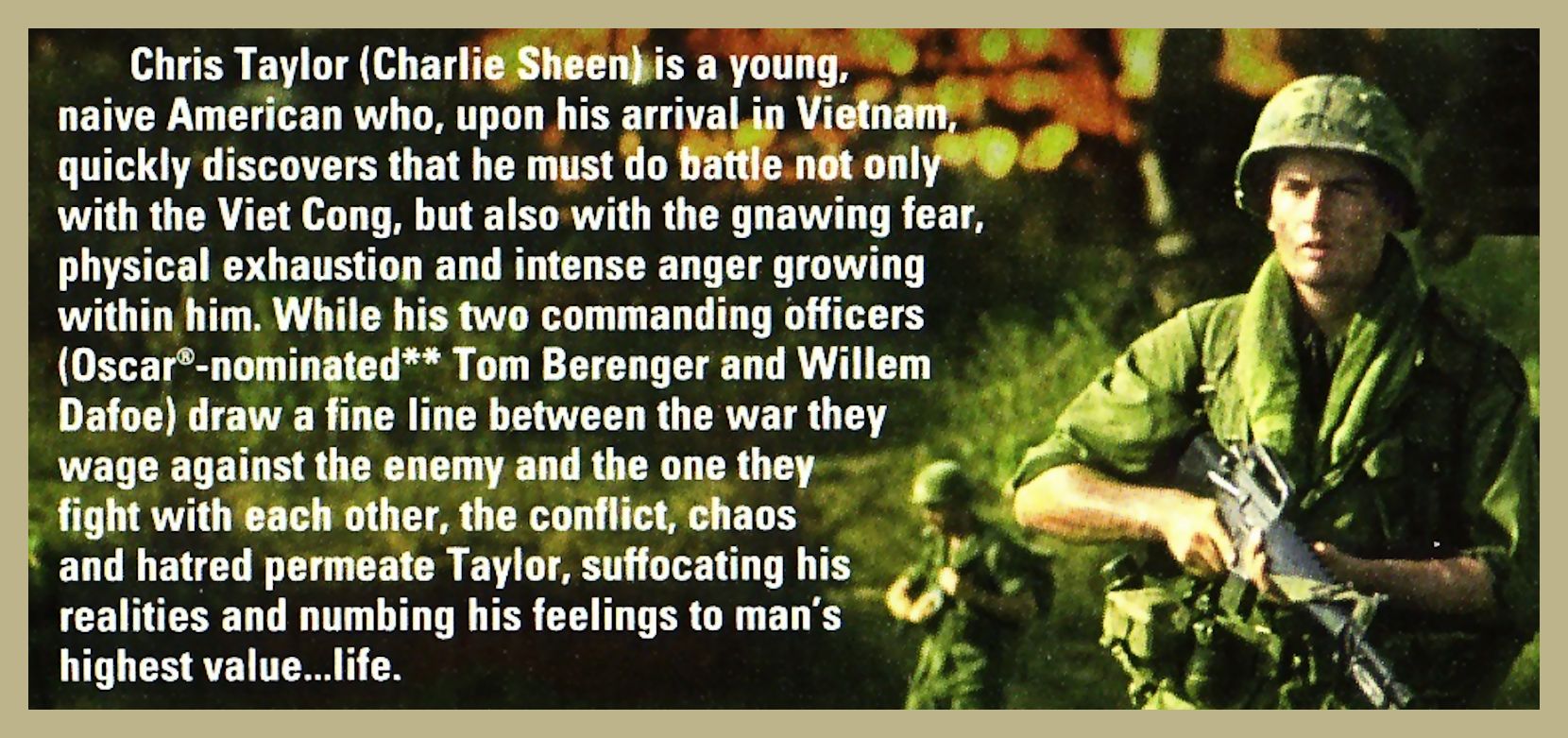
After a very brief introduction and without fanfare or warning, the audience descends into an impenetrable jungle. The camera at eye level draws us into a patrol alongside the newest member of Bravo Company, Chris Taylor (Charlie Sheen), who is confronted by the claustrophobic thick lush brush, with rough fronds brushing and irritating his fresh face. We experience the gut-wrenching physical exertion of the terrain as he hacks frustrated and incompetently with his machete, dry reaches and is harassed by ants, leaches, and mud. And we sense the contagious and overwhelming fatigue.
“Somebody once wrote: ‘Hell is the impossibility of reason.’ That’s what this place feels like: Hell.” So says the bewildered Taylor as he writes a letter to his grandma.
Most of us could identify with Taylor’s disillusionment. He’s a kid from a good family who dropped out of college because he felt the call to do his patriotic duty and “Live up to what Grandpa did in the first war, and Dad did in the second.”. And, as he put it, “…why should just the poor kids go off to war.” He soon realizes that in ‘Nam the drafted men are largely uneducated, “They’re poor. They’re unwanted… They’re the bottom of the barrel, and they know it.”.
Through Taylor, Oliver Stone stipulates that war has always been fought by the poor and “rich kids always get away with it.”. He’s right of course, You need look no further than the last president and vice-president of the USA, George W. Bush and Dick Cheney. It’s reported that Bush went AWOL (absent without leave) from the National Guard from 1972-’73, while Cheney applied for and received five Vietnam War draft deferments. When asked about his deferments, he reportedly said, “I had other priorities in the ’60s than military service”.
Story (Click to expand)
Platoon is set in a remote area of Vietnam’s east, near the Cambodian border, during 1967-’68. The men of Bravo Company live in barely tolerable conditions, rarely sleep and frequently go out on nerve-jangling ‘ambush’ patrols where they lie in wait for an ethereal enemy, who only seems to emerge from the mist as an apparition. We, like the rest of the patrol, intently watch the dense, steaming wet brush, looking for any movement. Like them, we have no idea if they will appear but sense the danger. Alongside the patrol, we also learn that veteran leaders, Sgt. Elias Grodin (Willem Dafoe) and Sgt. Bob Barnes (Tom Berenger), can spot the seemingly invisible source of much of the danger and uncertainty, the tunnels below them that the VC (Viet Cong) disappear into. Their sense of siege is heightened by the suspicion that the enemy are also the civilians, young and old in local villages. This paranoia and contempt for the Vietnamese results in the most shocking and viscerally disturbing scenes in the film.
In Stone’s vision of the Vietnam War, there are no heroics, just a very real sense that at any time, one of us could be thrown into that hell and how might we react; perhaps just like one of them.
Some of Oliver Stone’s other films, like Salvador, JFK and Natural Born Killers, almost blow the horn before coming down the street, so transparent is their intent; not so Platoon. Here, the plot doesn’t meander and yet, it is brilliantly disorienting, creating a palpable unease. Nor does it telegraph its trajectory and because the whole story is told from the point of view of the camera lens as a member of the squad, there’s no predictability or safe foxhole for us to rest and little indication what we might expect through the next bush.
While the wisps of the enemy provide the danger and uncertainty that keeps us riveted from the first frame, the narrative arc is provided by the tension within the squad. Sgt. Barnes, a scarred battle veteran sees every Vietnamese as the enemy and fosters an attitude among his acolytes that manifests in depraved violence. At the other pole, Sgt. Elias, who acts as mentor to Taylor, blunts his cynicism by shotgunning smoke in the old-fashioned way with his ‘hippy’ friends. He also acts to mitigate the excesses of Barnes. These two characters could easily have been caricatured but in Stone’s writing they are utterly convincing.
The screenplay has been wonderfully crafted and has the polish that often characterises a song-writer’s first album that’s been percolating for years. And knowing that Stone had been working this script for 18 years, seems to confirm that. Watching the result seems like witnessing Stone’s own catharsis, reliving his own experience in Vietnam.
The performances of all the ensemble are authentic and enhanced by the realism constructed in the locations and uniforms that show the effects of constant wear, as well as copious mud and grime that attaches to bodies that are seldom washed.
Before filming began in the Philippines, the cast was sent on a two-week boot-camp. The actors were given military haircuts, required to stay in character, required to dig foxholes, ate only military rations, not allowed to shower, camped in the jungle, had rotations for night watch, and were subjected to forced marches and nighttime “ambushes” with special-effects explosions. Stone explained that he was trying to break them down, “to mess with their heads so we could get that dog-tired, don’t give a damn attitude, the anger, the irritation… the casual approach to death”. In a Bombsite interview, Willem Dafoe said,
“the training was very important to the making of the film… It wasn’t boot camp with lots of push-ups. It was serious, getting no sleep; doing activities at night where you were attacked by real people. Certainly you weren’t going to die, but you did know exhaustion and confusion… the training was important because it gave us a relationship to soldiering… By the time you got through the training and through the film, you had a relationship to the weapon. It wasn’t going to kill people, but you felt comfortable with it.”
This preparation obviously paid off in the delivery of the cast. If anyone were to ask me how an actor is directed, I’d point to one of the worst I can remember as a contrast: George Lucas’ Star Wars: The Phantom Menace. There, fine actors, like Ewan McGregor, appear to be delivering lines with the care of a first Script Read-Through. in a Daily Express interview, McGregor even said,
“Quite honestly, after my initial excitement, the film-making process turned out to be the epitome of tedium,” he said. “There was no spontaneity. Your job, as an actor, was just to get it out. I was frowning a lot. It just became a frowning exercise.”
Now come back to Platoon, and while it’s not the finest bit of actor performance direction, it’s still very good. The acting of this ensemble is delivered with assurity and an easy familiarity. The performances are also understated even though the actions portrayed might be shocking and seem almost implausible at times. This restraint adds to the believability and menace of the scenario with very ordinary people doing inexplicable things.
One of the Vietnam War movies that’s frequently held up in comparison with Platoon, is Apocalypse Now by Francis Ford Coppola which was released seven years earlier. Where Apocalypse Now is epic in its bombast and artifice, Platoon is intimate but a lot more confronting. Where Coppola orchestrated a well crafted Wagnerian opera, Stone has unselfconsciously delivered a frank and unmannered masterpiece.
Francois Truffaut is often quoted as saying, “There is no such thing as an anti-war film”, reasoning that in a good war film, explosions and great cinematography always excite, and there’s always some sense of adventure. Well, I think Platoon goes a long way towards refuting Truffaut; this is a great anti-war film.
iRate:: 4½ out of 5.
4Movie Tragics
Extras:
• Feature Commentary by Director Oliver Stone (This filmmaker enjoys talking and this informative track relates just how personal this film was to him).
• Feature Commentary by Military Advisor Dale Dye (In this interesting track Dye details his training regimen for the cast and how he and the director worked to achieve authenticity. He also relates his own wartime experience).
• Deleted & Extended Scenes (12 scenes) – 12 minutes.
• On the Flashback to Platoon Menu, you’ll find 3 featurettes:
• • Snapshot in Time:1967-1968 (this featurette includes movie clips and interviews with Stone, Dye and others and recalls the Cold War political climate at that time) – 19 minutes.
• • Creating the ‘Nam (this production featurette looks at the design, effects and locations) – 12 minutes.
• • Raw Wounds: The Legacy of ‘Platoon’ (this piece looks at the healing process after the war and how American veterans reacted to the film) – 17 minutes.
• One War, Many Stories (veterans react to a screening of the film and relate how their own experiences compared with that depicted) – 26 minutes.
• Preparing for ‘Nam (war veterans recall their enlistment and basic training) – 7 minutes.
• On the Vignettes Menu there are 3 short elements:
• • Caputo & the 7th Fleet (recollections of the 1975 evacuation of Saigon) – 2mins.
• • Dye Training Method (the technical advisor, Dale Dye discusses his process for turning actors into soldiers) – 3mins.
• • Gordon Gekko (recalls how the name was hatched during a Platoon brainstorming session) – 1min.
• The DVD copy (this is the disappointing dvd version released in 2000 and a questionable addition to this set)
In my mind, this film ranks right up with All Quiet on the Western Front (1930) as one of the two or three best anti-war films yet produced. What do you think about the film?



 Zak From Downunder